
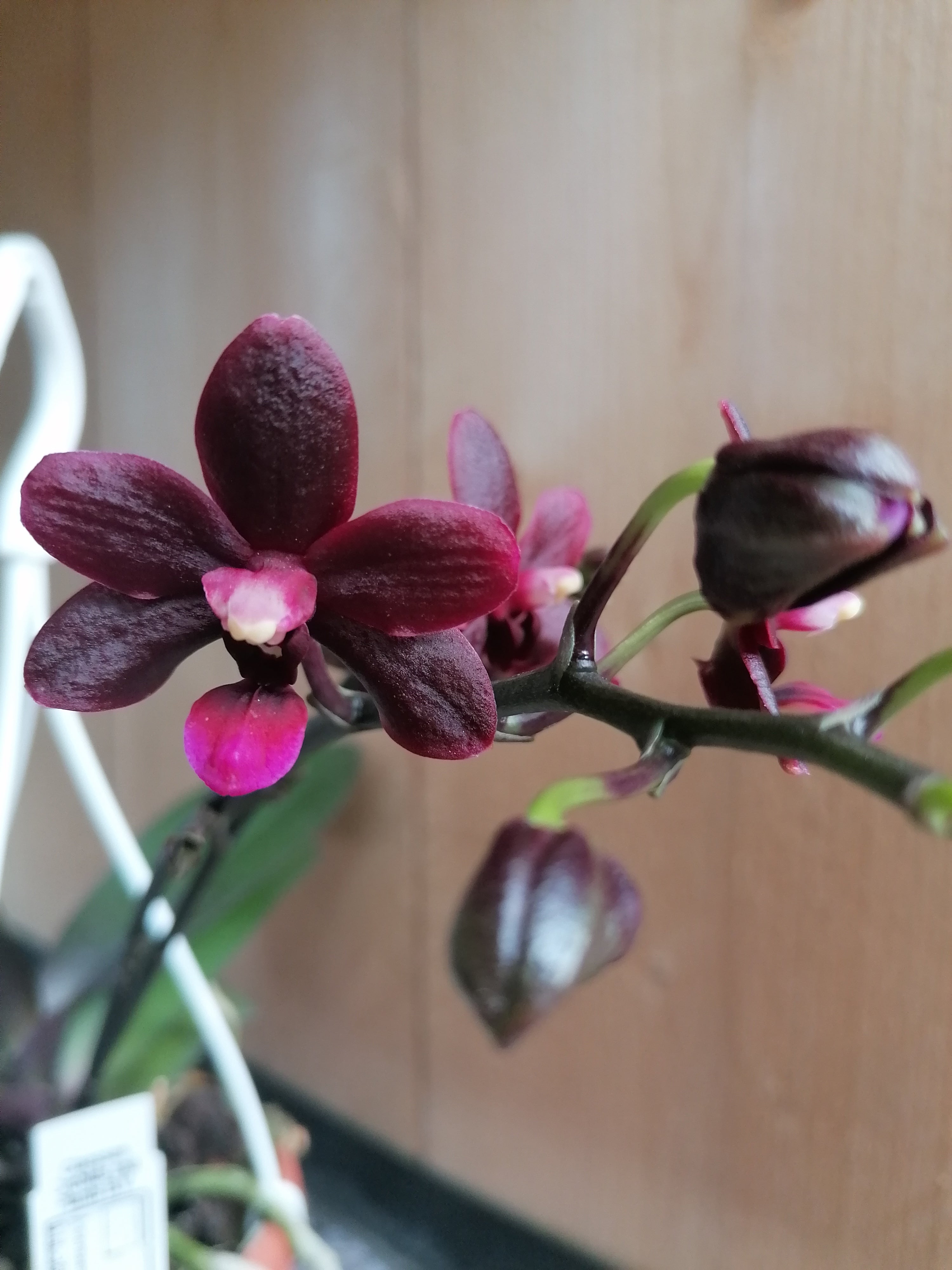
Doritaenopsis (Dtps.).
2 products
Showing 1 - 2 of 2 products
Doritaenopsis, often abbreviated as Dtps., is a historical name for Phalaenopsis hybrids in which the former Doritis plays a role. These orchids are collected for their compact growth habit, distinctive flower shapes, and colors that can range from white and bright pink to deep purple, violet, and almost bluish lavender.
Today, these hybrids are classified botanically and in the International Orchid Registry under Phalaenopsis. However, the name Doritaenopsis is still widely used in the trade and among collectors, as many older cultivars have become known under this name. In this collection, you will therefore find plants that may be offered as Doritaenopsis, Dtps., or under their current Phalaenopsis name.
Also check out our Phalaenopsis, Novelty Phalaenopsis, fragrant orchids, and compact orchids.
Recent bekeken
What is a Doritaenopsis?
The name Doritaenopsis was used for crosses between Phalaenopsis and Doritis. Doritis was long considered a separate orchid genus, with Doritis pulcherrima as the best-known species.
Botanical research has led to Doritis being indoors today Phalaenopsis is placed. The accepted name of Doritis pulcherrima is now Phalaenopsis pulcherrima. As a result, a cross between Doritis and Phalaenopsis according to the current classification, it is no longer a cross between two sexes, but one Phalaenopsis-hybrid.
The old name remains relevant. Older plant labels, in collections and in trade names can still contain indications such as:
Doritaenopsis;
Dtps.;
Doritis hybrid;
Phalaenopsis with Doritis background;
are used.
Anyone who searches for Doritaenopsis online is usually looking for a special one Phalaenopsis-hybrid with Phalaenopsis pulcherrima or descendants thereof in the lineage.
Why are these Phalaenopsis-hybrids special?
The former Doritis influence was used in breeding for properties such as a compact plant shape, upright flower spikes and flowers in strong pink, purple and violet shades.
Other Phalaenopsisspecies can then add additional characteristics. Phalaenopsis violacea can, for example, contribute to a more waxy flower structure, a more intense purple-violet color and, in certain offspring, also fragrance. Large flowered Phalaenopsishybrids can provide wider petals, rounder flowers or richer flower spikes.
However, the final result differs per cross. Not every Doritaenopsis:
remains just as compact;
produces many flowers;
smells;
blooms longer than a normal one Phalaenopsis;
is automatically suitable for every beginner.
Therefore, the parentage of the specific hybrid is more important than just the historical genus name.
Doritaenopsis Purple Martin
One of the best-known hybrids that we regularly have in our range is “Doritaenopsis Purple Martin”. The official registered name today is Phalaenopsis Purple Martin.
Purple Martin was registered in 1989 as the crossing:
Phalaenopsis Kenneth Schubert × Phalaenopsis violacea
Kenneth Schubert himself originated from:
Phalaenopsis pulcherrima × Phalaenopsis violacea
Purple Martin therefore consists of approximately 75% genetically Phalaenopsis violacea and 25% off Phalaenopsis pulcherrima. The RHS register states Phalaenopsis as the current genus name and Doritaenopsis as the former synonym name.
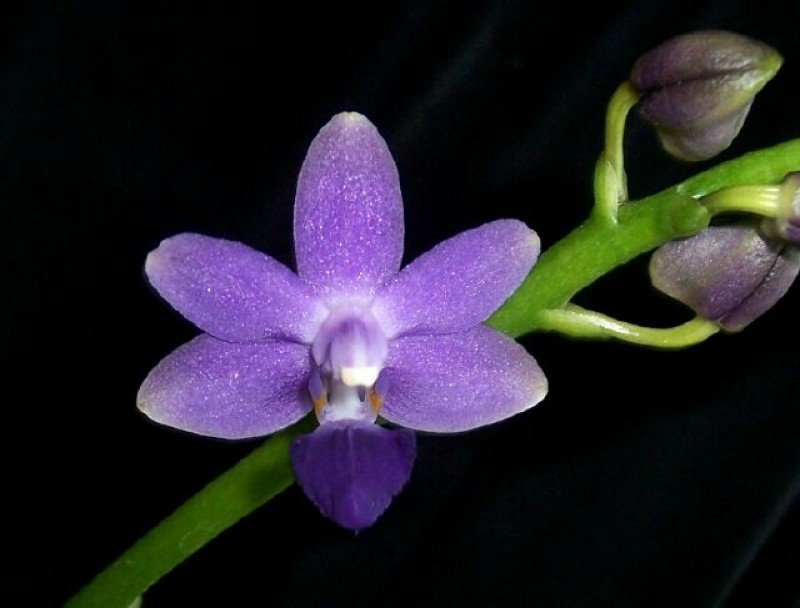
The purple-blue color of Purple Martin
Purple Martin is especially loved for its saturated purple-violet flower color. In certain plants, a cool, almost purple-blue haze develops over the petals.
A truly blue pigment, as in some other plant groups, is added Phalaenopsis not for. Words like blue, coerulea or blue usually refer to a cooler violet, lavender or slate shade with less red in the flower for these orchids.
The perceived color can also change due to:
daylight or artificial light;
temperature during bud development;
age of the flower;
camera settings;
genetic variation between seedlings.
The product photo therefore gives a realistic impression of the possible flower, but individual plants may bloom slightly darker, redder or cooler violet.
Can Purple Martin smells?
Because Phalaenopsis violacea forms a large part of the lineage, plants can grow from Purple Martin develop a light to distinct odor. However, this is not completely uniform in seedling propagated plants.
One plant may have a distinct scent, while another specimen is mainly interesting because of its color and flower shape. Temperature, time of day, maturity of the flower and number of opened flowers also influence the observation.
If scent is the most important purchasing characteristic for you, check whether this is explicitly mentioned as a characteristic for the specific plant or clone. A fragrant parent in the lineage is not an absolute guarantee that every offspring will smell equally strong.
How does a Doritaenopsis bloom?
Many hybrids within this group form flower spikes that appear from the base between the leaves. The number of flowers and the branching of the flower spike depend on the genetic background, age of the plant and growing conditions.
Hybrids with a lot of influence from Phalaenopsis violacea often bloom differently than the classic large-flowered butterfly orchid from a garden center. Instead of one long branch that is full of flowers almost simultaneously, they can produce several new flowers over a longer period of time.
Old, still green flower branches can become active again with this type. Therefore, do not cut away a flower branch immediately after the last flower has fallen. Do not remove it completely until it is brown and dried, unless the plant is weakened and needs to send energy to roots and leaves first.
“Long Blooming” can therefore mean two things with these orchids:
individual flowers remain beautiful for a relatively long time;
the plant continues to produce flowers repeatedly from existing or new flower branches.
That is not the same as one flower branch that remains completely full continuously.
Compact Phalaenopsis for the living room
Many former Doritaenopsis hybrids remain relatively compact. That makes them interesting for a windowsill, smaller orchid collection or light planter.
However, compactness does not mean that the plant grows well in every location. For healthy root growth and repeated flowering are especially important:
sufficiently bright, indirect light;
warm to moderate temperatures;
an airy root environment;
watering based on drying time;
protection against cold drafts;
sufficient air movement around leaves and roots.
A light windowsill facing east or west is often more suitable than a dark place in the middle of the room. A south window may require protection from bright afternoon sun.
Temperature
Purple Martin and many similar hybrids grow warm to temperate. Normal heated living room temperatures are usually suitable.
As a practical guideline you can consider:
during the day about 20–28 °C;
preferably not lower than approximately 17–18 °C for long periods of time at night;
protection against cold drafts and cold window glass.
A limited difference between day and night temperatures can support natural growth, but strong cold is not necessary. Due to the significant influence of Phalaenopsis violacea fits Purple Martin better in a warm location than in an unheated cool room.
Light
These hybrids require bright, indirect light. The leaves do not have to remain dark forest green; very dark leaves can actually mean that the plant receives too little light.
Too little light often leads to:
slow growth;
small or absent new roots;
few new flower sprays;
a plant that appears healthy, but does not bloom again.
Direct afternoon sun, on the other hand, can cause fire damage. Always allow a plant to get used to it gradually when it is moved to a brighter location.
Water and root condition
Water when the substrate has largely dried and the visible roots become lighter or silver-gray. Then let the pot drain well.
A set schedule of once a week is less reliable than actually watching:
color of the roots;
weight of the pot;
temperature;
Potsize;
composition of the substrate;
season.
During warm, light conditions the plant dries faster than during a dark Dutch winter.
Do not leave water in the heart of the plant for a long time. When water remains trapped between the leaves at low temperatures and little air movement, the growing point can be damaged.
Substrate and repotting
A lighthearted one Phalaenopsissubstrate based on orchid bark is usually suitable. Depending on the dryness in the grow room, a limited amount of sphagnum or other moisture-retaining material can be added.
Preferably repot when:
the substrate is digested or compacted;
the roots do not get enough air;
the pot becomes too small;
the plant starts to make new root tips.
Repotting is not always necessary immediately after import or receipt. When the roots are actively growing and the substrate is usable, it may be better to first let the plant get used to the new location.
The Purple Martin that we offer is delivered as a mature plant and has strengthened after import. The current batch has active root growth, but individual specimens may still be in the process of further acclimatization to European conditions.
Is Doritaenopsis suitable for beginners?
Many of these hybrids are suitable for someone who already understands how a Phalaenopsis is watered. They grow at normal room temperatures and do not require a pronounced cold rest period.
However, they are not always identical to the robust mass-production hybrid from the garden center. Novelty-like hybrids with a lot violacea may be more sensitive to:
cold;
heavy or digested substrate;
prolonged wet roots;
too little light;
sudden changes after import.
For a beginner, a well-rooted mature plant is usually a better choice than a small seedling. Who is already successful an ordinary Phalaenopsis has allowed it to grow and bloom again, can usually be transferred well to Purple Martin or a similar hybrid.
What mean Blooming and adult?
Within this collection plants can be found Blooming or not-Blooming are offered.
Blooming: Yes means that the selected specimen is sold with a flower or developed flower spike.
Blooming: No means that the photo shows how the hybrid can bloom under good conditions, but that the delivered plant does not have to have a flower or flower spike at that time.
Adult means that the plant is sufficiently developed to bloom under suitable conditions. There is no guarantee that the plant will produce a flower spike immediately after receipt. Acclimatization, root growth, light and temperature determine when the next flowering will occur.
Buy Doritaenopsis
Our range of Doritaenopsis consists of special ones Phalaenopsishybrids historically known under the abbreviation Dtps. have become known. The range varies and many cultivars are only available temporarily or in small numbers.
Frequently recurring names include:
Purple Martin;
Purple Gem 'Aida';
Sin Yaun Golden Beauty;
Anna Larati 'Soekardi White';
crosses containing Doritaenopsis and Novelty Phalaenopsislines meet.
Check the current availability for each product, Potsize, plant stage and flowering status. The current collection contains five registered product listings, but the majority of them are currently sold out.
Claessen Orchids & Plants has been working with special orchids since 2005. The plants are checked, prepared and carefully packaged before departure. More information about packaging, delivery times and weather protection can be found at “shipping” and in the “frequently asked questions”.
Are you looking for a compact one? Phalaenopsis with deep purple-violet flowers and a more interesting lineage than the usual butterfly orchid? Then view the current range of Doritaenopsis plants Phalaenopsis-hybrids.