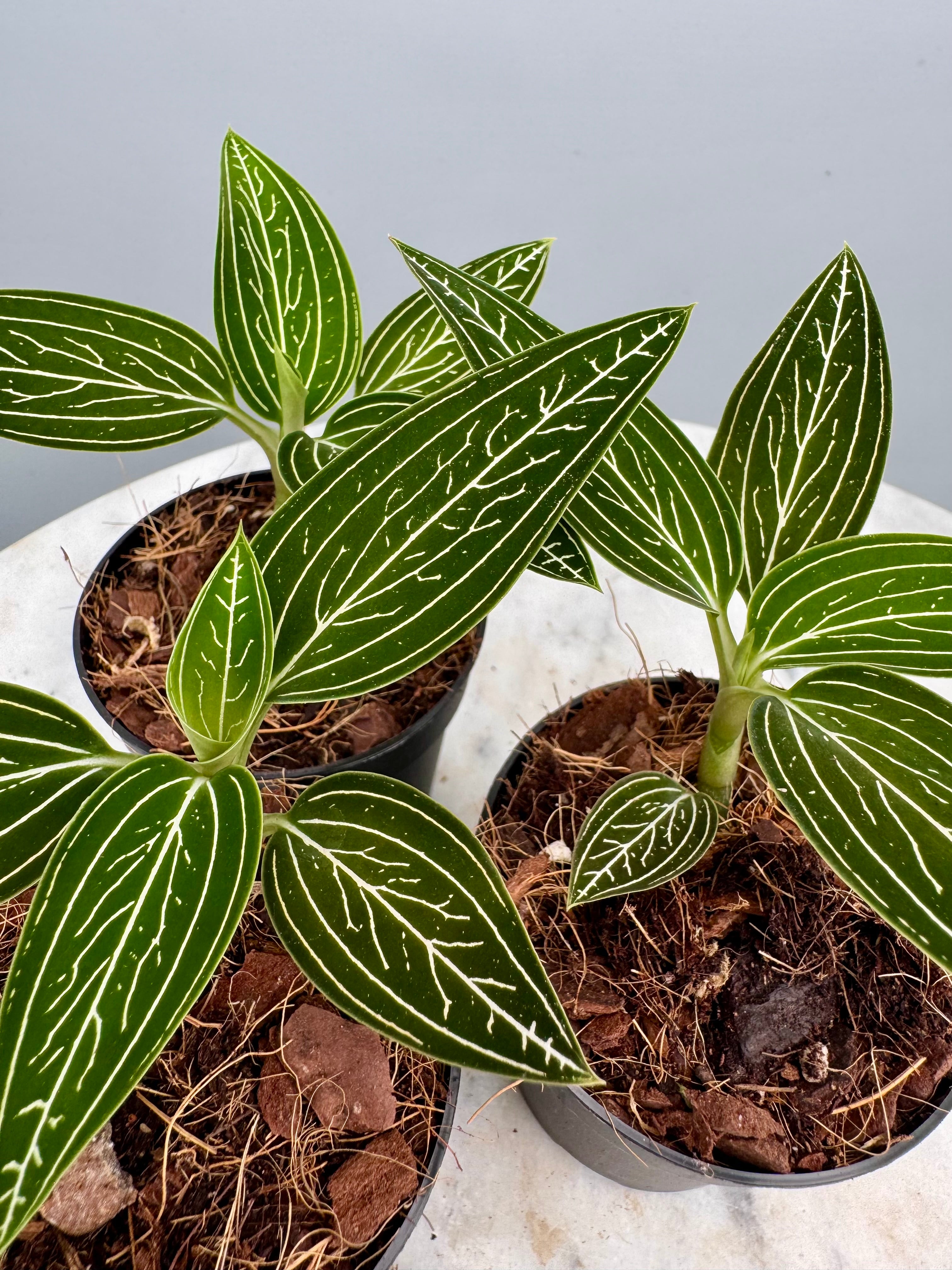
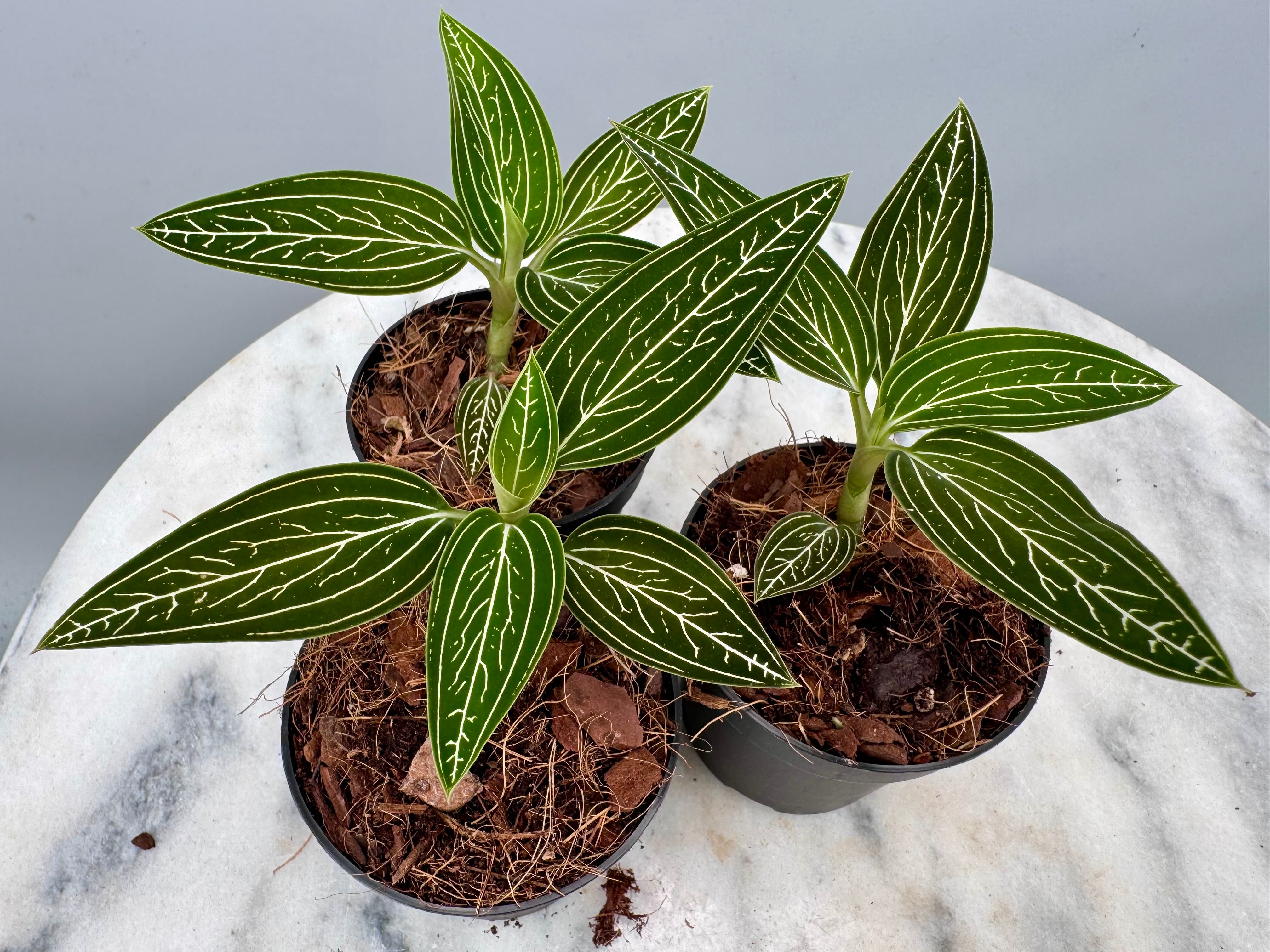
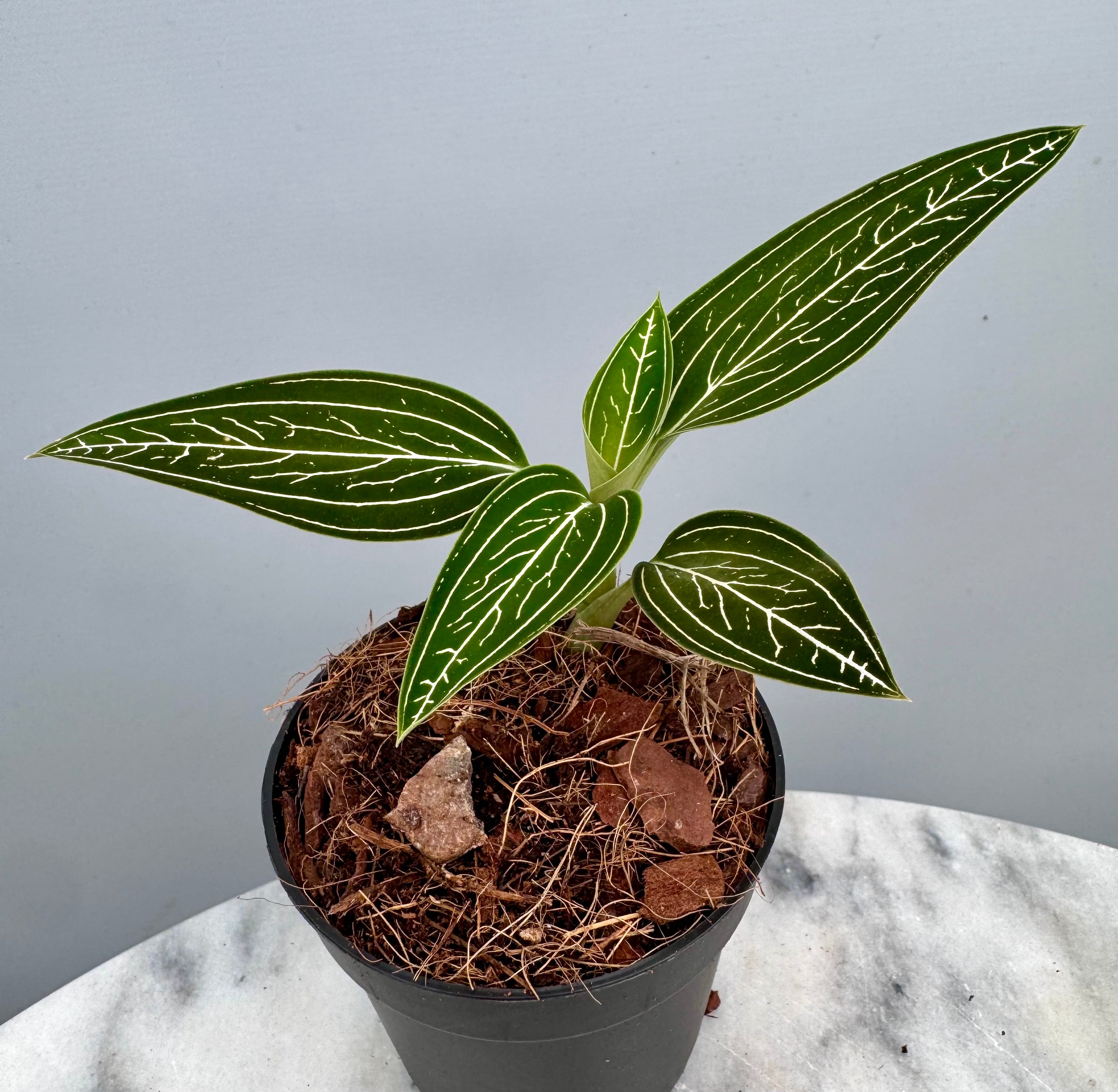
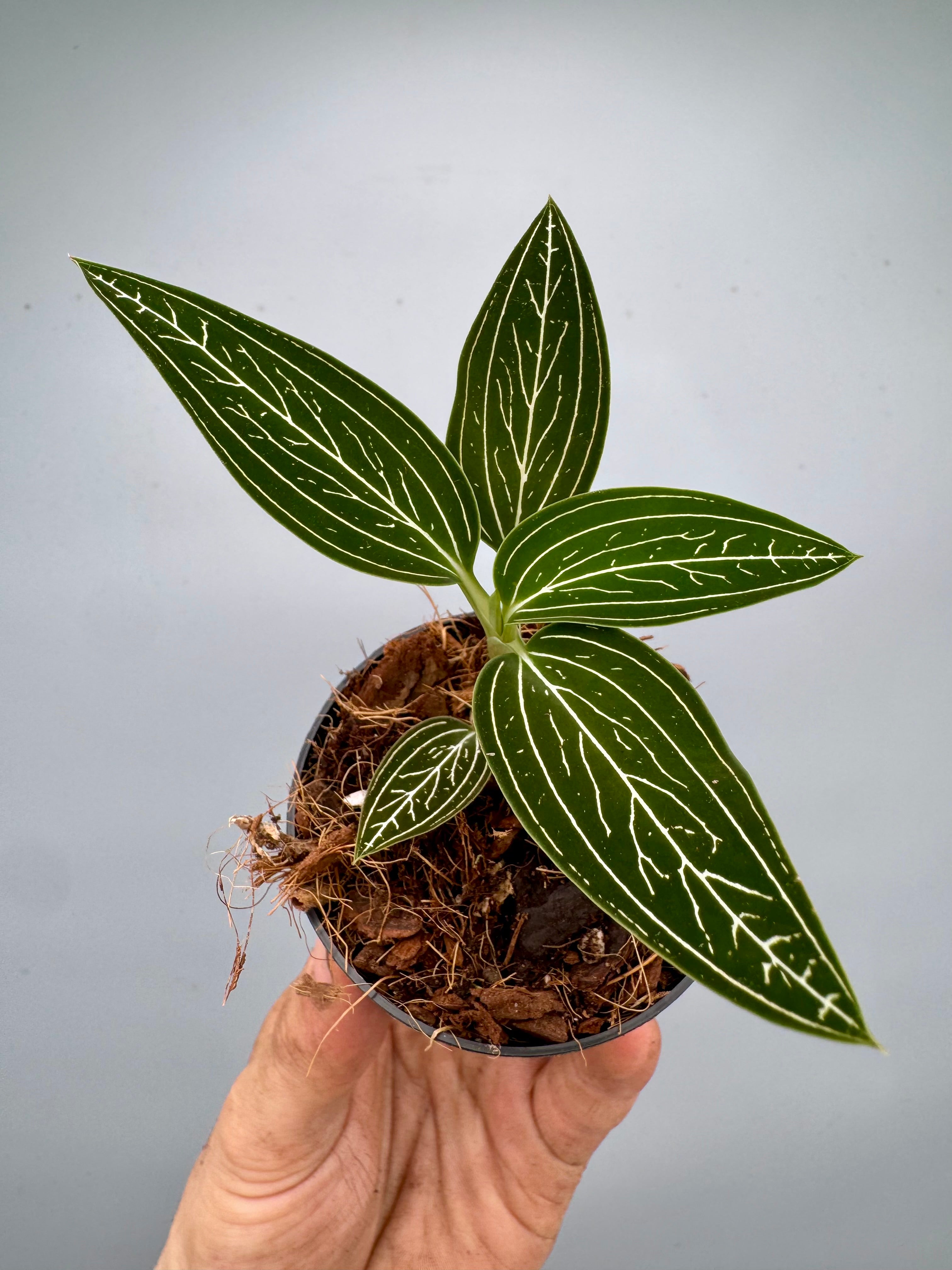
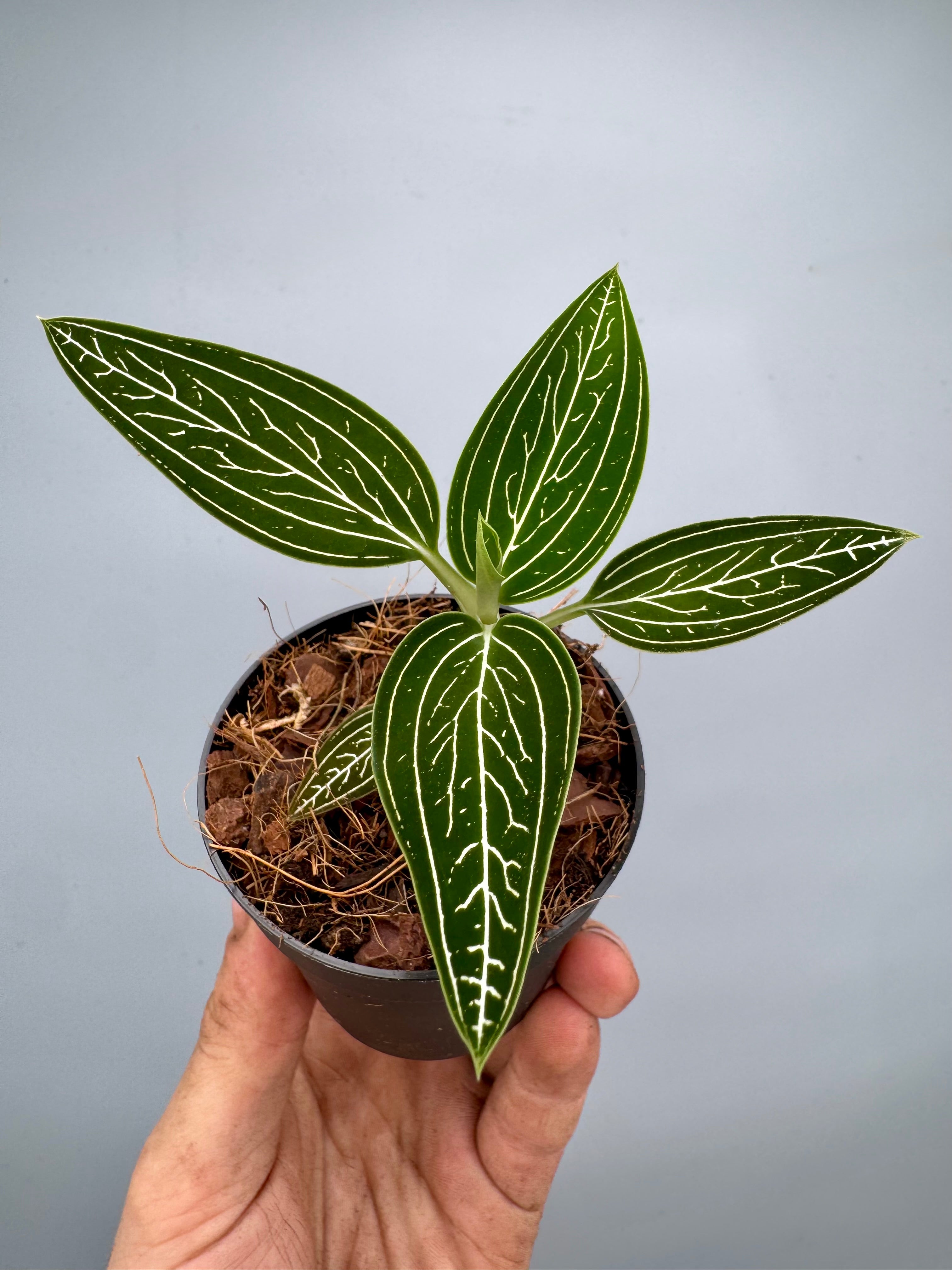
Ludisia discolor var. alba ‘Platinum Vein’ is a unique jewel orchid that is primarily cultivated for its striking leaves. Whereas the classic Ludisia discolor is known for its nearly black-green leaves with pink to copper-colored veins, this selection has a much lighter appearance. Its fresh green foliage is crisscrossed by contrasting silvery-white veins, giving the impression that fine platinum lines have been drawn across the leaves.
This plant remains relatively compact and gradually spreads into a fuller clump via creeping, fleshy stems. This makes ‘Platinum Vein’ particularly well-suited for a warm windowsill, plant display case, or tropical terrarium. Furthermore, this is an MC plant, or a mericlone. The plant has been vegetatively propagated from selected plant material, with the aim of preserving the characteristic leaf pattern as reliably as possible.
Name and Taxonomy
The botanically accepted species name is Ludisia discolor. The designations var. alba and ‘Platinum Vein’ are used in the orchid trade to distinguish this green, lightly veined selection from the dark-leaved form. Var. alba is primarily a horticultural designation and is not generally recognized as a separate botanical variety.
The addition of ‘Platinum Vein’ refers to the cool, silvery-white leaf veins. This distinguishes this selection from plants marketed under names such as ‘Gold Vein,’ which typically have a warmer, yellow-green vein pattern. However, the final color and contrast are also influenced by the age of the leaves, light intensity, and growing conditions.
MC stands for mericlone. This means that these plants have been propagated from a selected mother plant and are intended to retain the same recognizable characteristics. Minor differences between individual plants are still possible, but the leaf pattern is generally more consistent than in seedlings.
Origin
Ludisia discolor is native to much of tropical Southeast Asia, including southern China, Thailand, Vietnam, Malaysia, Sumatra, and the Philippines. The species grows terrestrially on shaded forest floors, where the roots develop in loose humus, leaf litter, and organic matter.
This natural growth habit is important for its care. Unlike many well-known orchids, a Ludisia does not grow with exposed aerial roots on tree branches. Instead, the plant requires a fine, airy, and slightly moist substrate in which its creeping stems and relatively fine roots can develop easily.
Characteristics
The most important ornamental feature of ‘Platinum Vein’ is undoubtedly its leaves. The leaves are oval to elongated, feel soft and somewhat velvety to the touch, and have a fresh green base color. A network of bright, silvery-white to cream-colored veins runs across them. Especially in soft, indirect light, a beautiful satin sheen emerges.
The plant grows from horizontal, fleshy stems. New leaves, roots, and eventually side shoots develop at the nodes. As a result, the plant remains low-growing but can slowly form a full clump as it spreads outward. A mature specimen is therefore decorative even outside of the flowering season.
The plant offered is in a Potsize pot measuring 5.5 centimeters and is in an adolescent growth phase. It is therefore a young specimen that still needs to grow further. Because these plants are imported, the roots may still be developing upon arrival. Under stable, warm conditions, the plant usually recovers gradually and forms new roots and shoots within a few months.
Care
Although this selection looks exclusive, Ludisia discolor is one of the more accessible jewel orchids. The plant does not require an extreme amount of light and therefore fits well in a home or in a display cabinet. The most important thing is that the growing medium remains airy and never becomes waterlogged for long periods.
Give a young or newly imported plant time to adjust to its new environment. A stable temperature, a substrate that is evenly moist, and sufficient air circulation are more important during this acclimatization period than rapid growth or heavy fertilization.
Light
Place ‘Platinum Vein’ in a bright spot without harsh direct afternoon sun. Bright, filtered light or light shade best mimics its natural growth on the forest floor. A north- or east-facing window is often suitable. If placed near a south- or west-facing window, it’s wise to keep some distance from the glass or provide protection with a light curtain.
Too much sun can quickly cause the light-colored leaves to fade or develop localized scorch marks. Furthermore, exposing the plant to an extreme amount of light does not automatically result in more attractive veining. Conversely, with too little light, the stems become longer and looser, while new leaves may remain smaller. A grow light in a display cabinet is therefore perfectly suitable, as long as the plant is not placed directly under a particularly strong lamp.
Temperature
This jewel orchid prefers warm, consistent temperatures. During the day, temperatures of about 20 to 27 °C are ideal, while nighttime temperatures should be around 17 to 21 °C. A slight natural drop in temperature at night is beneficial, but a cold dormancy period is not necessary.
Try to avoid temperatures below 15 °C. Young plants and those still developing new roots are particularly sensitive to a combination of cold and wet growing medium. Therefore, do not place the plant against cold window glass and protect it from drafts caused by open windows or air conditioning.
Substrate and Cultivation Method
Since Ludisia discolor is a terrestrial orchid, this plant should not be grown exclusively in coarse orchid bark. A suitable mixture retains some moisture while also providing sufficient aeration. A combination of fine bark, airy coconut fiber or peat-free potting mix, perlite or pumice, and a small amount of finely chopped sphagnum moss usually works well.
The substrate should not be packed down too tightly. The creeping stem should preferably rest on or just against the surface, so that the nodes can easily make contact with the moist material. Do not bury the fleshy stem too deeply, as this increases the risk of rot.
As the plant grows larger, a shallow and somewhat wider pot is often more practical than a tall, narrow orchid pot. The roots do not need much depth, while the creeping shoots require space to spread out laterally. Good drainage remains essential.
In a terrarium, the plant can also be placed directly in suitable soil. In that case, ensure there is a drainage layer and an airy root zone where standing water does not accumulate. Continuously waterlogged soil or a location directly next to a waterfall or splash zone is less suitable.
Humidity
A humidity level of approximately 55 to 75 percent supports healthy, consistent growth. At the same time, a well-rooted Ludisia can usually adapt to a normal living environment, provided the air isn’t exceptionally dry for extended periods. In very dry conditions, the leaf edges may turn brown, and the development of new shoots slows down.
In a terrarium or display case, the humidity may be higher, but there must also be sufficient air circulation. Constant condensation on the leaves combined with stagnant air can cause soft spots, stem rot, or mold on the flowers. Daily misting is therefore not necessary and can even be harmful if ventilation is insufficient.
Watering
Keep the growing medium evenly slightly moist, but never permanently wet. Water again when the top half to one centimeter of the mixture begins to dry out slightly. Do not let the root ball dry out completely, as the fine roots and fleshy stems can quickly lose moisture as a result.
Soft leaves, wrinkled stems, and a severely dried-out growing medium usually indicate a lack of water. Yellow, translucent leaves or a soft, darkening stem base, on the other hand, are more commonly associated with overly wet conditions. Therefore, check not only the surface but also how moist the substrate remains around the roots.
Preferably use rainwater, reverse-osmosis water, or other low-mineral water at room temperature. Water the plant preferably in the morning and avoid letting water remain between the leaves or around young growth points for extended periods overnight. During the dark winter months, the plant uses less moisture, but even then it does not need a completely dry dormant period.
Fertilizer
During active growth, apply a weakly diluted orchid fertilizer or balanced houseplant fertilizer about once every three to four weeks. About a quarter of the normal dosage is usually sufficient. Because the plant grows in a more organic substrate than many epiphytic orchids, regular but careful feeding is better than occasionally applying a high concentration.
Reduce fertilization when the plant shows little new growth. Also, rinse the substrate occasionally with clean water to remove accumulated fertilizer salts. Over-fertilization can lead to weak, fragile growth and browning of the roots or leaf edges.
Flowering
Although ‘Platinum Vein’ is primarily purchased for its foliage, the plant can also produce attractive flowers. An upright flower stalk with several small, pale flowers typically emerges from a mature shoot. Flowering often occurs in late fall or winter, but can also occur at other times under consistent indoor conditions.
A mature plant with multiple shoots can produce several flower stalks and thus bloom profusely. However, you shouldn’t always expect a young plant in a 5.5-centimeter pot to bloom profusely right away. When both a flowering and a non-flowering variety are available, that choice determines whether the plant will already have a flower stalk upon delivery. After flowering, only the spent, dried-out flower stalk should be removed at the base; the creeping leaf stalks should be left intact.
Care Level
Ludisia discolor var. alba ‘Platinum ‘Vein’ has an easy to moderate care level. This species is more accessible than many other jewel orchids and can therefore be grown even by less experienced orchid growers. However, this young, imported selection initially requires a stable environment in which the roots can recover undisturbed.
Do not repot the plant immediately upon receipt, unless the existing growing medium is clearly decomposed, compacted, or permanently wet. It is best to wait until new root tips or a fresh shoot become visible. These are reliable signs that the plant is actively growing and will better tolerate repotting.
Who is this plant suitable for?
This variety is particularly well-suited for enthusiasts of jewel orchids, compact foliage plants, and unique terrarium plants. Collectors who already own a classic dark-leaved Ludisia discolor will find that “Platinum Vein” offers a distinctly different color form with a cooler, lighter appearance.
Thanks to mericlone propagation, the plant is also appealing to buyers who are specifically looking for a recognizable and relatively consistent leaf selection. Keep in mind, however, that the specimen offered is still young. Anyone expecting a broad, densely branched plant right away will need to give it time to first develop multiple creeping shoots.
For enthusiasts primarily looking for large, striking orchid flowers, this isn’t the most logical choice. Its main ornamental value lies in the foliage, which remains visible year-round.
Experience growing indoors, in a greenhouse, or in a terrarium
Indoors, ‘Platinum Vein’ thrives near a north- or east-facing window, or slightly further away from a sunnier window. Thanks to its compact size, the plant fits easily on a windowsill, plant table, or in a glass display cabinet. As the stems grow longer, the plant’s growth habit is beautifully showcased in a wide bowl.
A warm orchid greenhouse also provides suitable conditions, provided the plant is placed low and in the shade. Light that’s too bright can cause damage more quickly here than in an average living room.
In addition, this Ludisia is well-suited for a tropical terrarium or a well-ventilated plant display case. The combination of warmth, high humidity, and diffused light supports steady growth. Be sure, however, that the plant isn’t constantly getting wet from sprayers or misting systems and that excess water can drain away from the root zone.
Extra care tip
When a creeping stem gets longer, you can gently pin a healthy node to the moist substrate. New roots often develop from this node, followed by a side shoot. This allows the plant to grow more quickly into a full clump without having to cut the stem off immediately. Do not bury the stem completely; light contact with the substrate is sufficient.
Short product description
Ludisia discolor var. alba ‘Platinum Vein’ (MC) is a compact jewel orchid with fresh green, velvety leaves and striking silvery-white veins. This vegetatively propagated selection grows via creeping stems and is suitable for a warm windowsill, plant display case, or tropical terrarium. The young plant is supplied in a 5.5-centimeter pot and, after a gentle acclimatization period, can grow into a full, richly flowering foliage plant.