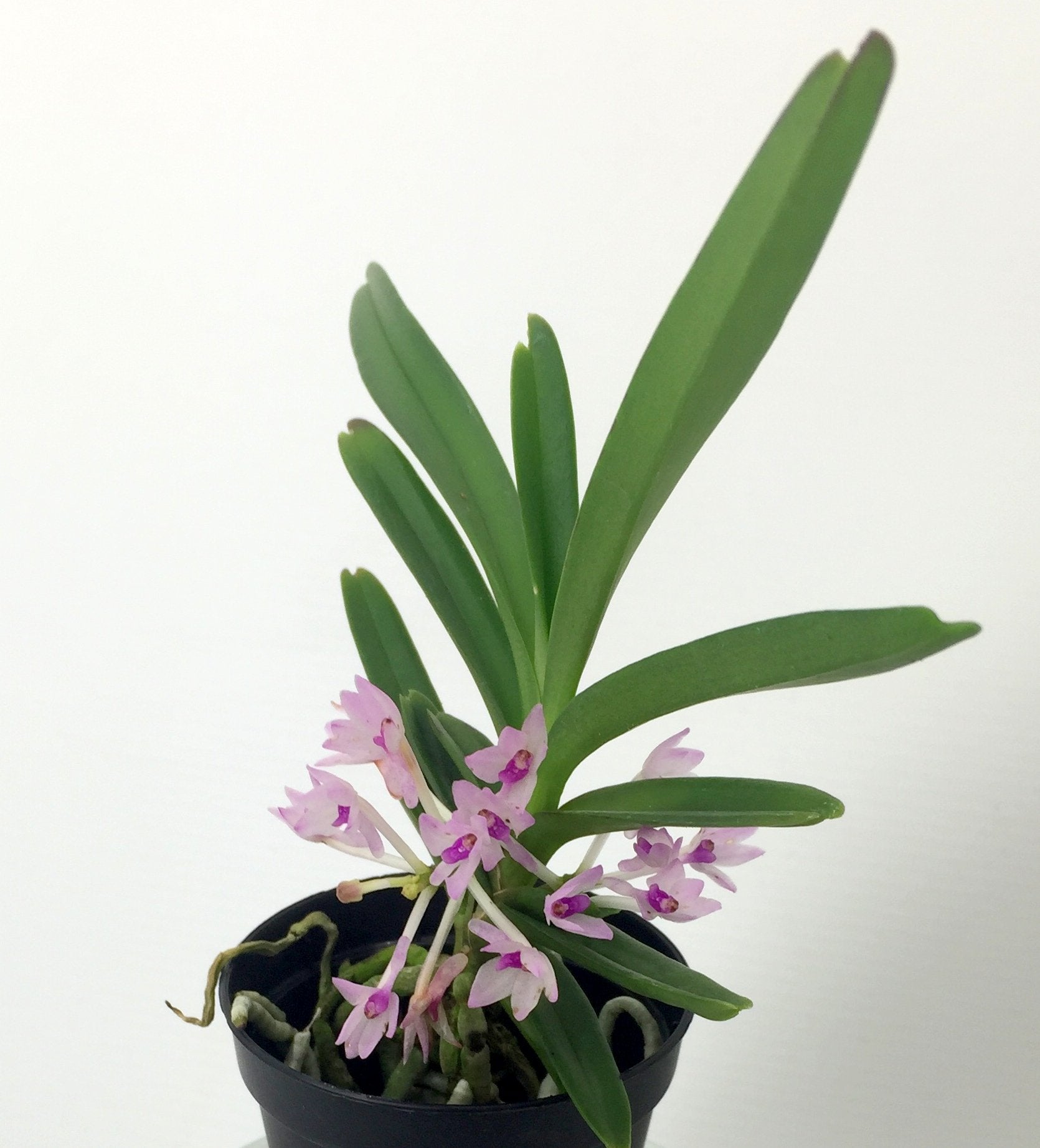
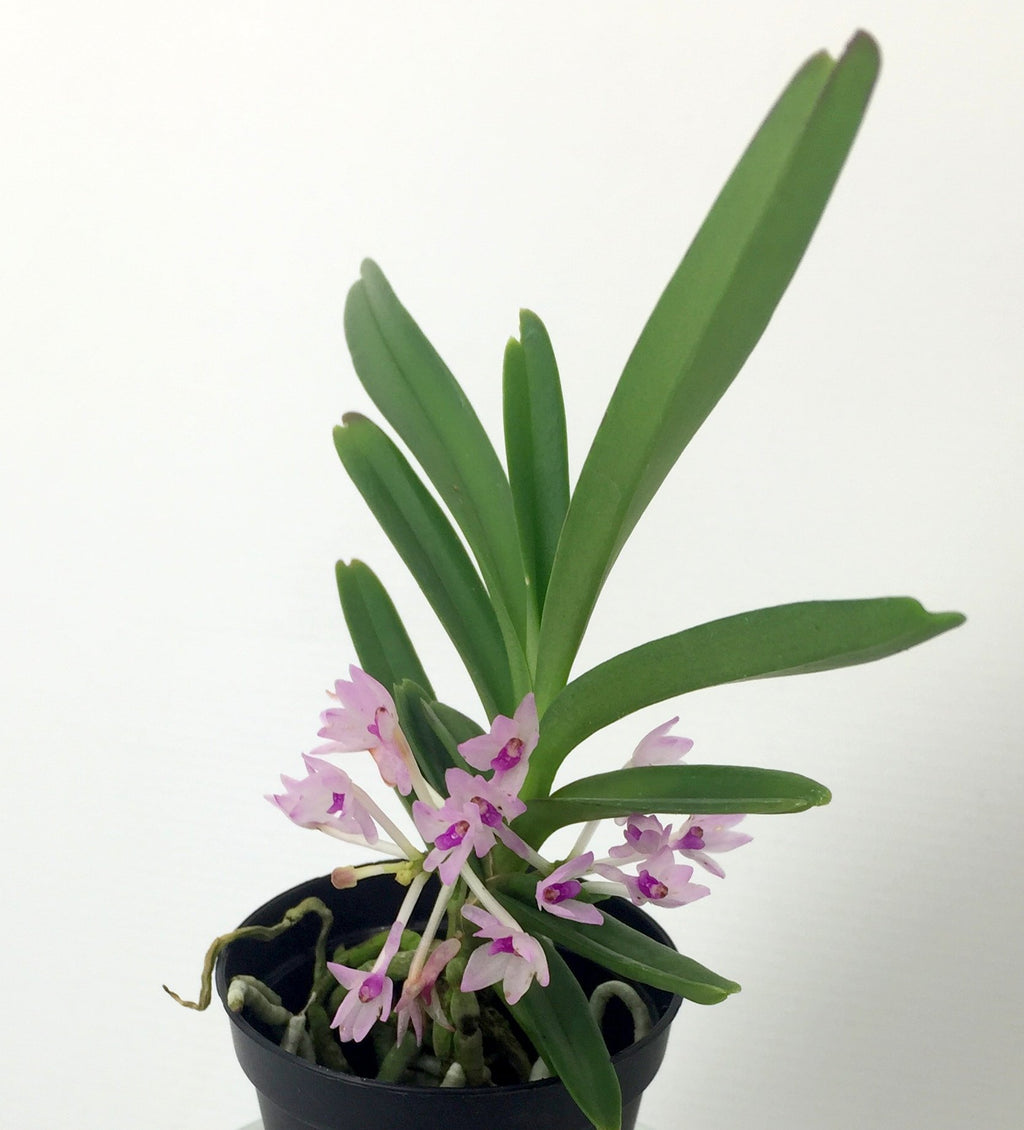
Vanda nana is a unique miniature Vanda for enthusiasts of compact, botanical orchids. While many Vandas grow large and require a lot of space, this species remains strikingly small. This makes Vanda nana appealing to collectors who want the look of a Vanda but don’t always have room for a large hanging plant with long aerial roots.
The plant blooms with small, delicate flowers that are typically white-pink, light pink, or purple-pink. Due to its compact size and raceme-like flowering, Vanda nana has a charming, almost bouquet-like appearance. This is not an orchid that impresses with enormous flowers, but rather with its proportions: small leaves, delicate flowers, and a distinct botanical character.
Origin
Vanda nana is a botanical species within the genus Vanda. The species was formerly known as Ascocentrum pusillum but is now classified as Vanda nana. Both names may still appear in the trade, which is why the same plant is sometimes sold as a miniature Vanda or as an Ascocentrum-like orchid.
The species is native to Southeast Asia and is primarily associated with Vietnam and neighboring countries such as Thailand and Cambodia. In the wild, it grows as an epiphyte on trees, where its roots receive plenty of air and can dry out quickly after rain or dew. This natural growth habit is important for its care: Vanda nana prefers airy roots, bright light, consistent moisture, and good air circulation.
Characteristics
Vanda nana is a true miniature within the Vanda genus. The plant forms short, compact fans with sturdy leaves and delicate aerial roots. Due to its small size, it fits well in a display case, small greenhouse, plant room, or on a bright windowsill with sufficient humidity.
The flowers appear in small clusters and are usually soft in color. Depending on the individual plant, they may display shades of white with pink accents, light pink, lilac-pink, or purple-pink. The flowers are small, but their sheer number and delicate shape make them striking nonetheless. On a well-grown plant, the blooms can create a very graceful effect, especially when the plant is mounted or kept in a small open basket.
Because Vanda nana remains compact, it is more practical than many large Vanda varieties. Nevertheless, the plant still requires proper Vanda care: plenty of light, well-aerated roots, and a good balance between watering and drying time.
Care
Light
Vanda nana prefers bright, filtered light. It can tolerate more light than many shade-loving orchids, but intense midday sun through a window can damage the leaves. Morning sun or late afternoon sun is usually suitable, especially when humidity levels are good.
If there’s not enough light, the plant will often survive, but it will grow slowly and be less likely to bloom. A bright windowsill, a display case with grow lights, or a small, warm greenhouse is therefore ideal.
Temperature
Vanda nana grows best in moderate to warm conditions. A daytime temperature of about 20 to 27°C is suitable. At night, the temperature may drop to about 16 to 20°C. Short periods of cooler weather are usually not a problem, as long as the plant isn’t left cold and wet for an extended period.
In a warm environment, the plant grows faster, but it also needs more water, humidity, and air circulation. Heat without sufficient moisture can quickly cause the delicate roots to dry out.
Substrate and Cultivation Method
Vanda nana can be grown well in a small open basket, on a piece of cork or wood, or in a very airy mixture of fine to medium-coarse bark and possibly some sphagnum moss. Because the plant remains small, mounted cultivation is a viable option, but this does require regular watering.
For indoor cultivation, a small open basket is often more practical than growing the plant completely bare-root or mounted. This keeps the roots well-aerated, but they dry out less rapidly than they would on cork. A closed pot with compact substrate is less suitable, as the roots can remain wet and oxygen-deprived for too long.
Humidity
A humidity level of about 60 to 80% is ideal. Vanda nana often grows more easily in a display case or greenhouse than on a dry windowsill, because the small roots dry out less quickly there. At higher humidity levels, good air circulation remains important.
Dry air is especially a problem for mounted plants. In such cases, daily misting or regular soaking may be necessary. In a small pot or open basket, care is usually a bit easier to manage.
Watering
Allow the roots to get completely wet and then dry out slightly again. Vanda nana likes regular moisture, but not roots that remain wet and stifled for long periods. When grown on cork or wood, the plant may often need water during hot periods. In a small basket or well-ventilated pot, slightly more moisture remains available.
Preferably use demineralized water, rainwater, or other soft water at room temperature. Healthy roots turn green when wet and silvery when they dry out. This makes it easy to see when they need watering again.
Fertilization
During active growth, apply a light dose of orchid fertilizer regularly. Because Vanda nana remains small, heavy fertilization is not necessary. A quarter to half the recommended dose is usually sufficient. Rinse the roots regularly with clean water to prevent the buildup of fertilizer salts.
During cooler or darker periods, you can reduce the amount of fertilizer. Fertilize especially when the plant is actively producing new roots or leaves.
Flowering
Vanda nana can produce small clusters of pink to purplish-pink flowers. The blooms are delicate and compact, but their miniature size makes them particularly charming. With sufficient light, healthy roots, and a slight drop in temperature at night, the plant will reliably bloom once it is well-established.
Do not cut back the flower stems until they have fully bloomed and begin to dry out. After flowering, the plant continues to grow from the top and may produce new flower stems later.
Care Level
Vanda nana is of moderate difficulty. It is smaller and therefore more practical than many large Vandas, but its care still requires attention. Watering and humidity are especially important, as the small roots dry out more quickly than those of larger plants.
This plant is not suitable for a dark location or for someone who doesn’t want to spend much time watering. Those who already have experience with miniature orchids, mounted orchids, or small Vanda-like species will generally be able to care for Vanda nana successfully.
Who is this plant suitable for?
Vanda nana is suitable for enthusiasts looking for a true miniature Vanda with botanical value. The plant is a good fit for people with a display case, small greenhouse, plant room, grow lights, or a bright windowsill where it can be regularly misted or soaked.
For collectors, the size is particularly appealing. Vanda nana offers the distinctive look of the Vanda alliance but remains much more compact than most well-known Vandas. This makes it a good choice for those with limited space who still want to grow unique varieties.
For beginners, this plant may only be suitable if the location is bright enough and watering is carefully monitored. It is less suitable for a dry, dark living room.
Experience growing at home or in a greenhouse
In practice, Vanda nana grows best when its roots can be visibly monitored. In an open basket or on cork, you can immediately see whether the roots are dry, active, or too wet. This makes care more straightforward than with plants in a closed pot.
In a display case or warm greenhouse, the plant is often easier to care for because humidity and temperature are more stable. It can also be kept on a windowsill, but in that case, consistency is more important. Especially in the summer, the plant can dry out quickly, while in the winter it actually needs less water.
Extra care tip
With Vanda nana, pay special attention to the balance between light and water. The brighter and warmer the location, the faster the roots dry out and the more frequently the plant needs water. If the plant is in a cooler or darker spot, reduce the amount of water you give it. Healthy root tips are the best sign that the plant is thriving.