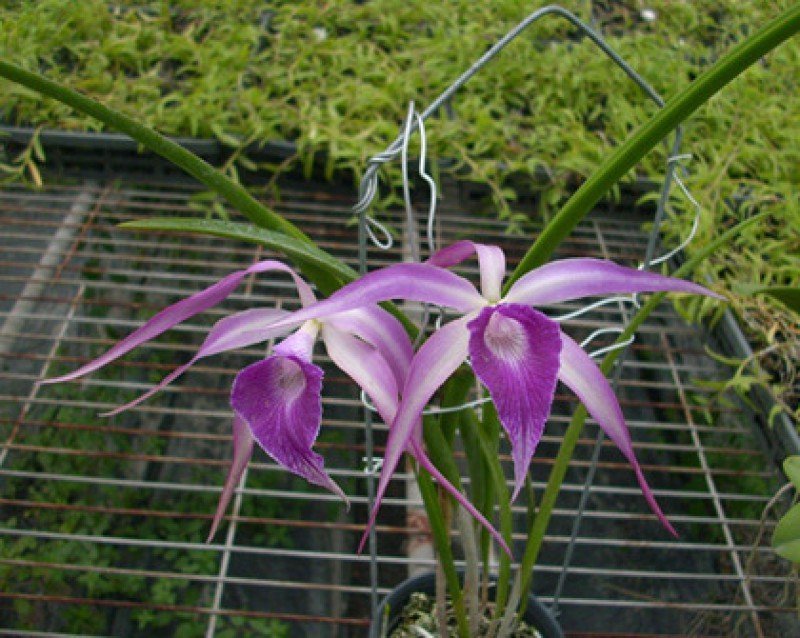
Brassocattleya Amethyst is a unique primary hybrid resulting from Brassavola cucullata × Laelia purpurata. In modern nomenclature, Laelia purpurata is often treated as Cattleya purpurata, which is why this hybrid is also written as Cattleya purpurata × Brassavola cucullata. In the trade, however, the classic name using Laelia purpurata remains recognizable and widely used.
This hybrid combines two very different parents: the graceful, spider-like flower form and fragrance of Brassavola cucullata with the larger, more colorful flowers of Laelia purpurata. The result is an orchid with elegant, often somewhat elongated flowers, usually in shades of white, pink, lilac, purple, or amethyst-colored violet. The flowers can also be distinctly fragrant, especially due to the influence of Brassavola.
Origin
Brassocattleya Amethyst is a registered primary hybrid from 1980. A primary hybrid means that the plant was created directly from two botanical species. In this case, those are Brassavola cucullata and Laelia purpurata, which is now often taxonomically classified as Cattleya purpurata.
Brassavola cucullata is native to tropical America and is known for its narrow, spider-like flowers with a fringed lip and a scent that is most noticeable in the evening or at night. Laelia purpurata, or Cattleya purpurata, is an iconic species from Brazil with large, elegant flowers and a striking lip color. This combination gives Brassocattleya Amethyst both the airy flower form of Brassavola and the more classic Cattleya appearance of purpurata.
Characteristics
Brassocattleya Amethyst grows sympodially, with pseudobulbs and sturdy leaves, as seen in many Cattleya relatives. The plant has an airy, open growth habit and, with proper care, produces sturdy new shoots. Flower spikes bearing large to medium-sized flowers can develop from mature shoots.
The flowers are usually strikingly elegant in form. They are less rounded and full than many modern Cattleya hybrids, but also less extremely narrow than pure Brassavola cucullata. This creates a beautiful balance: a flower with movement, length, and graceful lines, yet with sufficient size and color.
The color can vary by clone or seedling. The shades are often white, soft pink, lilac, purple, violet, or amethyst. The lip may be more distinctly marked and display greater color intensity than the other parts of the flower. Some plants have a distinctly fragrant character. Secret Garden describes the flowers of Brassocattleya Amethyst as large, strongly fragrant, and variable in color, with a flower size of about 11.5 cm.
Care
Light
Brassocattleya Amethyst needs plenty of bright light to grow and bloom well. Place the plant in a bright spot with filtered sunlight. Morning sun or late afternoon sun is usually suitable. Bright midday sun through a window can damage the leaves, especially in the summer.
Like many Cattleya relatives, this hybrid will often grow even with insufficient light, but will not bloom, or will bloom only sparingly. A bright windowsill, sunroom, greenhouse, or spot under good grow lights is therefore ideal. Healthy foliage is usually firm and light to medium green; very dark foliage may indicate insufficient light.
Temperature
This hybrid thrives in moderate to warm conditions. During the day, temperatures of about 20 to 28°C are suitable. At night, the temperature may drop to about 15 to 20°C. A slight drop in nighttime temperature often helps Cattleya-type orchids grow more vigorously and bloom better.
The American Orchid Society generally recommends nighttime temperatures of approximately 12.7 to 22.2°C and daytime temperatures of approximately 21.1 to 29.4°C for Cattleya orchids, with higher daytime temperatures possible when humidity, watering, air circulation, and shade are adjusted.
Substrate and Cultivation Methods
Brassocattleya Amethyst prefers an airy growing medium that dries out quickly. A mixture of medium-coarse to coarse bark, possibly with some perlite or coarse coconut chips, is suitable. The roots must be allowed to re-oxygenate after watering.
Do not use a compact mixture that stays wet for a long time. This hybrid tolerates brief periods of drying out better than constantly wet roots. An open pot or basket often works well, especially for plants with a strong Brassavola influence. Elevated cultivation is also possible, but requires more frequent watering and is particularly practical in a greenhouse or in conditions of higher humidity.
Humidity
A humidity level of about 50 to 70% is suitable. At higher temperatures and with plenty of light, the humidity may be higher, as long as there is sufficient air circulation. Stagnant, moist air can cause mold or rot, especially around young shoots and in the leaf axils.
In a normal living room, the plant can grow well as long as the roots remain healthy and watering is adjusted according to temperature and light. A sunroom or greenhouse often makes care easier, especially during active growth.
Watering
Water generously when the growing medium is nearly dry, and then allow the pot to drain thoroughly. During active growth, when new shoots and roots appear, the plant may be watered more frequently. Once growth has slowed and the plant is kept in a cooler or darker location, watering can be reduced.
Preferably use demineralized water, rainwater, or other soft water at room temperature. Make sure no water remains standing around young shoots for long periods. For Cattleya-type orchids, balance is especially important: water generously during growth, but always allow sufficient drying time.
Fertilization
During the growing season, apply a light dose of orchid fertilizer regularly. A quarter to half the recommended dose is usually sufficient. Fertilize especially when the plant is actively producing new roots; this is when the plant can absorb the nutrients most effectively.
Rinse the growing medium occasionally with clean water to limit the buildup of fertilizer salts. During the dormant period, you may reduce or temporarily stop fertilization.
Flowering
Brassocattleya Amethyst can bloom from mature, well-developed shoots. The flowers are usually medium to large, elegantly shaped, and often fragrant. Due to the influence of Brassavola cucullata, the flower parts may be somewhat longer and more graceful, while Laelia purpurata contributes to larger flowers and more vibrant color.
Flowering primarily requires sufficient light, healthy roots, and a good growth rhythm. Insufficient light is one of the most common reasons why Cattleya-like orchids fail to bloom. Do not cut the flower spike until it has finished blooming and begins to dry out.
Care Level
Brassocattleya Amethyst is of medium difficulty. The plant is generally easy to care for by enthusiasts who already have some experience with Cattleya, Brassavola, or other orchids that prefer well-ventilated conditions. It isn’t extremely sensitive, but it does require sufficient light and a growing medium that doesn’t stay wet for too long.
This hybrid may be suitable for beginners if they deliberately choose a bright location and learn to water based on drying time rather than a fixed schedule. Those accustomed to Phalaenopsis should especially keep in mind the need for more light, better air circulation around the roots, and a more distinct drying period between waterings.
Who is this plant suitable for?
Brassocattleya Amethyst is suitable for enthusiasts looking for a fragrant, elegant Cattleya-like orchid with a distinctive flower shape. The plant is a good fit for people who appreciate botanical influences but also prefer larger and more colorful flowers than those of the pure Brassavola cucullata.
This hybrid is a good choice for a bright windowsill, sunroom, greenhouse, or plant room. It is less suitable for a dark living room. For collectors of Cattleya alliance hybrids, Brassocattleya Amethyst is particularly interesting due to the combination of Brassavola’s fragrance and flower shape with the color and flower size of Laelia purpurata.
Caring for it at home or in a greenhouse
Indoors, Brassocattleya Amethyst is best kept in a well-ventilated pot with coarse bark. This makes care more practical than with mounted cultivation, while still allowing the roots to get enough air. Place the plant in as much light as possible, but avoid harsh afternoon sun.
In a greenhouse or conservatory, the plant can often grow more vigorously because light, temperature, and humidity are better balanced. An open basket or mounted setup can also work well there. Pay special attention to the new roots: as soon as they start growing actively, that’s the best time to slightly increase watering and fertilization.
Extra care tip
Make sure to give Brassocattleya Amethyst plenty of light. With this hybrid, insufficient light is more often a problem than a slight lack of fertilizer. As long as the roots are healthy and the growing medium dries out properly, the plant can grow quite vigorously. Sturdy pseudobulbs, fresh green root tips, and light green leaves are good signs.