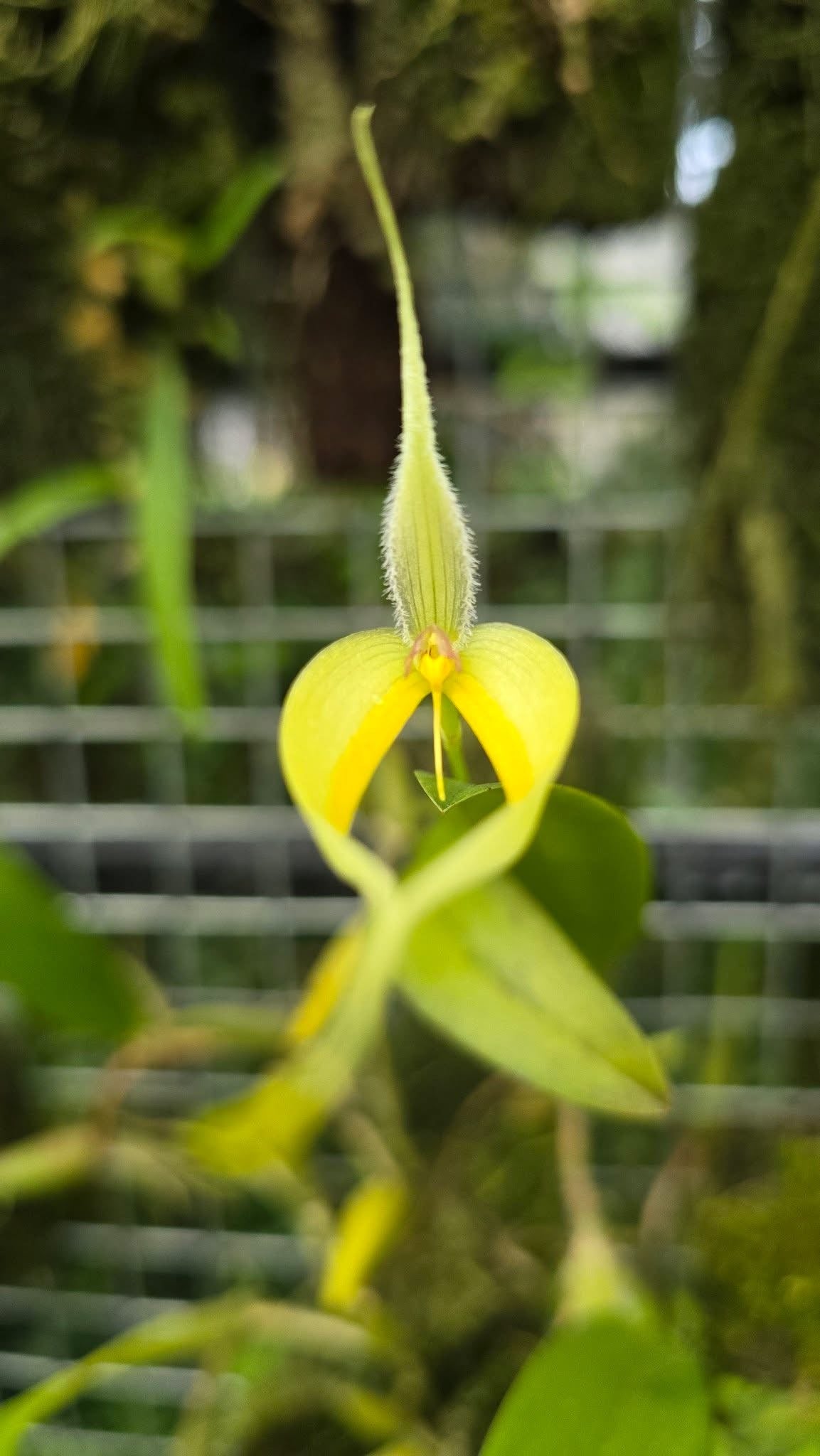
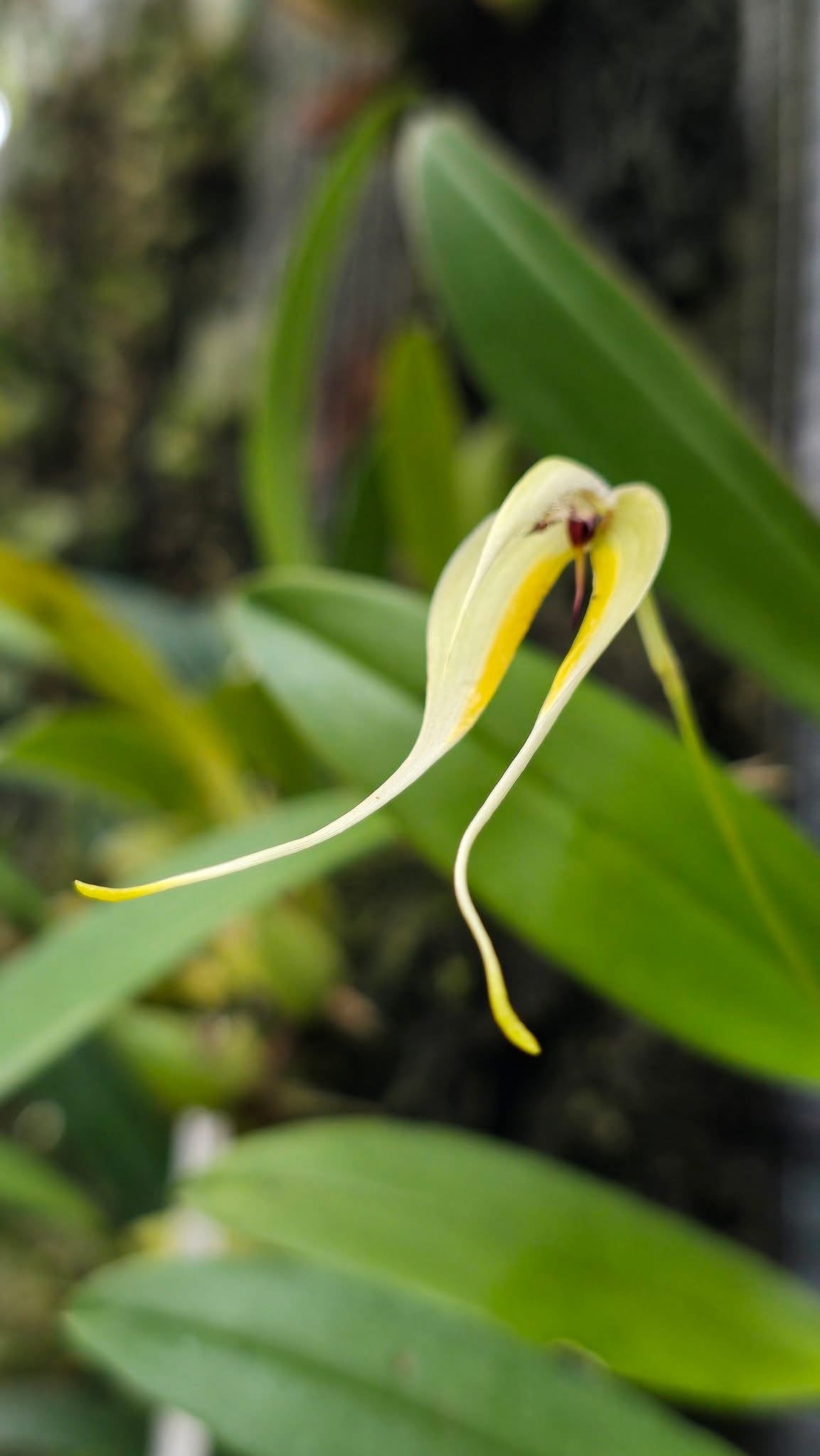
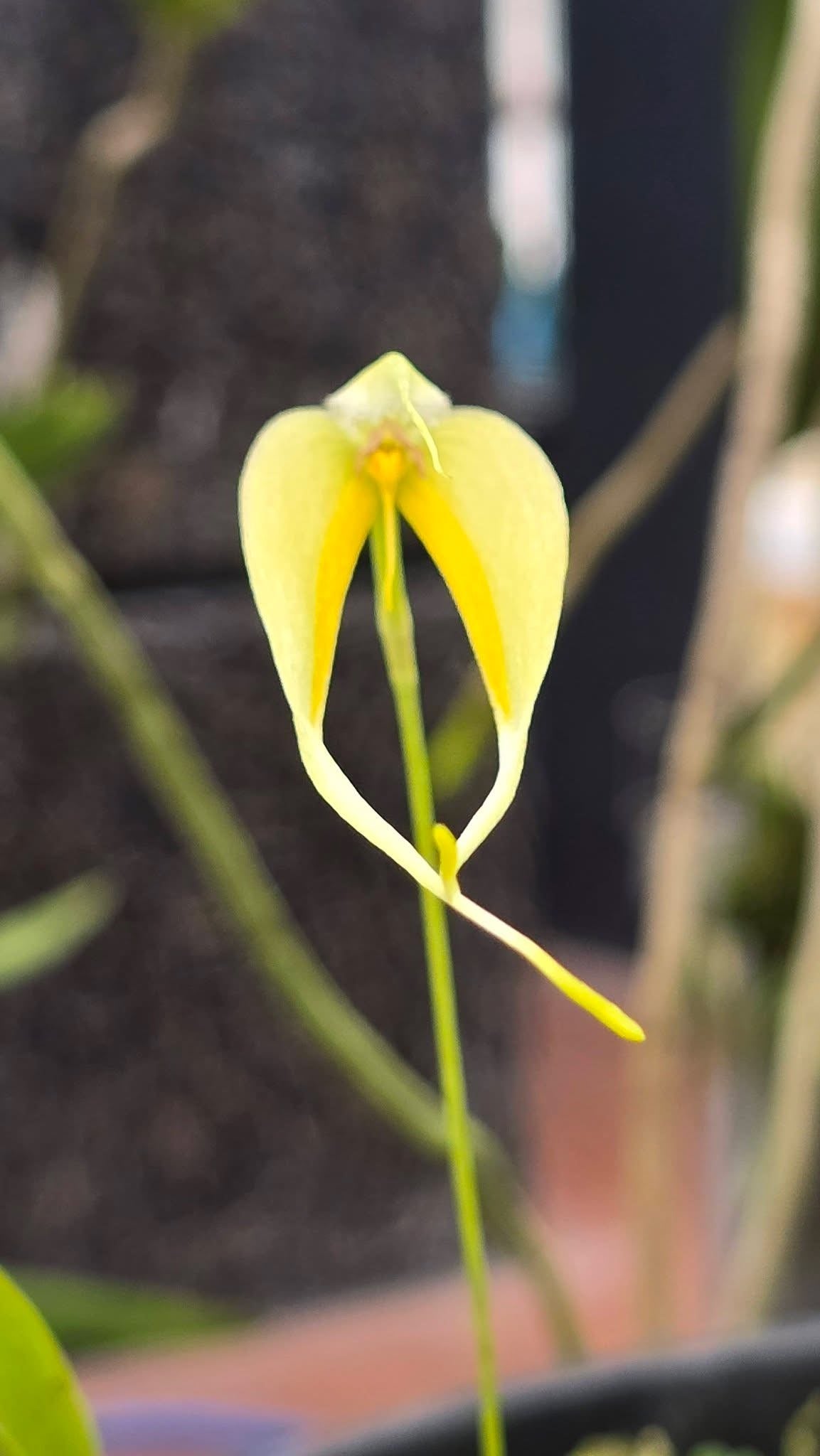
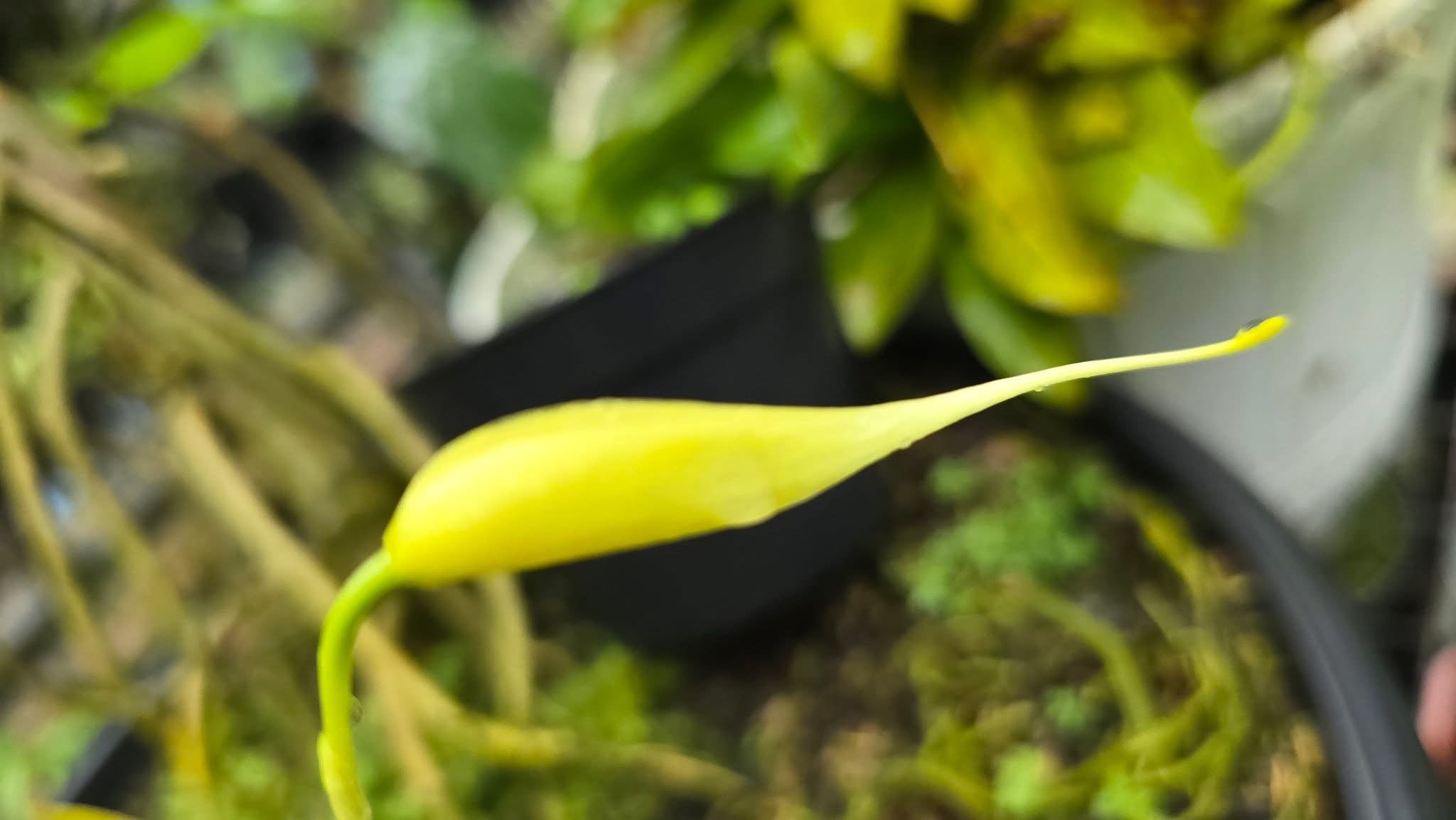
Bulbophyllum blumei var. Alba is a rare light-colored variety with striking yellow-green to cream-colored flowers. The long, hairy flower segments, broad, curved sepals, and flexible lip give the flower an almost animal-like appearance. Compared to the common dark red form, this alba variant appears much lighter and more refined.
The currently accepted botanical name of the species is Bulbophyllum maxillare. However, Bulbophyllum blumei remains a commonly used name among orchid collectors. The addition “var. alba” is used in cultivation for this low-pigment color form, but is not considered an officially recognized botanical variety.
Origin
The species has a wide natural range extending from the Nicobar Islands and Southeast Asia to New Guinea, the Solomon Islands, and northern Queensland. There, it grows as an epiphyte on tree trunks and lower branches and sometimes as a lithophyte on moss-covered rocks.
Its natural habitats are primarily found in warm, humid lowland forests. The roots receive regular moisture but are constantly supplied with oxygen due to air movement and their shallow growth. In cultivation, this means: keep it warm, never allow it to dry out for long periods, and at the same time avoid a dense or waterlogged growing medium.
Characteristics
Bulbophyllum blumei var. alba forms small, cone-shaped pseudobulbs, each with a single sturdy, leathery leaf. The pseudobulbs grow along a creeping rhizome and may eventually continue to grow outside the pot. The plant remains relatively short but can spread widely.
A flower spike typically bears one or two flowers. The elongated flowers can grow to about 6 to 9 centimeters in length. The narrow upper sepal is finely hairy along the edges, while the two larger lateral segments curve gracefully downward and end in long points.
In this light-colored form, most of the dark red to purple pigmentation of the standard variety is absent. As a result, the flowers are lime yellow, yellow-green, or cream-colored. A soft pink or peach-colored glow may still be visible around the lip and column. In this plant, “Alba” does not necessarily mean that the flowers are completely snow-white.
The small lip is hinged and can move visibly in the breeze. In nature, this mechanism aids in pollination by small insects.
Care
This Bulbophyllum requires warmth, high humidity, and a slightly moist root environment year-round. The main challenge lies in striking a balance between sufficient moisture and sufficient oxygen around the fine roots.
The plant does not have a distinct dry dormant period. Even outside the active growing season, the substrate must not be allowed to dry out completely.
Light
Provide the plant with bright, filtered light or light partial shade. A spot near an east- or west-facing window is suitable, as long as the plant is protected from harsh midday sun.
Too much direct sun can quickly cause the leaves to fade or burn. If there is too little light, the plant may still produce new pseudobulbs, but the likelihood of flowering decreases. A medium-green leaf color is usually a good indication that the light intensity is appropriate.
Temperature
Bulbophyllum blumei var. Alba thrives in warm to moderately warm conditions. Daytime temperatures of approximately 22 to 30 °C are suitable. At night, temperatures may drop to about 17 to 21 °C.
Short-term, slightly cooler conditions are usually tolerated, but prolonged temperatures below 15 °C are not ideal. In particular, the combination of cold, wet substrate, and stagnant air can cause root and leaf spot problems.
Substrate and Cultivation Method
Use an airy growing medium that retains moisture without becoming compacted. A mixture of fine to medium-coarse bark with live or dried sphagnum moss, fine coconut fiber, or tree fern fiber is suitable.
Due to its creeping growth habit, a wide, shallow pot or open basket is often more practical than a tall pot. The plant can also be tied to cork, tree fern, or a wide branch. However, a tied specimen requires much more frequent watering and consistently higher humidity.
Place the rhizome on the substrate and do not bury the pseudobulbs. A constantly wet base can quickly lead to rot.
Humidity
A humidity level of about 65 to 85 percent is ideal. At warmer temperatures, the humidity may be higher, provided there is sufficient ventilation.
Gentle, constant air movement helps the leaves dry after watering and reduces the risk of leaf spots and mold. High humidity without ventilation is therefore less suitable than slightly lower humidity with good air circulation.
Watering
Keep the growing medium evenly slightly moist, but not soggy. Water again when the top layer begins to dry out. The fine roots should not be allowed to remain completely dry for long periods.
Shriveling pseudobulbs may indicate insufficient water, damaged roots, or low humidity. Therefore, check not only the growing medium but also the condition of the roots.
Preferably use rainwater or other water with low levels of dissolved salts. During hot periods, you may need to water potted plants daily.
Fertilizer
During active growth, apply a low dose of orchid fertilizer every two to three waterings. A quarter of the recommended dose is usually sufficient.
The fine roots are sensitive to accumulated fertilizer salts. Therefore, rinse the pot or mounting material regularly with clean water. In low light and during slower winter growth, the amount of fertilizer can be further reduced.
Flowering
Mature plants can bloom at various times of the year. In a warm greenhouse or plant cabinet, flowering is less tied to a single season. New flower spikes emerge from the base of a pseudobulb and can initially be easily overlooked among the roots and the growing medium.
The flowers are particularly prized for their rare color, bizarre shape, and movable lip. As with various Bulbophyllum species, a flower may produce a distinctive scent that attracts insects. The intensity and perception of this scent can vary from flower to flower and depending on the time of day. Therefore, this is not an orchid that is primarily chosen for its sweet floral scent.
Care Level
Bulbophyllum blumei var. alba has a moderate to advanced care level. The species can grow vigorously when temperature and humidity are right, but does not tolerate prolonged dryness, cold, wet substrate, or stagnant air.
Due to the rarity of this light color form, the plant is particularly suitable for a collector who has experience with Bulbophyllum or other warm- and moisture-loving epiphytes.
Who is this plant suitable for?
This plant is intended for collectors seeking rare color forms and flowers with an unusual botanical structure. The combination of the pale yellow-green flower, hairy segments, and hinged lip gives it clear collector’s value.
The plant fits well in a specialized Bulbophyllum collection, a warm orchid greenhouse, or a ventilated plant cabinet. This species is less suitable for a cool room, a dry windowsill, or a collector primarily seeking long-blooming, fragrant orchids.
Experience growing at home, in a greenhouse, or in a plant cabinet
In a warm greenhouse or ventilated plant cabinet, it is easiest to maintain the desired humidity and ensure a consistent supply of moisture. Make sure the plant has room to continue growing horizontally.
Indoors, this species can be kept near a bright window without harsh afternoon sun. A display case or open plant cabinet can help increase humidity. Ventilation remains essential in this case.
A spacious tropical terrarium may be suitable if it provides air circulation, sufficient light, and space for the creeping rhizome. A completely enclosed, constantly damp terrarium without ventilation, on the other hand, increases the risk of mold and rot.
Additional care tip
When placing the plant, pay attention to the growth direction of the newest shoot. Position the oldest pseudobulbs at the edge of the pot so that the young growth has room to continue creeping across the substrate. Repot before the plant grows completely out of the pot, and preferably wait until new root tips become visible.
Short product description
Bulbophyllum blumei var. alba is an extremely rare, low-pigment color form of the species, which is now botanically referred to as Bulbophyllum maxillare. The yellow-green flowers, with hairy segments and a mobile lip, make this a true collector’s orchid, best suited for a warm, humid, and well-ventilated growing environment.