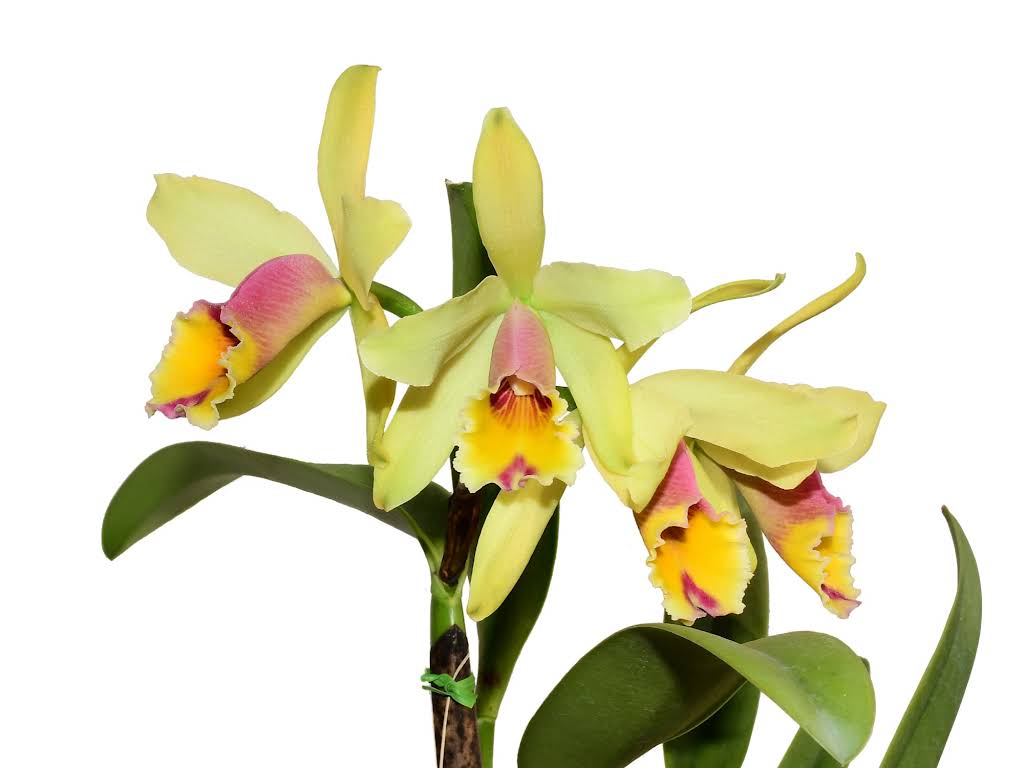
Cattleya Aurora (1905) is a historic primary hybrid for enthusiasts who appreciate the original appearance of classic Cattleya orchids. The cross was registered as early as 1905 and consists of exactly half Cattleya dowiana and half Cattleya luteola.
These two parents differ greatly from one another. Cattleya dowiana is known for its large, golden-yellow flowers with a velvety, dark carmine-red lip and a network of golden veins. Cattleya luteola, on the other hand, is a compact Amazonian species with smaller, pale lemon-yellow flowers. In Aurora, these characteristics come together in a plant that generally remains more compact than a pure C. dowiana, yet retains its warm colors, striking lip markings, and fragrance.
Don’t expect a modern, perfectly round show-type Cattleya. The charm of this hybrid lies precisely in its botanical flower form, historical background, and the strong contrast between the light-colored petals and the deeply colored lip.
Name and Registration
The correct name is Cattleya Aurora (1905). Aurora is the registered grex name of the cross:
Cattleya dowiana × Cattleya luteola
The name Aurora is capitalized and not placed in quotation marks. Quotation marks are used only when an individual plant from this grex has been given its own name as a separate clone.
The year 1905 helps distinguish this historic grex from other plants and cultivars with “Aurora” in their names. The cross was registered by W. Appleton and thus belongs to the early generations of artificially created Cattleya hybrids.
Because the plants offered here were propagated from seed, each plant is genetically unique. All specimens belong to the same grex but may differ in flower color, shape, size, scent, and vigor. The product photo shows what can result from this parent combination but is not a guarantee of a completely identical flower.
Why This Cross Is Special
Cattleya Aurora combines two extremes within the genus. Cattleya dowiana is one of the most famous yellow-flowering Cattleya species and has large flowers with a striking dark, gold-veined lip. The species has had a major influence on the development of yellow- and red-lipped Cattleya hybrids, but is also known to be sensitive in cultivation.
Cattleya luteola remains considerably smaller and grows naturally in the warm Amazon region. Its pale yellow flowers are smaller, more delicate in form, and have a relatively narrow, tubular lip. This parent can impart a more compact growth habit and a less heavy flower form to its offspring.
The result is a primary hybrid in which the characteristics of both botanical species remain clearly recognizable. This makes Aurora particularly interesting for collectors who enjoy seeing the influence of individual species in a cross.
Origin
As a man-made hybrid, Cattleya Aurora has no natural range of its own. The two parents originate from different parts of tropical Central and South America.
Cattleya dowiana occurs naturally from Costa Rica through Panama to Colombia. There, the species grows as an epiphyte in warm, humid forests. The roots are located on tree branches and receive regular watering during the growing season, while also getting plenty of oxygen.
Cattleya luteola is found in northern Brazil as well as in Ecuador, Peru, and Bolivia. This species also grows as an epiphyte, primarily in the warm and humid Amazon region.
Both parents give Aurora a preference for warm conditions, relatively high humidity, and an airy root zone. The influence of C. dowiana, in particular, means that prolonged cold and wet conditions must be avoided.
Characteristics
The plant grows sympodially and successively forms new pseudobulbs from a creeping rhizome. Each mature pseudobulb typically bears a single sturdy, leathery leaf.
The exact plant size may vary from seedling to seedling. Some specimens remain relatively compact under the influence of C. luteola, while others develop significantly larger pseudobulbs and leaves. The supplier lists an approximate plant height of 30 centimeters, but older plants may spread wider across the pot due to their lateral growth.
The flowers can range from medium to large in size. Their shape usually falls between the large, broad flower of C. dowiana and the narrower, more open flower form of C. luteola. Some seedlings may develop broad petals, while others display a somewhat slimmer or more star-shaped form.
The base color typically ranges from soft lemon yellow and cream yellow to a warmer golden yellow. The lip can be dark raspberry red, carmine red, or purplish red, often with yellow to golden veins running from the throat across the lip.
The amount of red on the lip and the width of the light-colored flower segments can also vary from plant to plant. In some seedlings, the contrast is very strong, while others have a softer, more pastel-colored appearance.
Fragrance
Both parent lines can contribute scent, and Cattleya dowiana is known for passing on its scent relatively strongly to its offspring. Aurora’s flowers may therefore emit a distinct, sweet Cattleya scent.
The scent is usually most noticeable during the day, when the flower is kept warm and receives sufficient light. The exact intensity and scent perception may vary from seedling to seedling. The age of the flower, temperature, and humidity also play a role.
However, do not choose this hybrid based solely on scent. Since these are genetically distinct seedlings, one plant may have a stronger scent than another.
Care
Cattleya Aurora has a moderate to high care requirement. The hybrid may be slightly more forgiving than a pure Cattleya dowiana, but it retains some of its sensitivity to cold, old potting mix, and damaged roots.
The most important conditions are plenty of light, warm conditions, a well-aerated growing medium, and watering adjusted to the plant’s active growth phase. During the development of new shoots and roots, the plant should be watered regularly. Once growth matures, watering should be reduced.
This is not an ideal plant for someone who wants to place an orchid in a dark spot or keep it slightly moist at all times. For an enthusiast who observes the roots and growth stages, its care is easy to understand.
Light
Provide Aurora with plenty of bright, filtered light. A bright location helps the plant form sturdy pseudobulbs and is essential for reliable flower bud formation.
Gentle morning and evening sun are generally well tolerated. If placed near a south-facing window, the plant must be protected from very intense midday sun through the glass on hot summer days.
The leaves should be medium green to light green. Very dark green, elongated leaves often indicate insufficient light. The plant may still grow, but the likelihood of flowering decreases significantly.
A slight reddish discoloration along the leaf edges can be normal under intense lighting. Pale, dry, or sharply defined spots are more likely to indicate sunburn.
Under grow lights, Aurora can be placed relatively close to the light source. Be sure to check that the leaves do not feel warm to the touch and ensure adequate air circulation around the plant.
Temperature
This hybrid thrives in warm to moderately warm conditions. Daytime temperatures of approximately 22 to 29 °C are suitable. At night, the temperature may drop to about 17 to 21 °C.
A difference between day and night temperatures supports vigorous growth and can promote flower bud formation. Prolonged nighttime temperatures below approximately 15 °C should be avoided, especially when the growing medium is still moist.
Due to the influence of Cattleya dowiana, the plant may be more sensitive to cold than many common Cattleya hybrids. A brief drop in temperature does not necessarily cause immediate problems, but the combination of cold, low light, and wet roots can lead to root loss and stunted growth.
During summer temperatures above 30 °C, special attention should be paid to ventilation and the drying time of the growing medium. The plant tolerates heat well when there is air movement and the roots receive sufficient water during active growth.
Substrate
Use an airy, fast-draining orchid growing medium. Medium-coarse bark can be combined with charcoal, perlite, or pumice. In a warm, dry living room, a small amount of loose, moisture-retaining material may be added.
The potting mix must not become compacted or remain waterlogged for days after watering. Oxygen around the roots is essential for this hybrid.
Do not choose a pot that is unnecessarily large. A large amount of potting mix dries out too slowly around a limited root system. Leave just enough space for about one or two new shoots.
An open basket is also an option and provides the roots with extra air. Mounting on cork is possible, but is less practical for a normal living room because a mounted plant requires very frequent watering during warm, active growth.
Repotting
Repot Aurora only when the growing medium begins to decompose, the plant is clearly growing over the edge, or new root tips become visible. The onset of new root growth is by far the safest time.
This is especially important due to the influence of Cattleya dowiana. If newly formed root tips are damaged during repotting, it can take a long time for the plant to form a complete root system again. Sometimes new roots do not appear until the next shoot.
Carefully remove the old substrate and trim away only completely dead, hollow, or soft roots. Secure the plant firmly so that young root tips do not move along the pot and become damaged.
Place the oldest pseudobulbs close to the edge of the pot and leave space in the direction the new shoots are growing. Keep the rhizome at or just above the surface of the potting mix.
The plants offered here have been recently imported and show active root growth. Upon receipt, it is best to first provide the plant with a stable location. Repot only when the current potting mix or the condition of the roots truly warrants it.
Humidity and Ventilation
A humidity level of approximately 55 to 75 percent is suitable. During warm, active growth, slightly higher humidity helps prevent new root tips from drying out too quickly.
High humidity must always be combined with air circulation. Stagnant, humid air increases the risk of mold, bacterial infections, and rot around young shoots.
In a normal living room, extremely high humidity is not necessary. Proper watering, a well-aerated growing medium, and an open arrangement are more important than daily misting.
Do not allow water to pool in young shoots or leaf axils. Water preferably in the morning so that the above-ground parts of the plant can dry out before nightfall.
Watering
Water generously during active shoot and root growth. Moisten the entire growing medium and allow excess water to drain completely. Water again when the growing medium is nearly dry.
The roots must not remain dry for weeks during the main growth phase. Young green root tips, in particular, may stop growing if the plant repeatedly dries out too much.
At the same time, Aurora cannot tolerate a root zone that remains constantly wet and oxygen-deprived. The correct method is therefore to water thoroughly, allow the water to drain quickly, and then let the substrate dry out sufficiently.
Preferably use rainwater, filtered water, or other water with few dissolved minerals. With hard tap water, salts can accumulate in the growing medium and damage the active root tips.
Once the new pseudobulb is fully developed and root growth slows down, watering can be reduced slightly. However, continue to water sufficiently to prevent the pseudobulbs from shriveling severely. A short, quieter period is appropriate; a months-long period of complete dry dormancy is not.
Fertilization
During active growth, apply a heavily diluted orchid fertilizer once every one to two weeks. A quarter to half the recommended dose is usually sufficient.
Reduce fertilization once the new pseudobulb is fully grown and the plant requires less water. During a clear dormant period, little or no fertilizer is needed.
Rinse the substrate regularly with clean water to remove residual fertilizer salts. This is especially important for plants with young, sensitive root tips.
A higher fertilizer dose does not compensate for a lack of light. If the plant produces dark green leaves but no flowers, check the lighting conditions first.
Flowering
The flowers emerge from the top of a mature pseudobulb. The influence of Cattleya dowiana can cause the plant to bloom relatively soon after the new shoot matures. The exact flowering period may vary due to genetic variation and growing conditions.
In Europe, the best chance for flowering is generally from the warmer growing season through the fall. Some plants may deviate from this due to the influence of Cattleya luteola or a shifted growth cycle following import.
A strong mature shoot can produce one or more flowers. Do not expect a long spike like that of a Cymbidium or Epidendrum; the appeal lies in the size, color, and fragrance of the individual flowers.
The flowers may have a slightly shorter vase life than those of some modern, large-flowered Cattleya hybrids. Protect a flowering plant from bright sunlight, very high temperatures, and direct contact with water to keep the flowers looking their best for as long as possible.
Flower Variation
Because the plants are propagated from seed, each first bloom may vary. One seedling may produce a bright golden-yellow flower with a broad dark-red lip, while another may bloom in shades of cream-yellow, green-yellow, or light lemon-yellow.
The golden-colored veining may also be either strongly or subtly visible. The flower shape can vary from relatively broad and open to narrower and more star-shaped. Some plants will lean more toward C. dowiana, while others will more clearly display the more delicate form of C. luteola.
This variation is characteristic of the grex and makes each plant a unique selection. Anyone who wants a flower that exactly matches the product photo will need a vegetatively propagated, named clone.
Care Level
Cattleya Aurora has a moderate to advanced care level. This hybrid is particularly suitable for someone who already has experience with Cattleya or other epiphytic orchids that need to dry out between waterings.
The hybrid is generally slightly easier to care for than a pure Cattleya dowiana, but remains more sensitive than the average modern houseplant hybrid. Repotting at the wrong time, prolonged wet substrate, and cold winter nights can cause problems in particular.
Active green root tips are the most important sign that the plant needs water, fertilizer, and possibly a new pot. As soon as this growth stops, care should also be scaled back.
Depending on the product variant selected, the plant is supplied as Blooming or non-Blooming. A non-Blooming specimen may first direct its energy toward developing new roots and shoots after being moved to a new environment before forming a flower.
Who is this plant suitable for?
This hybrid is particularly well-suited for collectors of historic Cattleya grexes, primary hybrids, and yellow-flowering orchids. The parent combination is still clearly recognizable, making Aurora particularly interesting for enthusiasts who are exploring the influence of botanical species on classic Cattleya breeding.
In addition, the plant is a good fit for someone who values fragrance, flower markings, and a unique story more than a perfectly round, modern show flower. The combination of light-colored petals, a dark velvety lip, and golden veining gives it a distinctly botanical character.
For an absolute beginner, Aurora is less straightforward. Those primarily looking for a forgiving orchid for a dark windowsill would be better off choosing a modern Cattleya hybrid. On the other hand, those who can provide sufficient light, warmth, and a quick drying time will be rewarded with a rare hybrid of genuine historical collector’s value.
Growing Experience at Home or in a Greenhouse
Indoors, Aurora does best right next to a bright east-, west-, or south-facing window. If placed by a south-facing window, provide light protection from the hottest midday sun.
Take into account the rhizome’s lateral growth. Although the plant can remain more compact than a pure C. dowiana, an older specimen needs space for new pseudobulbs and aerial roots.
In a heated greenhouse, the plant can be placed among the warm-climate Cattleya orchids. Provide plenty of filtered light, good air circulation, and sufficient warmth around the roots.
A well-lit orchid cabinet may also be suitable, provided it is large enough and the air is actively circulated. The plant is less suitable for a small, enclosed terrarium. The roots must be able to dry out quickly, and over time, the pseudobulbs will expand beyond a compact arrangement.
Additional care tip
Never repot this hybrid simply because the plant is leaning or has a few aerial roots extending outside the pot. Aerial roots are normal for Cattleya orchids and do not all need to be forced into the substrate.
Wait for fresh root tips at the base of the newest shoot. This brief moment often determines whether a repotting will go smoothly or whether the plant will need months to re-root. For a hybrid with Cattleya dowiana in its lineage, this distinction is particularly important.
Brief Product Description
Cattleya Aurora (1905) is a historic primary hybrid of Cattleya dowiana and Cattleya luteola. The fragrant flowers bloom in shades ranging from cream to golden yellow, featuring a velvety carmine-red lip and striking golden veins. Because it is propagated from seed, each plant is genetically unique. A special choice for the experienced Cattleya enthusiast with a bright, warm growing location.