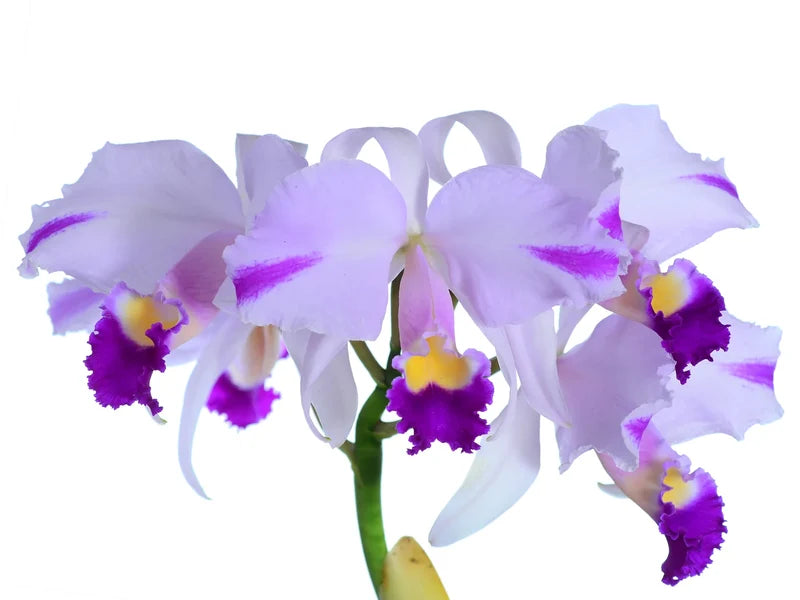
Cattleya trianae ‘Cuencanita’ × ‘Morlaquita Splash’ is a unique seedling hybrid within one of the best-known botanical Cattleya species. Both parents are selected clones of Cattleya trianae, and it is particularly the striking splash pattern of ‘Morlaquita Splash’ that makes this combination interesting.
The expected flowers combine a light, often white to soft pink base color with bold magenta to purplish-red accents. In well-marked specimens, the color of the lip appears to partially extend into the broad petals. This creates the characteristic splash effect: brushstroke-like streaks or patches of color that make the flower much more vibrant than a classically marked Cattleya trianae.
Because this is a cross between two parent clones and not a vegetatively propagated clone with its own name, each seedling is genetically unique. The final flower color, shape, and number of splash may therefore vary from plant to plant. It is precisely this uncertainty that makes the first bloom especially interesting for collectors.
Name and Parent Combination
The most accurate way to write the name of this plant is:
Cattleya trianae ‘Cuencanita’ × ‘Morlaquita Splash’
‘Cuencanita’ and ‘Morlaquita Splash’ are the names of the two selected parent clones. The offspring may not be designated individually by either of these clone names. Botanically, they still belong to the species Cattleya trianae, but they carry the characteristics of both parent lines.
The term ‘Splash’ refers to a floral pattern in which parts of the lip color are repeated on the two petals. This can range from narrow magenta streaks to broad patches of color. Not every seedling will display this characteristic with the same intensity. Some plants may produce nearly white flowers with distinct purple splashes, while others may turn a softer pink or develop a more subtle pattern.
The product photo therefore shows what this cross can produce, but does not guarantee the exact flower of every individual plant.
Origin
Cattleya trianae occurs naturally only in Colombia. There, the species grows as an epiphyte on trees in the Andes region, primarily on mid-elevation mountain slopes. There, the roots receive plenty of air, while rainwater quickly runs off the bark. The climate is humid, but not constantly hot or stifling.
The species has been Colombia’s national flower since 1936 and is known there as Flor de Mayo, among other names. The botanical name honors the Colombian botanist and naturalist José Jerónimo Triana.
The parent combination offered here is a hybrid created by humans and therefore has no natural range of its own. However, its growth habit and care requirements remain those of the botanical species Cattleya trianae.
Characteristics
This Cattleya has a sympodial growth habit. Sturdy, somewhat club-shaped pseudobulbs emerge successively from a short rhizome. Each mature pseudobulb typically bears a single thick, leathery leaf. As the plant ages, a cluster of new and older growth parts develops.
The pseudobulbs store water and nutrients. A slight wrinkling in a mature pseudobulb is therefore not necessarily a cause for concern, but severely shriveled pseudobulbs usually indicate dehydration or poorly functioning roots.
A protective flower sheath may form from the tip of a mature pseudobulb. After a period of dormancy, flower buds develop within this sheath. The large flowers typically open in light shades, with an intensely colored lip and a warm yellow to golden-yellow throat.
In offspring with a strong splash pattern, the magenta or purplish-red pigment also appears on the petals. The exact distribution varies from plant to plant. The width and undulation of the flower parts, the size of the lip, and the intensity of the color can also vary.
The flowers are usually pleasantly fragrant. The scent is often most noticeable during the day, when the plant is kept in a warm location and receives sufficient light. The intensity may vary by seedling and by flowering stage.
Care
Cattleya trianae ‘Cuencanita’ × ‘Morlaquita Splash’ is not extremely difficult, but it clearly requires more light and a more airy root environment than a standard Phalaenopsis. In particular, a dark location or a substrate that remains wet for long periods can severely limit growth and flowering.
Care follows a recognizable seasonal rhythm. While a new shoot and new roots are developing, the plant is watered and fertilized regularly. Once the new pseudobulb has matured, watering is gradually reduced. This quieter period helps the plant prepare for its next flowering.
Light
Provide this Cattleya with plenty of bright light. A bright windowsill facing east, west, or south is suitable, provided the plant is carefully acclimated to direct sunlight. Gentle morning and evening sun is generally well tolerated. On hot summer days, protect the leaves from intense midday sun by placing them behind a window.
The leaves should be medium green to light green. Very dark green leaves may sometimes look healthy, but in Cattleya orchids they often indicate insufficient light for reliable blooming. A slight reddish-purple discoloration along the leaf margin may be normal under strong lighting, as long as no pale or dry scorch marks develop.
Under grow lights, the plant should be placed in a spot that is noticeably brighter than for most Phalaenopsis species. Make sure to keep a sufficient distance from the light so that the leaves do not overheat.
Light is one of the most important conditions for flowering in this species. A plant that is growing well but hasn’t produced flowers for years is often simply not getting enough light.
Temperature
This Colombian species prefers moderate to warm conditions. During the day, temperatures of about 20 to 28 °C are suitable. At night, the temperature may drop to approximately 15 to 19 °C.
A difference of about 5 to 8 °C between day and night supports robust growth and can aid in flower bud formation. Avoid prolonged temperatures below about 13 to 15 °C, especially when the roots and growing medium are still wet.
On hot summer days, the plant can temporarily tolerate temperatures above 30 °C. In such cases, increase air circulation and check more frequently to ensure the roots do not remain dry for too long. Stagnant, hot air can quickly damage young shoots and tender root tips.
Substrate and Repotting
Use a coarse, airy orchid growing medium that drains quickly. Medium-coarse to coarse bark can be combined with charcoal, perlite, or pumice. In a dry living room, a small amount of loose sphagnum moss can be added, but the mixture should never become compacted or remain constantly wet.
Do not choose a pot that is unnecessarily large. Cattleya orchids generally grow better when the roots are relatively compact within the pot and the potting mix can dry out quickly after each watering. Leave only enough space for about one or two new shoots.
It is best to repot as soon as fresh root tips appear at the base of a new shoot. The plant can then quickly establish itself in the new growing medium. Repotting outside of this growth phase can lead to a prolonged growth stagnation, because damaged older roots do not always continue to branch out.
Place the oldest pseudobulbs close to the edge of the pot and leave more space free for the new direction of growth. Keep the rhizome and the base of the young shoots above the growing medium so that water cannot pool there.
An open basket or mounted growing method is also possible. In a typical living room, however, a pot is more practical, since a mounted plant requires very frequent watering during active growth.
Humidity and Ventilation
A humidity level of about 50 to 70 percent is usually sufficient. In a warm greenhouse or grow room, this level may be higher, as long as there is a constant, gentle air current.
Good ventilation helps young shoots, leaves, and flower buds dry off after watering. This reduces the risk of bacterial or fungal infections. Standing water in a young shoot, in particular, can quickly cause problems.
In a normal living room, extremely high humidity is not necessary. A bright, open location and proper watering are more important than daily misting. Do not place the plant in a closed decorative pot where water remains at the bottom.
Watering
Water generously while new shoots and roots are developing. Moisten the entire growing medium thoroughly and then allow the excess water to drain away completely. Do not water again until the growing medium is almost dry.
Wetting the substrate thoroughly and then allowing it to dry out quickly is safer than watering in small amounts repeatedly. With small amounts of water, the center of the substrate sometimes remains unevenly moist, while other roots receive hardly any water.
Preferably use rainwater, filtered water, or other water with low levels of dissolved minerals. If the tap water in your area is hard, salts may accumulate in the growing medium and on the roots over time.
Once the new pseudobulb has matured and growth slows down, the plant may be kept slightly drier. However, the dormant period is not intended to be months of complete dryness. Water sufficiently to prevent the pseudobulbs from shriveling severely.
Always adjust the frequency based on the temperature, Potsize, and drying time of the substrate. A fixed weekly schedule is less reliable for this species than actually checking the pot.
Fertilization
During active shoot and root growth, apply a diluted orchid fertilizer regularly. A quarter to half the recommended dose once every one to two weeks is usually sufficient.
Reduce fertilization once the new pseudobulb has matured and growth has come to a halt. During a pronounced dormant period, little or no fertilization is needed. Resume fertilization as soon as new root tips or a young shoot appear.
Rinse the substrate thoroughly with clean water from time to time. This removes any residual fertilizer salts, which can otherwise damage the young root tips.
Growth and Flowering Cycle
Cattleya trianae typically undergoes one distinct growth cycle per year. During the active growth period, the new shoot develops into a mature pseudobulb. A flower sheath may form at the top of this pseudobulb.
After the shoot matures, a quieter period usually follows. The flower buds then develop within the previously formed sheath. Under European conditions, flowering usually occurs in winter or early spring, although the exact timing may vary depending on the plant’s origin and growing conditions.
A flower sheath may initially appear empty but may later contain buds. Therefore, do not automatically remove a sheath that has become dry or papery. Carefully check to see if thickenings or flower buds are developing inside.
The flowers can reach a width of approximately 15 to 20 centimeters. A mature pseudobulb can bear one or more large flowers. Due to their size, fragrance, and high-contrast markings, even a few flowers can have a significant visual impact.
Expected Flower Variation
The parent combination was chosen for the flower quality and striking color distribution of the two clones. However, with a seedling cross, an exact replica of the example flower cannot be guaranteed.
Possible differences include:
- a white, cream-colored, or soft pink base color;
- narrower or wider magenta splashes on the petals;
- a nearly symmetrical or, conversely, irregular splash pattern;
- a deep purplish-red, raspberry-red, or magenta lip;
- a more or less visible yellow throat;
- differences in flower size, shape, ruffling, and fragrance intensity.
A plant with fewer splash is no less botanically genuine. For a collector who desires an exact color pattern, a vegetatively propagated and already selected clone is more suitable. This hybrid is specifically intended for someone who appreciates the unique outcome of a plant’s first bloom.
Care Level
This plant requires a moderate level of care. For someone who already has experience with Cattleya orchids or other orchids grown in a well-aerated medium, caring for it is quite straightforward. The most important considerations are sufficient light, a rapid wet-dry cycle around the roots, and recognizing when the plant is actively growing.
The plants offered here are imported, and their roots are still developing. Therefore, after receiving the plant, place it in a stable, warm, and well-lit location. Do not repot immediately if the current growing medium is still sufficiently airy. It is best to wait until new root tips become visible.
Depending on the product variant selected, the plant is delivered as Blooming or non-Blooming. After the change in environment, a non-flowering plant may first direct its energy toward growing new roots and a new shoot. As a result, the first bloom with the new owner may not appear immediately in the following season.
Who is this plant suitable for?
This hybrid is particularly well-suited for enthusiasts of botanical Cattleya orchids who are looking for more than just a standard pink flower. The combination of a classic, large-flowered variety with a potential splash pattern gives each plant its own collectible value.
It’s also an attractive choice for anyone who likes to experience the first bloom as a surprise. Each seedling can display a different balance of white, pink, magenta, and purple hues.
The plant is less suitable for a dark windowsill or for someone who prefers to keep an orchid slightly moist at all times. Additionally, you should consider the size of a mature unifoliate Cattleya and the space the flowers need to fully open.
Growing Experience at Home or in a Greenhouse
Indoors, this Cattleya does best near a bright window. An east- or west-facing windowsill is often practical. If placed near a south-facing window, light shading may be necessary during the hottest months.
Keep plenty of space clear around the plant. New shoots grow sideways from the rhizome, and large flowers can become significantly wider than the pot. Therefore, do not place the plant permanently among densely packed foliage plants.
In a moderately warm greenhouse, this species benefits from plenty of filtered light, higher humidity, and constant air circulation. There, a well-established plant can develop into a lush cluster with multiple pseudobulbs ready to bloom.
This Cattleya is less suitable for a closed terrarium. Its mature size, need for plenty of light, and the requirement to allow the roots to dry out periodically are better suited to an open planting area, conservatory, greenhouse, or sunny windowsill.
Additional Care Tip
Pay special attention to when new root tips appear at the base of a young shoot. This is the most critical phase for watering, fertilizing, and, if necessary, repotting. A new shoot without a well-developed root system can grow using the reserves of the older pseudobulbs, but will ultimately mature less vigorously.
Do not cut away older green pseudobulbs, even if they no longer have leaves. They store water and nutrients, thereby supporting the formation of new shoots and flowers.
Short product description
Cattleya trianae ‘Cuencanita’ × ‘Morlaquita Splash’ is a unique hybrid between two selected clones of Colombia’s national flower. The large, fragrant flowers combine a light base color with an intense magenta to purplish-pink lip and striking splash markings on the petals. Each seedling is genetically unique, so the exact flower color and markings may vary from plant to plant.