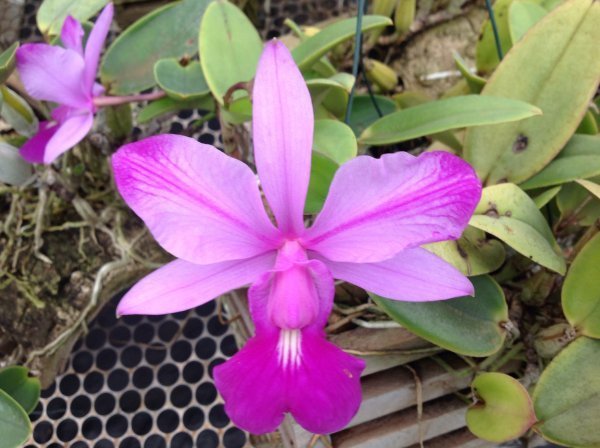
Cattleya walkeriana does not quite follow the typical Cattleya pattern. While most species produce their flower spike from the top of a mature pseudobulb, this Brazilian species can form a short, virtually leafless flowering shoot directly from the rhizome. As a result, the large flowers appear to float almost freely above the compact plant.
In this seedling hybrid, two different ‘flamea’ parents were crossed. “Flamea” refers to the darker, flame-like color patches that run from the tips across the petals. Against a lighter pink to lavender-colored background, this can make the flower look as if it were painted with broad brushstrokes. The lip usually adds a deeper purple-pink center and a light to yellowish throat.
Because this is a cross between two individual plants, each seedling is genetically unique. The first bloom may show subtle lines, develop broad magenta patches, or be closer in color to one of the parents. Flower shape, color intensity, and the exact distribution of the flamea pattern may also vary. The flower photo therefore illustrates the direction in which this cross was selected and does not constitute an exact guarantee for every plant.
Compact plant, strikingly large flower
Cattleya walkeriana remains relatively small. The short pseudobulbs usually bear one or two sturdy leaves, while a mature flowering spike typically produces one or two flowers. These flowers can grow to about ten centimeters wide and thus appear strikingly large next to the plant itself. The sturdy flower structure ensures that a well-developed flower often remains attractive for several weeks.
In addition, the species is known for its sweet, distinctly perceptible fragrance. The intensity may vary from seedling to seedling and throughout the day. Combined with its compact growth habit, broad flower shape, and unpredictable flamea pattern, this makes the hybrid particularly interesting for collectors who enjoy growing their plants until they produce their first bloom.
Origin
Cattleya walkeriana is a botanical species native to west-central and southeastern Brazil. There, it grows as an epiphyte on trees and as a lithophyte on rocks in areas with a distinct difference between wetter growing periods and a drier season. The sturdy leaves and pseudobulbs help the plant tolerate temporary drought and intense light.
This origin explains the most important requirements for cultivation: plenty of light, warmth, a very well-aerated root environment, and a clear rhythm between thorough watering and allowing the soil to dry out again.
Care
Place this Cattleya in a very bright spot with bright, filtered sunlight. An east- or west-facing window is suitable; for a south-facing window, protection from the harshest midday summer sun is advisable. Insufficient light can easily result in dark green growth without flowers. Be sure to gradually acclimate the plant to a brighter spot, as leaves coming from a shaded greenhouse can get scorched in direct sunlight.
A daytime temperature of about 20 to 28 °C and a nighttime temperature of 15 to 20 °C are ideal for this species. On hot days, air circulation and sufficient humidity are important. Cold, wet roots are poorly tolerated.
Use a small pot or basket filled with coarse, fast-draining bark mulch. Cultivation on cork or other wood is also possible with higher humidity and frequent watering. The roots require plenty of oxygen and should not be left standing for long in a compacted, wet mixture after watering.
Water thoroughly during the formation of new shoots and fresh root tips, then allow the pot to dry out almost completely. Once growth has matured and root activity slows, gradually reduce watering. The plant may then be kept drier, though the pseudobulbs should not be allowed to shrivel severely for extended periods. A consistently wet winter growing period poses a greater risk of root loss than a controlled dry period.
During active growth, a weak solution of orchid fertilizer can be applied regularly. Reduce fertilization when growth stops. Repot preferably as soon as a new shoot begins to form fresh root tips; damaged Walkeriana roots recover quite slowly outside of this phase.
After receiving the plant, allow it to acclimate for a few days first and do not automatically water it right away. First check whether the substrate inside the pot has dried out sufficiently.
Why this hybrid?
A standard Cattleya is often purchased for a flower that is already set. With Cattleya walkeriana (flamea I × flamea II), the appeal lies precisely in the first, as-yet-unknown bloom. Two selected flamea parents increase the likelihood of distinct magenta markings, but each seedling creates its own version of these.
This makes it a plant for the collector who appreciates not only the final result but also the journey toward it. Its compact growth also makes it easier to house than many large-flowered Cattleya varieties, while the flowers are hardly inferior in appearance to larger species.
Short product description
Cattleya walkeriana (flamea I × flamea II) is a compact Brazilian species orchid derived from two selected flamea parents. Future flowers may range in color from pink to lavender with dark magenta brushstrokes across the petals, a striking lip, and the characteristic sweet fragrance of Cattleya walkeriana. Each seedling is unique, making the first bloom a true discovery.