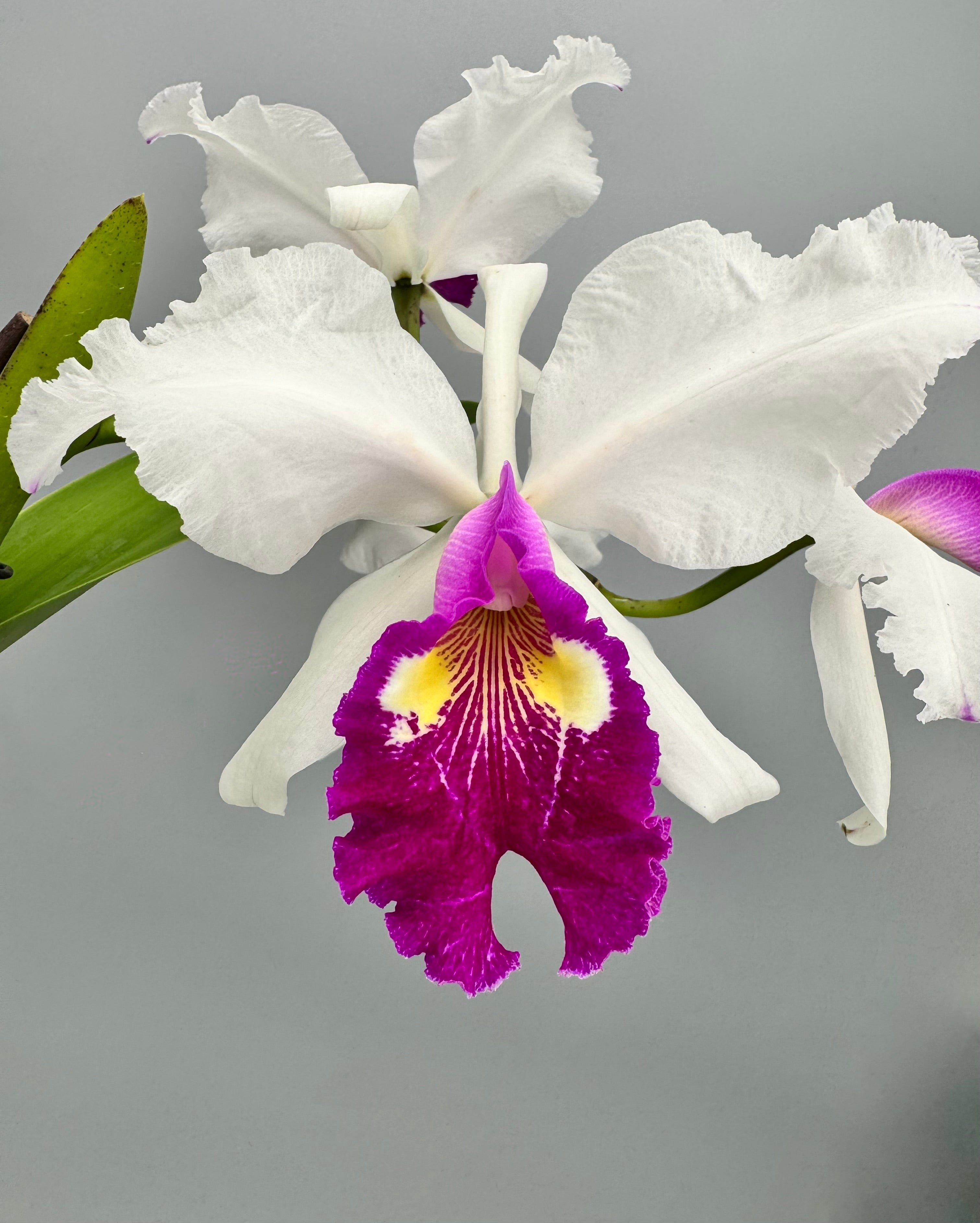
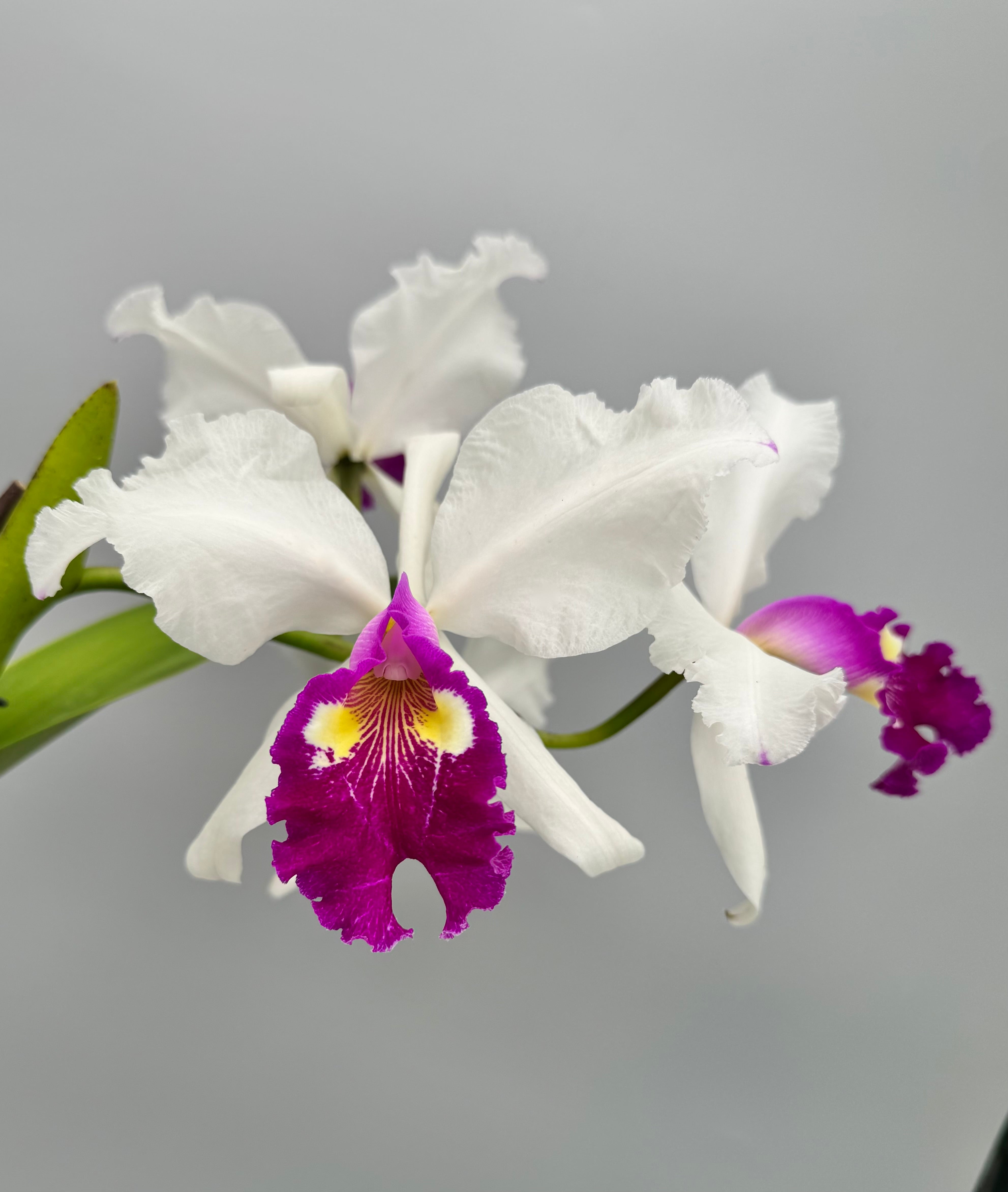
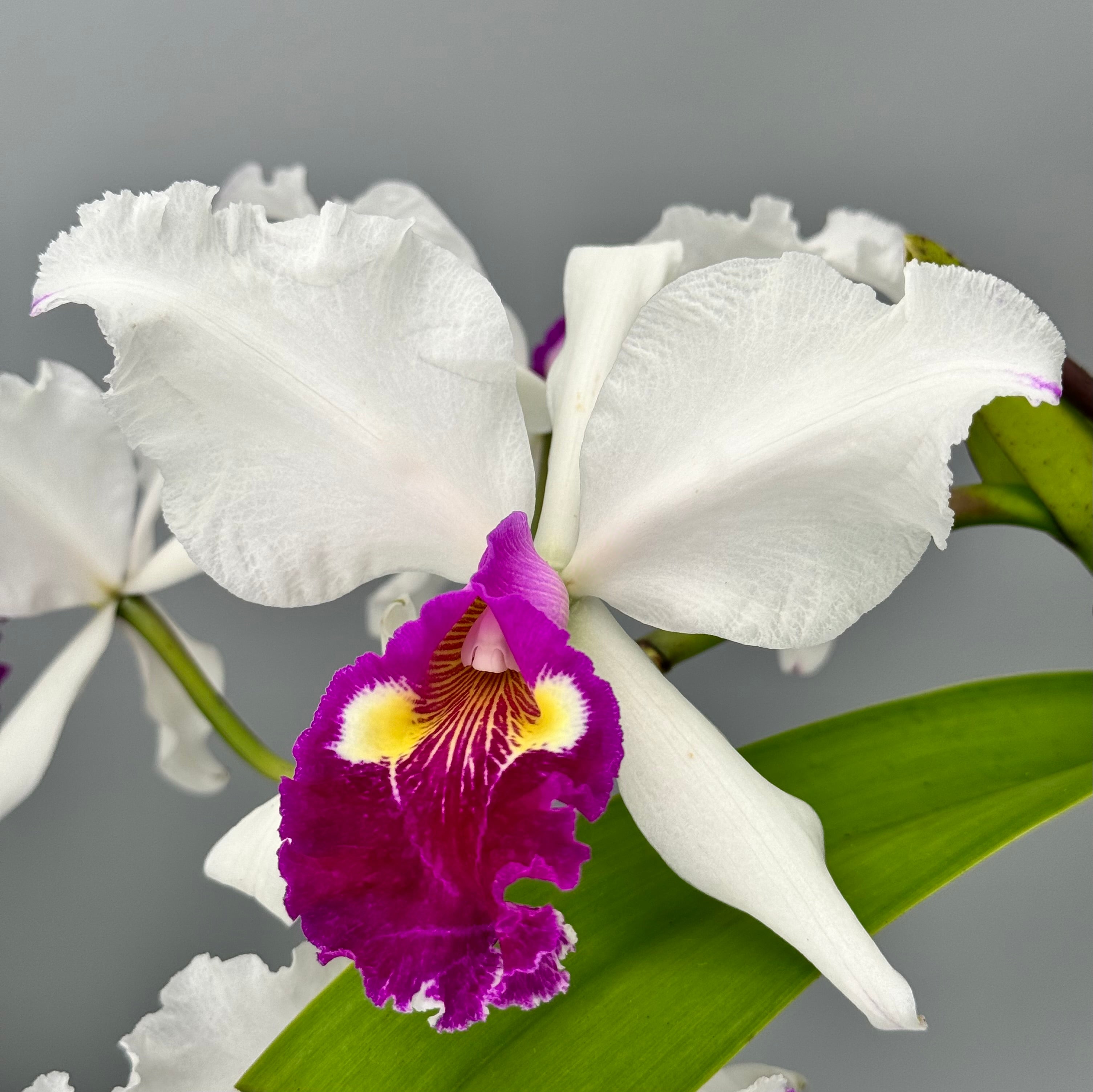
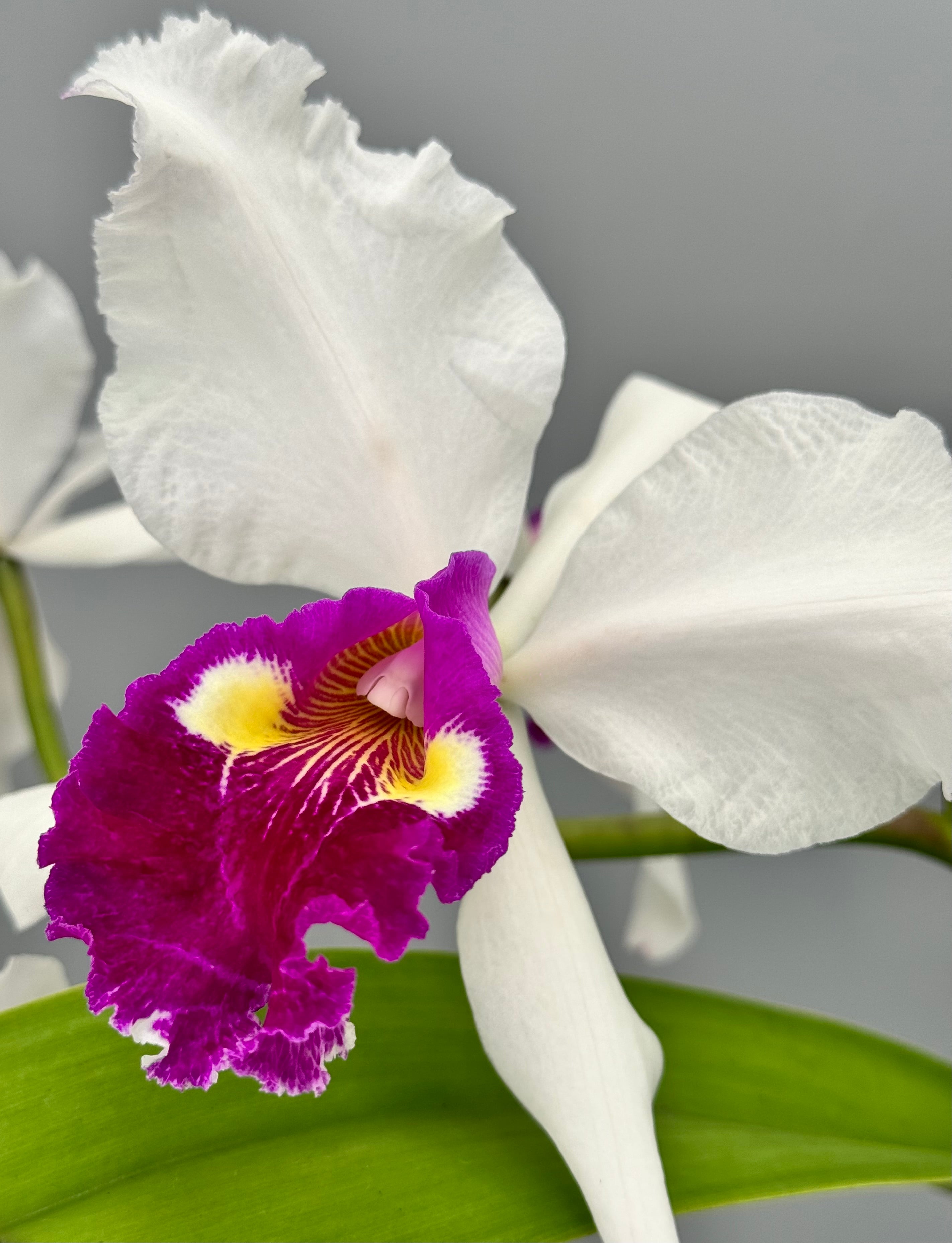
In the Cattleya warscewiczii semi-alba ‘Bedford’, the white is not used to make the flower appear subdued. Instead, the nearly white sepals and broad petals form a blank canvas against which the intense purple-pink lip commands all the attention. Two yellow-marked patches in the throat enhance that contrast and give the flower the characteristic, almost watchful gaze for which Cattleya warscewiczii is known among collectors.
‘Bedford’ is a selected clone and not a seedling cross. As a result, the character of the future flower is much more clearly defined: a classic semi-alba pattern, large light-colored flower segments, and a richly colored lip. Light, temperature, and the vigor of the plant can still influence color intensity and flower form, but the bloom is much more predictable than with a genetically unique seedling.
The designation BM/JOGA refers to the Bronze Medal this clone received from the Japan Orchid Growers Association. It is thus an officially evaluated selection within a species that, even without this award, is already among the most impressive large-flowered Cattleya orchids.
The old name ‘gigas’ still applies
Cattleya warscewiczii was also formerly offered as Cattleya gigas. That name is now a botanical synonym, but it still aptly describes its appearance. A robust mature plant forms tall, firmly grooved pseudobulbs, each ending in a single large leaf. A flower spike bearing several exceptionally large flowers may then emerge from the sheath.
Under good conditions, the individual flowers can reach well over twenty centimeters in width. Wide, slightly wavy petals give the flower volume, while the large, velvety lip adds depth. In ‘Bedford,’ this size is particularly noticeable due to the bright semi-alba coloration.
The fragrance is also part of the presentation. The flowers emit a pleasant, sweet Cattleya scent, the intensity of which can vary with temperature, light, and the time of day. In a mature plant with multiple flowers, this scent can be distinctly noticeable in the room.
Origin
Cattleya warscewiczii is a botanical species found exclusively in the wild in Colombia. There, it grows as an epiphyte on trees in the humid forests of the Andes region, at elevations ranging from approximately 300 to 1,600 meters. During the growing season, the roots receive regular water, but due to their exposed position, they also dry out quickly.
The combination of humid growing conditions, plenty of air around the roots, and a noticeable drop in nighttime temperature forms the basis for its care. Although the plant tolerates warmer days, it is not a lowland species that thrives in constantly hot and muggy conditions.
Care
Place this Cattleya in a very bright spot with strong, filtered sunlight. An east- or west-facing window is suitable; a slightly shaded south-facing window can also work well. If light is insufficient, the new pseudobulbs often become long and weak, and flowering will not occur. The leaves may be medium green and do not need to retain the dark green color of a shade-loving plant.
A daytime temperature of about 21 to 29 °C and a nighttime temperature of 15 to 20 °C provide a good foundation. A clear difference between day and night supports the development of robust growth and flowers. During hot summer days, extra air circulation, humidity, and light protection from the midday sun are important.
Use a relatively small pot filled with coarse, fast-draining bark, possibly combined with perlite, pumice, or charcoal. The thick roots require plenty of oxygen. A large pot or a fine, dense growing medium will remain wet for too long around the center of the root ball, increasing the risk of root loss.
While a new shoot and active roots are developing, the plant may be watered generously. Allow the growing medium to dry out thoroughly before watering again. The pseudobulbs must be able to fill out completely during this period, because weak or prematurely stunted growth will prevent them from supporting a large flower spike later on.
During active growth, apply a mild orchid fertilizer regularly. As soon as the pseudobulb has matured and growth slows down, reduce both watering and fertilization. Keep the plant slightly drier at this time, without allowing the pseudobulbs to shrivel severely for extended periods. Cattleya warscewiczii does not need to remain completely dry for months after the growth phase.
Repot only at the right time
For this species, the timing of repotting is more important than a fixed schedule. Cattleya warscewiczii develops new roots during a clearly defined growth phase. If the existing roots are damaged outside of that period, it can take a long time for the plant to re-establish itself in the substrate.
Therefore, repot only when fresh root tips appear at the base of new growth. Do not wait until these roots are already long, as the delicate growth tips can easily break off during repotting. If the current potting mix is still loose and healthy, it is better to leave the plant undisturbed.
After receiving the plant, let it acclimate for a few days first and do not automatically water it right away. First, check how much moisture is still present inside the pot. Repot a newly received plant only when it is truly necessary and active new roots are visible.
Why this clone?
With many Cattleya orchids, size is achieved through complex hybridization. ‘Bedford’ demonstrates just how much scale and contrast can exist within a single botanical species. The light-colored flower segments immediately highlight the flower’s size, while all the color remains concentrated in the lip.
Furthermore, this plant is a named and award-winning clone. The combination of botanical origin, a recognizable semi-alba flower, fragrance, and exceptional size makes it appealing to a collector who wishes to grow a documented selection and can provide the necessary space and care for it.
Please note that Cattleya warscewiczii does not remain a compact windowsill variety. A mature plant develops tall pseudobulbs, broad leaves, and a flower spike that requires ample space. It is precisely when given that space that ‘Bedford’ can grow into the impressive specimen for which this clone was selected.
Short product description
Cattleya warscewiczii semi-alba ‘Bedford’ BM/JOGA is an award-winning Colombian species orchid with exceptionally large, nearly white flowers and a striking purple-pink lip with yellow accents. The sweet fragrance, monumental flower form, and distinctive semi-alba pattern make this clone a special choice for the experienced Cattleya collector. Provide the plant with plenty of filtered light, a well-aerated growing medium, and ample water during active growth, allowing the roots to dry out between waterings.