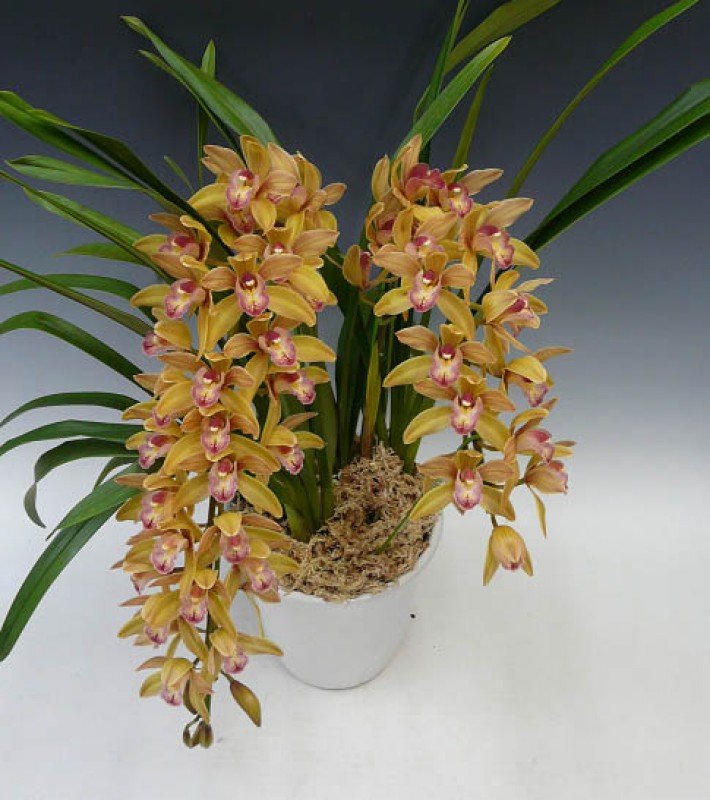
Cymbidium Joan Taylor ‘Million Kiss’ is a profusely flowering Cymbidium with long, overhanging flower stems full of copper-yellow to bronze-colored flowers. The pink to wine-red lip adds a warm splash of color to each flower. Its cascading blooms are shown to their best advantage, especially on a raised standard or in a hanging basket.
‘Million Kiss’ is a selected cultivar within the registered grex Cymbidium Joan Taylor. The plant is not primarily chosen for its fragrance, but for its large number of flowers, its distinctive earth tones, and its strongly trailing inflorescence.
Origin
Cymbidium Joan Taylor is a hybrid created by crossing Cymbidium Touchstone and Cymbidium Cariga. The grex was registered by Santa Barbara in 1991. ‘Million Kiss’ is a selected specimen with a distinctive flower color and profusely blooming, pendulous flower stems.
Cymbidium devonianum plays an important role in its further lineage. This botanical species, native to cool Asian mountain forests, is known for its long, hanging clusters of many relatively small flowers. This explains why “Million Kiss” blooms distinctly differently from the well-known large-flowered Cymbidiums with upright stems.
Characteristics
The plant grows sympodially and forms sturdy pseudobulbs with long, strap-shaped leaves. New shoots emerge annually from the base and develop into mature pseudobulbs during the spring and summer.
The flower spikes grow in an arched to fully pendulous manner and can bear dozens of flowers. The flowers are smaller than those of standard Cymbidiums but appear in much greater numbers. Their color ranges from warm yellow and caramel to copper-bronze. The lip is marked with shades of cream, pink, and wine red.
The flowers are sturdy in structure and can remain beautiful for several weeks in cool conditions. A distinct fragrance is usually not or barely noticeable.
Although the flowers are smaller, the plant itself is not a miniature. A mature specimen eventually forms a broad cluster of pseudobulbs and requires space both above and below the pot.
Care
Cymbidium Joan Taylor ‘Million Kiss’ requires plenty of light, ample water and nutrients during the growing season, and, above all, cool nights in late summer and fall. The plant often grows without problems in a warm room, but without a cooler period, it will not always bloom again.
The seasonal rhythm therefore determines the difference between just healthy foliage and a mature plant with multiple flowering stems.
Light
Place this Cymbidium in a very bright spot. The plant clearly needs more light than a Phalaenopsis. A few hours of direct morning or evening sun are beneficial. Protect the leaves from the scorching midday sun on hot summer days.
From late spring through early fall, the plant can be placed outdoors in a sheltered spot with filtered sun. Allow it to gradually acclimate to the higher light levels to prevent leaf burn.
Healthy foliage is bright medium green to light green. Very dark green foliage usually indicates insufficient light and is often accompanied by a lack of flowering.
Temperature
During active growth, temperatures of approximately 18 to 26 °C are suitable. Short-term heat up to about 30 °C is tolerated if the plant receives sufficient water, shade, and air circulation.
Cool nights are important for the formation of flower stalks. At the end of summer and in the fall, provide the plant with nighttime temperatures of approximately 8 to 13 °C for several weeks. In the Netherlands and neighboring countries, this often happens naturally when the plant remains outdoors.
Bring the plant indoors before prolonged temperatures below about 5 °C or night frost are expected. During flowering, the flowers stay beautiful the longest at about 12 to 18 °C.
Potting Mix and Growing Method
Use a well-aerated but clearly moisture-retaining Cymbidium growing medium. A mixture of fine to medium-coarse, composted tree bark with coconut fiber, perlite, and possibly some chopped sphagnum moss is suitable. Pure sphagnum moss can also work well if it is applied loosely and watering is adjusted accordingly.
The substrate should not dry out completely too quickly during active growth. A very coarse Cattleya mix often lacks sufficient moisture retention under average indoor conditions. At the same time, do not use heavy, compact potting soil: the thick Cymbidium roots also need oxygen and cannot tolerate a root ball that remains waterlogged for long periods.
A standard, sturdy plastic pot is suitable. During flowering, place it on a raised stand or in an elegant hanging structure so that the downward-growing flower spikes can hang freely. A very open basket is only practical if you can water the plant frequently enough.
Do not repot immediately after purchase if the existing potting mix is still fresh and the roots are growing healthily. Cymbidiums respond better when their root system is disturbed as little as possible. Generally, repot every two to three years, preferably immediately after flowering and as soon as new growth begins to form roots. Do not divide a large plant unnecessarily; mature clumps with multiple pseudobulbs grow more vigorously and bloom more profusely.
Humidity
A humidity level of about 40 to 60 percent is usually sufficient. During hot summer days, the humidity may be higher, provided there is good air circulation.
Ventilation is also important during flowering. Cool, stagnant, and humid air can cause small brown Botrytis spots on the flowers. Therefore, avoid wetting the flowers and ensure that the leaves and young shoots dry off before nightfall.
Watering
Water generously during the active growth period in spring and summer. The growing medium should remain evenly moist, but excess water must be able to drain away immediately.
Once the new pseudobulbs have matured by the end of summer, watering can be gradually reduced. During the cooler months, allow the potting mix to dry out slightly before watering again, but do not let the thick roots and pseudobulbs dry out completely for extended periods.
Severely shriveled pseudobulbs may indicate insufficient water or damaged roots. Preferably use rainwater, and never leave the pot standing in a pool of water.
Fertilization
During their growing season, Cymbidiums require more fertilizer than many epiphytic orchids. From spring through summer, apply a low- to medium-strength dose of orchid fertilizer every one to two weeks.
A slightly nitrogen-rich fertilizer supports the formation of new shoots in the spring. Starting in the second half of summer, switch to a balanced fertilizer and gradually reduce the dosage.
During the cool winter months, little to no fertilizer is needed. Rinse the growing medium regularly with clean water to remove accumulated fertilizer salts.
Flowering
Cymbidium Joan Taylor ‘Million Kiss’ typically blooms from late winter through spring. The exact timing depends on the temperature, the maturation of the new pseudobulbs, and the time at which the flower spikes were formed.
Flower spikes emerge from the base of a mature pseudobulb. A young flower spike is usually rounder and blunter than a new leaf shoot, which is flatter and tapers to a point.
Place the pot on a raised surface as soon as a flower spike becomes visible. Do not try to force the stem upward: the natural beauty of this cultivar lies precisely in its cascading flowers. Rotate the plant as little as possible while the stem is developing, as the flower spike will naturally orient itself toward the light.
After flowering, cut the stem off at the base. Old green pseudobulbs should be left intact, as they store reserves and support the next growth cycle.
Care Level
Cymbidium Joan Taylor ‘Million Kiss’ has a moderate care level. The plant itself is robust and generally grows easily with sufficient water and nutrients. Encouraging it to bloom again requires more attention.
In particular, an overly warm fall and a location that’s too dark can cause the plant to produce only new leaves. If you can place the Cymbidium outdoors in the summer and expose it to cool nights in the fall, you’ll have a much better chance of getting it to bloom every year.
Who is this plant suitable for?
This cultivar is ideal for enthusiasts of profusely flowering Cymbidiums, trailing flower spikes, and warm bronze and caramel hues. The historic grex, the influence of Cymbidium devonianum, and the large number of flowers give “Million Kiss” clear collector’s value.
The plant is best suited for someone with a garden, balcony, cool conservatory, unheated room, or temperate greenhouse. For a dark, permanently heated living room without the possibility of a cool fall period, this Cymbidium is less suitable.
If you’re primarily looking for a compact plant or a strongly scented orchid, you’re better off choosing a different variety. “Million Kiss” requires space, but rewards you with exceptionally full, drooping blooms.
Growing Experience in the Home, Conservatory, or Greenhouse
In a cool conservatory or temperate greenhouse, Cymbidium Joan Taylor ‘Million Kiss’ will bloom again most easily. There, the plant receives plenty of light and experiences a natural difference between day and night temperatures.
Indoors, a very bright, unheated room, hallway, or windowsill is suitable. Keep the flowering plant away from radiators; warm, dry air shortens the flowering period and can cause buds to dry out.
During the summer, the plant can be placed outdoors in a sheltered, sunny spot. Check it regularly for snails, which are particularly attracted to young shoots and root tips.
The Potsize offered, which is 14 centimeters tall, does not mean the plant will remain compact. Mature plants can form a broad clump of leaves, and the trailing flower stems require extra space beneath the pot. This Cymbidium is not suitable for a terrarium or small plant cabinet.
Extra care tip
Place the pot on a raised stand as soon as you notice a flowering stem. If the stem first grows over a windowsill, table, or other plants, it will be difficult to move later without breaking it or causing an unnatural bend. Allow the flowering stem to develop freely downward from the start.
Short product description
Cymbidium Joan Taylor ‘Million Kiss’ is a profusely flowering cultivar with long, hanging clusters full of copper-yellow to bronze-colored flowers and pink-wine-red lips. A special Cymbidium for a bright spot, with cool fall nights and plenty of space beneath the pot.