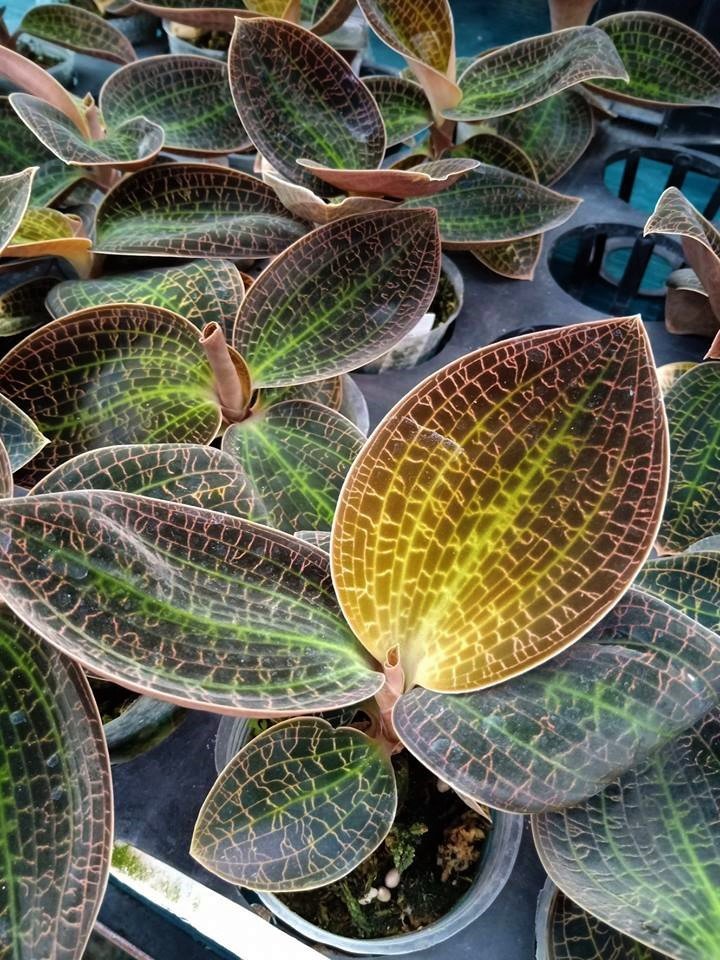
The Dossinia marmorata is a true gem of an orchid that you’ll choose primarily for its foliage. Instead of large flowers, this species impresses with velvety leaves and a striking network of golden veins. It is a compact, terrestrial orchid that thrives best in a stable, humid microclimate such as a terrarium or a closed-top grow box.
Origin
Dossinia marmorata is endemic to Borneo, where it grows on the sheltered forest floor in the warm, humid rainforest. In the wild, the plant is constantly bathed in filtered light, with a light layer of humus-rich organic material on top of the soil, where the roots never dry out completely.
Characteristics
This species forms a low rosette with sturdy, velvety leaves that can appear copper to olive green, depending on light and location. The veins stand out clearly in a golden pattern that becomes increasingly contrasting under stable conditions. In our plants, the leaf length currently averages about 3 to 5 cm, measured from the base to the tip. This is because they are still at a relatively young stage. As the plant continues to grow and remains in a stable environment for an extended period, the leaves generally become larger and more fully patterned. Minor variations in leaf color and pattern are normal and are part of the natural character of jewel orchids.
Care
Light
This Dossinia prefers soft, indirect light. A spot with light similar to “shade in a greenhouse” is ideal. Too much light can cause the leaves to lighten more quickly and may dull the velvety texture, while too little light noticeably slows growth.
Temperature
A stable, warm temperature works best, roughly between 20 and 27 °C. Avoid cold drafts and prolonged periods of lower temperatures, as this can halt growth and increase the risk of root problems.
Substrate
Choose an airy, organic, and fine substrate that retains moisture without becoming waterlogged. A mix containing, for example, fine bark material and high-quality sphagnum, possibly supplemented with fibrous organic components, closely matches the plant’s natural growth habits. It is important that oxygen can always reach the roots.
Humidity
Higher humidity is clearly beneficial, preferably 60 to 80 percent. In a terrarium or enclosed container, the foliage stays more attractive, growth is more even, and the plant recovers more quickly from being moved.
Watering
Keep the substrate slightly moist, but avoid letting the plant stand in water for long periods. Preferably, let the top layer dry out slightly for a short time and then water again with a small amount. Preferably use demineralized water or other soft water, as jewel orchids can be sensitive to salt buildup.
Fertilizing
Fertilize sparingly during the growing season. A low dose of orchid fertilizer usually works best, as over-fertilization can stress the roots and make the leaves less attractive.
Repotting
Avoid repotting too often. As soon as the substrate visibly sags, starts to smell sour, or remains wet for an extended period, it’s time to refresh it. Work gently, as the roots are relatively delicate and prefer stability.
Flowering
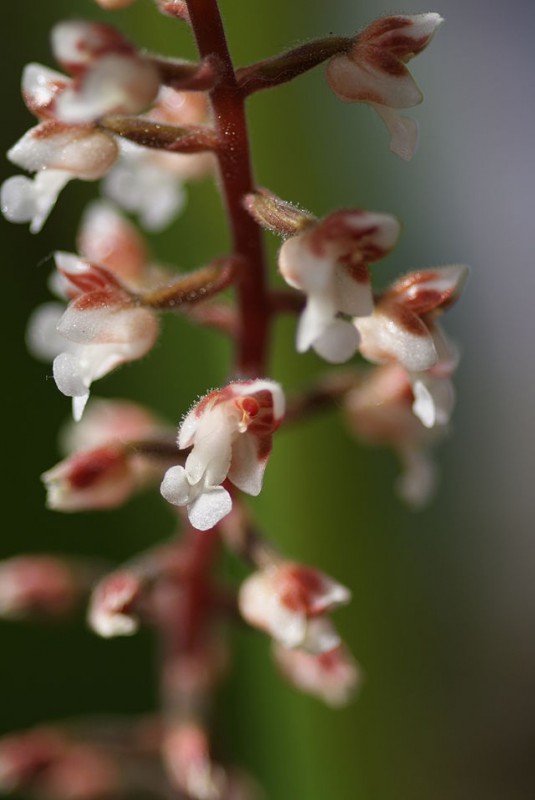
Flowering is usually modest and often occurs on a somewhat longer flower stalk with small, light-colored flowers. Many enthusiasts choose to remove the flower stalk when the plant is still young, so that energy is directed primarily toward root and leaf growth. Once the plant is mature and stable, you can let the flowers bloom as a nice bonus.