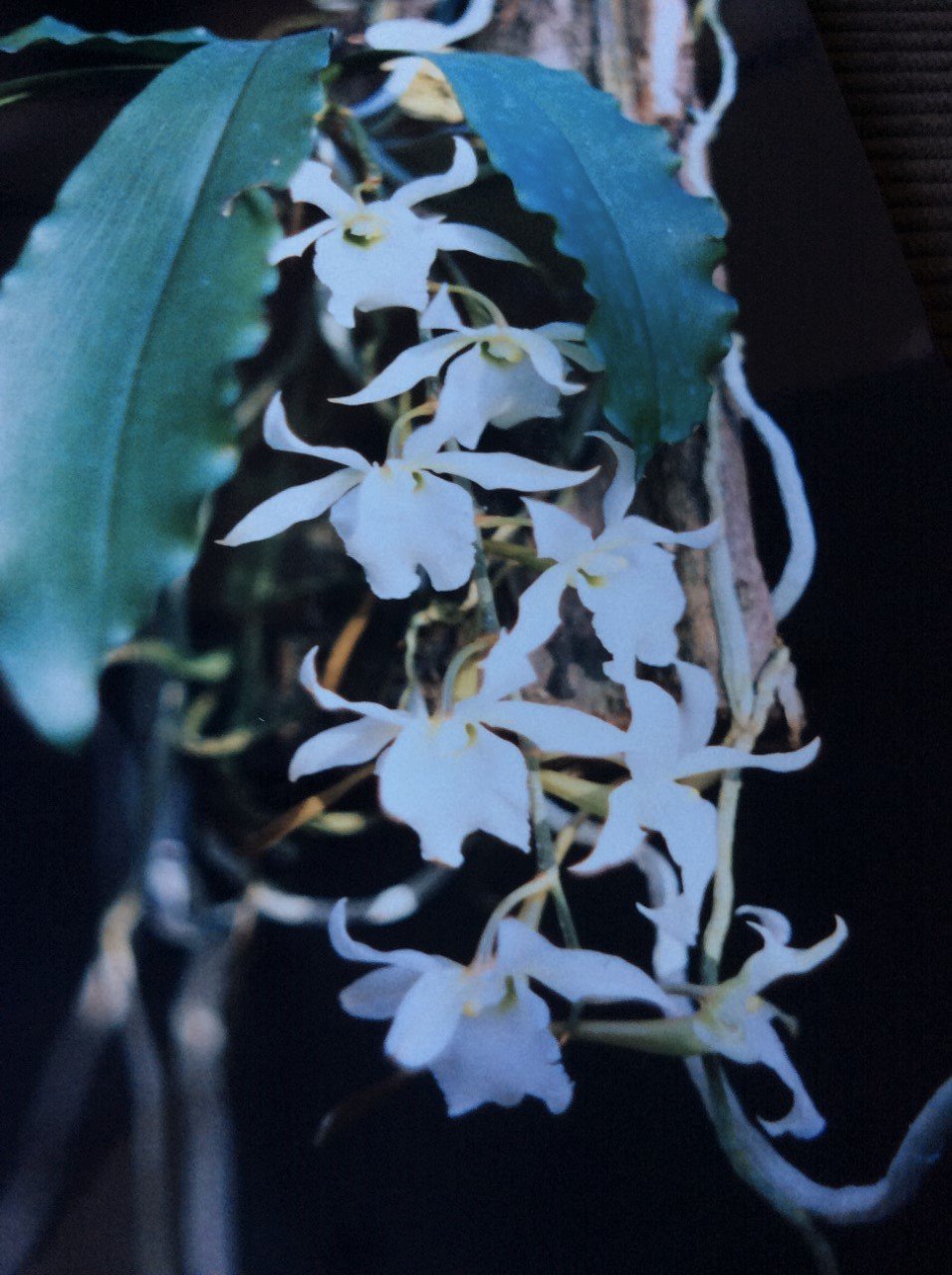
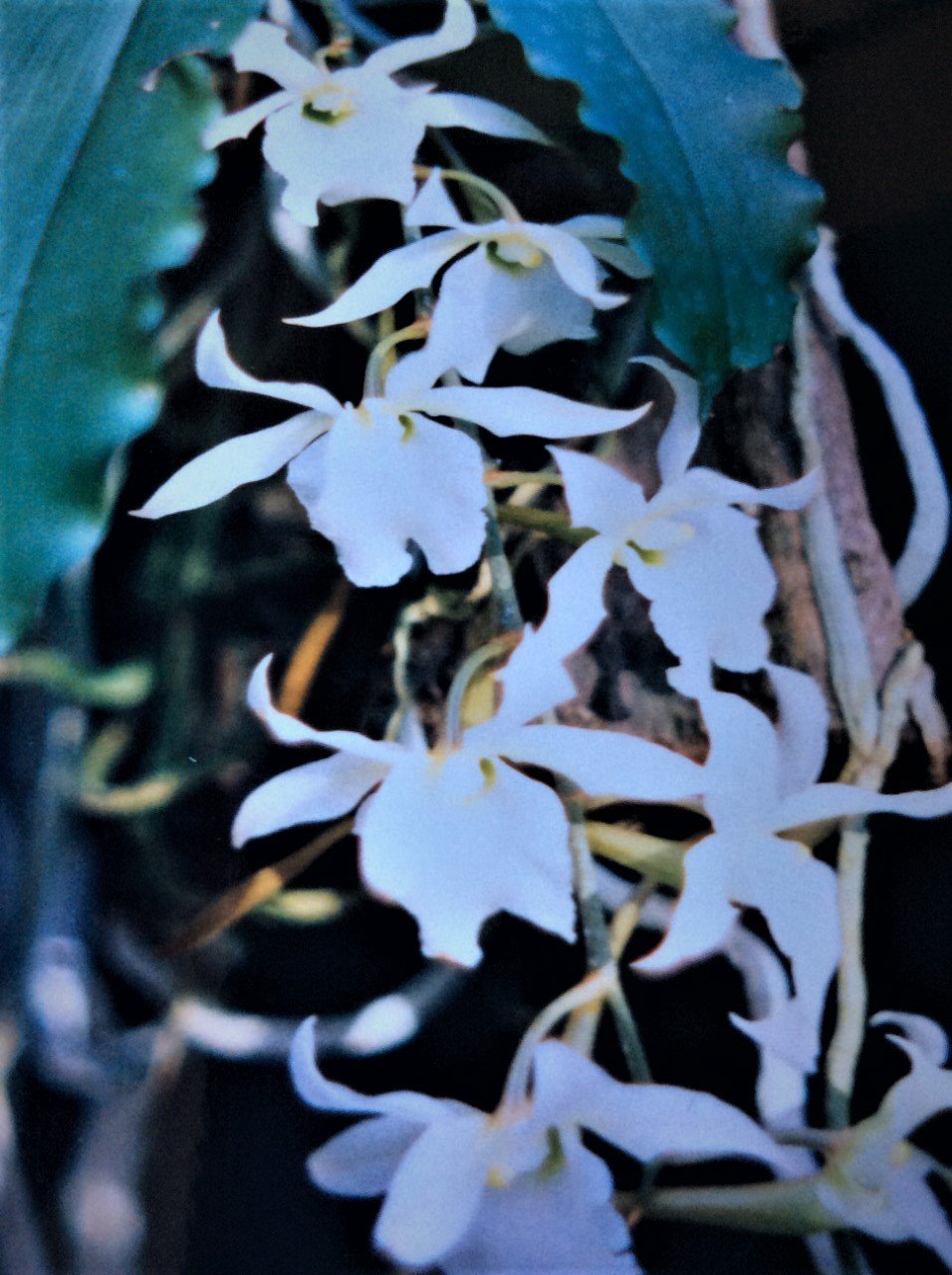
Eurychone rothschildiana is a compact botanical orchid native to tropical Africa with flowers that are strikingly large in proportion to the plant. Above the dark green foliage, white-green, somewhat translucent flowers appear, featuring a broad, funnel-shaped lip. The color transitions from the green center to a deep chestnut-brown to purplish-brown throat, giving each flower a striking sense of depth.
In addition to its distinctive flower shape, this species is known for a pleasant, sweet-spicy fragrance that is often more noticeable later in the day and in the evening. Due to its compact size, pendulous inflorescence, and large flower size, this is a distinct collector’s orchid suitable for a warm greenhouse, display case, or well-ventilated orchidarium.
Name and Taxonomy
Eurychone rothschildiana is the accepted botanical name. The species was originally described as Angraecum rothschildianum and can still be found under that older name in orchid literature and collections.
In 1918, the species was placed in the genus Eurychone. This small African genus comprises only two accepted species: Eurychone rothschildiana and Eurychone galeandrae. The name Eurychone refers to the flower’s strikingly broad, funnel-shaped lip. This distinguishes the genus from many related African orchids within the Angraecum group.
The fact that this is one of only two Eurychone species, combined with its limited availability in cultivation, enhances its botanical and collector’s value.
Origin
This orchid has a broad but scattered natural range in tropical West and Central Africa, extending as far as Uganda. The species is known from Guinea, Sierra Leone, Liberia, Côte d’Ivoire, Ghana, Nigeria, Togo, Gabon, the Democratic Republic of the Congo, and Uganda, among other places.
There, it grows epiphytically in shaded, moist, evergreen forests, sometimes near small watercourses. The plants are found up to an elevation of approximately 1,200 meters. Despite its tropical origin, Eurychone rothschildiana does not thrive best in extreme heat. Moderately warm days, cooler nights, high humidity, and constantly moving air better match its natural conditions.
The roots attach themselves to tree bark and receive regular water during the rainy season. However, thanks to their epiphytic position, they do not remain wet for long periods. It is precisely this alternation between thorough watering and rapidly circulating air around the roots that is key to successful care.
Characteristics
Eurychone rothschildiana grows monopodially from a single central growth point. The short stem bears two rows of broad, leathery leaves, giving the plant a somewhat compact appearance at first glance. The leaves are medium to dark green and often have a slightly wavy margin. The leaf tip is irregularly bilobed, a distinctive characteristic of this type of African orchid.
The central stem usually remains short. Mature plants, however, can develop several broad leaves that are considerably larger than the young plant initially suggests. Nevertheless, the species remains easy to care for and takes up very little space, especially in height.
The roots are relatively sturdy and covered with a moisture-absorbing velamen layer. Healthy, active root tips are green and smooth, while older, dry root sections may appear silver-gray. Because the plant does not form pseudobulbs in which water is stored for long periods, it must not be allowed to remain dry for weeks during active growth.
The plants offered are at a Adolescent stage. They were recently imported, then acclimated at Claessen, and are showing active root growth. These are therefore plants that are already well-developed but can still grow further before reaching their maximum flowering potential.
Care
This species requires a careful balance between moisture and air. High humidity alone is not sufficient. If the roots remain constantly wet or the air around the growing point becomes stagnant, root and crown problems may arise.
Upon receipt, it is best to maintain the existing growing conditions for the time being. A plant with active root tips does not need to be repotted or re-staked immediately. Provide it with a stable location and wait until growth is visibly continuing before making any major changes.
Light
Provide Eurychone rothschildiana with soft, filtered light comparable to the light requirements of a shade-loving Phalaenopsis. A light level of approximately 12,000 to 18,000 lux is usually sufficient. Direct midday sun should be avoided.
If there is too much light, the leaves turn yellow-green and dry, scorched spots may appear. The delicate flowers may also age more quickly. Dark green leaves without new growth, on the other hand, may indicate a location that is too dark, although this species naturally has leaves that are significantly darker than those of many sun-loving orchids.
A north- or east-facing window may be suitable. For a south- or west-facing window, protection with a light curtain or some distance from the glass is necessary. In a display case, the plant can be placed under a growth lamp set to a moderate intensity.
Temperature
A daytime temperature of approximately 20 to 27 °C is ideal. At night, the temperature may drop to about 16 to 20 °C. A distinct but not extreme difference between day and night supports vigorous growth and can contribute to flower development.
Avoid prolonged heat above about 29 to 30 °C. If temperatures do rise higher, increased air circulation and higher humidity are important. Stagnant, hot air can quickly slow growth and increases the risk of leaf and root problems.
Do not let the temperature drop below about 15 °C for extended periods. A combination of cold and wet roots is particularly risky. Therefore, do not place the plant against cold window glass in the winter.
Substrate and Cultivation Method
This epiphyte can be attached to cork or tree fern substrate. Use only a thin layer of sphagnum moss or coconut fiber around part of the roots. A thick, permanently wet layer of moss obstructs airflow and is less suitable for this species.
Tied-up plants look visually striking, and the hanging flower stalks have plenty of room to grow. However, this growing method requires high humidity and regular watering. In a typical living room, a tied-up specimen can dry out too quickly.
If daily watering isn’t feasible, it’s better to keep the plant in a small, shallow pot or hanging basket. In that case, use a very well-aerated mixture of medium-coarse bark, charcoal, and coarse perlite or pumice. A very small amount of loose sphagnum moss can be added to slightly slow down drying out. However, the core of the mixture must remain airy and be able to drain quickly after each watering.
Repot only when the growing medium is breaking down, the plant has outgrown its container, or there is a serious root problem. The safest time to repot is when new green root tips appear. This allows the plant to re-establish itself in its growing medium most quickly.
Humidity
A humidity level of approximately 70 to 85 percent closely matches the plant’s natural growing conditions. During the active growing season, humidity may be at the upper end of this range. During the darker winter months, about 65 to 75 percent is often sufficient, provided the plant does not dry out for extended periods.
High humidity must always be accompanied by air movement. A small fan in the greenhouse or plant display case helps to disperse moisture around the leaves and growing tip. The air does not need to blow strongly against the plant, but it should not remain completely still for long periods either.
In a typical living room, a tied-up plant is particularly more difficult to care for. A pot or basket with a very airy growing medium retains moisture slightly longer and is therefore often more practical in lower humidity conditions.
Watering
Water regularly and thoroughly during periods of active root and leaf growth. However, allow the roots to aerate and dry out slightly after each watering. The plant tolerates short periods with drier roots better than a constantly waterlogged root zone.
For a tied-up plant, daily watering may be necessary during hot periods. In a pot or basket, the frequency is lower, and watering should resume as soon as the growing medium is nearly dry. Always check the roots and the growing medium rather than following a fixed weekly schedule.
Preferably use rainwater, reverse-osmosis water, or other low-mineral water at room temperature. Water early in the day so that no water remains in the central growing point overnight. Because the leaves grow densely around the short stem, standing water in the crown is a significant risk.
During the dark winter months, watering may be reduced slightly. However, this species does not have a strict, completely dry dormant period. Above all, do not allow the roots of a Adolescent plant to shrivel for an extended period.
Fertilization
During active growth, apply a weak dose of orchid fertilizer regularly. About one-quarter of the recommended concentration, once every one to two weeks, is usually sufficient. Every fourth watering can consist of plain water only to rinse fertilizer salts from the roots.
Reduce fertilization when root and leaf growth comes to a halt in winter. Resume fertilization as soon as fresh green root tips become visible. More concentrated fertilization does not reliably accelerate growth and may actually damage the sensitive root tips.
Flowering
The short flower stalks emerge from the leaf axils and usually grow downward or at an angle beneath the leaf. A single flower stalk can bear multiple flowers. As a result, this species looks particularly beautiful when grown as a hanging plant, in a basket, or on a vertical support.
The flowers can reach a width of about four to six centimeters and are large in proportion to the compact plant. The sepals and petals are white-green to light green and somewhat translucent. The most striking feature is the broad, deep lip. The wavy white margin transitions into a fresh green center, after which the throat turns dark chestnut brown, wine red, or purple-brown.
On the underside is a relatively short, thickened spur. Together with the broad funnel-shaped lip, this gives the flower its characteristic Eurychone shape.
The flowers emit a pleasant sweet-spicy scent, which often becomes more pronounced in the evening. The intensity of the scent varies depending on the plant, the age of the flower, and the environment. Under stable conditions, mature plants can bloom regularly and sometimes several times a year, although summer is often the most active period.
When selecting the variety ‘Blooming: Yes’, a plant with flower buds or an existing flowering stem will be chosen. The ‘No’ variety is delivered without current blooms. Because live flower stems continue to develop, the stage of bloom may vary upon delivery.
Care Level
Eurychone rothschildiana has a moderate to advanced care level. This species is not ideal for an absolute beginner who has experience only with standard Phalaenopsis hybrids. In particular, the combination of high humidity, roots that dry out quickly, and constant air movement requires some attention.
For a collector with a warm orchid greenhouse, display cabinet, or orchidarium, this species is quite manageable. The plant remains compact, responds well with active green root tips, and can bloom regularly under stable conditions.
The plants have been acclimated after import and exhibit active root growth. Nevertheless, it is wise to keep the environment as consistent as possible after receipt. Do not move or repot the plant unnecessarily as long as the roots continue to grow healthily.
Who is this plant suitable for?
This species is suitable for collectors of African botanical orchids, miniature orchids, and plants from the Angraecum group. Especially for those seeking a compact plant with flowers that appear much larger than the foliage, Eurychone rothschildiana is a striking choice.
This species is also of interest to lovers of fragrant orchids. The scent isn’t consistently strong, but in the evening it adds an extra dimension to the distinctive green, white, and dark-colored flowers.
The plant is less suitable for a dry, sunny windowsill or for someone who only wants to check on a mounted orchid once a week. In that case, growing it in a small pot with a very well-draining substrate is more practical than mounting it on cork.
Growing Experience Indoors, in a Greenhouse, or in an Orchidarium
Indoors, this species can be grown near a sheltered north- or east-facing window, provided the humidity does not drop too low. A potted specimen is usually easier to care for in this setting than a mounted plant. Keep it away from radiators and cold drafts.
A warm to moderately warm orchid greenhouse provides excellent conditions. Place the plant in a shaded spot and ensure a constant, gentle air current. Because the flower spikes grow downward, a raised or hanging position is practical.
Its compact size is shown to its best advantage in a display case or orchidarium. The plant can be mounted on a branch or cork board, as long as the roots can dry out after watering. In a completely enclosed terrarium without ventilation, however, excess moisture can easily accumulate. Do not place the plant in an area prone to splashing water or directly above permanently wet soil.
Extra care tip
With this species, pay particular attention to the active root tips. A smooth, fresh-green root tip indicates that the plant can absorb water and nutrients and marks the best time for repotting or re-tying. Once the root tip stops growing or becomes damaged, the plant recovers much more slowly from any changes.
Also, allow the trailing flower stems to grow freely beneath the foliage. Do not plant the plant too deeply in a narrow decorative pot, and do not push a flower stem upward, as it can easily break.
Short product description
Eurychone rothschildiana is a compact botanical orchid from tropical Africa with large, fragrant white-green flowers. The broad, wavy lip has a green center and a striking dark brown to purplish-red throat. This Adolescent plant has been hardened off after import, shows active root growth, and is best suited for a warm greenhouse, a ventilated display case, or an orchidarium.