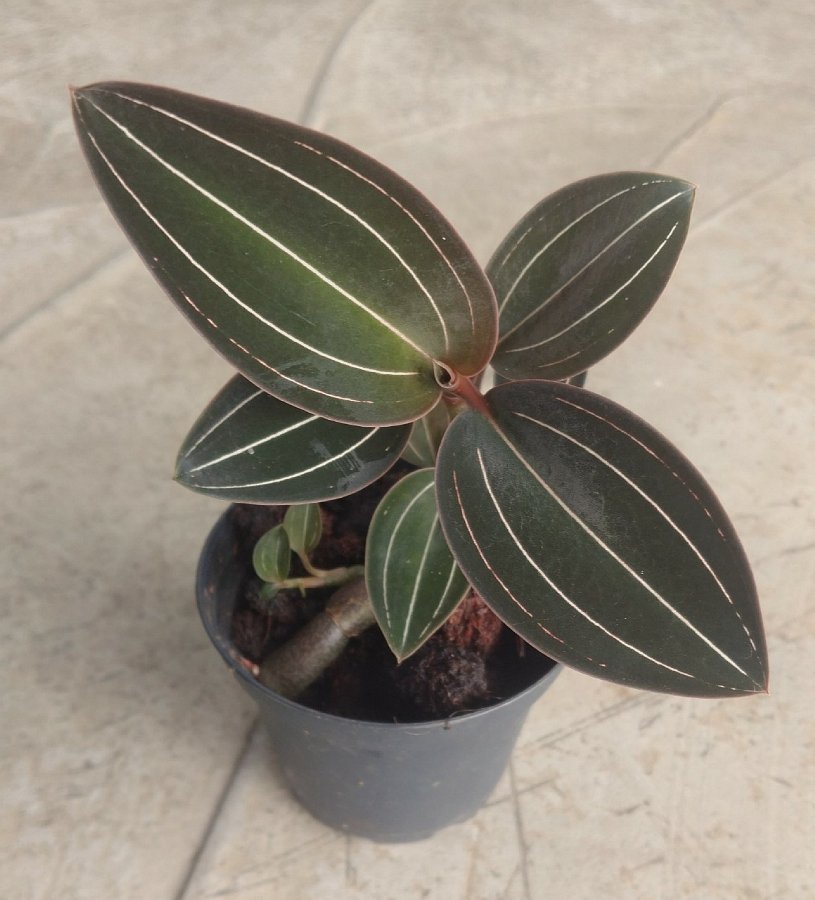
Ludisia discolor is the classic jewel orchid: a terrestrial orchid collected primarily for its dark, velvety leaves. Delicate copper-red to silver-pink veins become visible when the leaf is viewed from different angles. In winter, slender flower spikes also appear, bearing small white flowers with a yellow center.
This species is hardier and more forgiving than many other jewel orchids. This makes Ludisia discolor suitable as a first jewel orchid, but also as a low-maintenance staple within a specialized leaf collection.
Origin
Ludisia discolor occurs naturally from southern China to large parts of Southeast Asia, including Myanmar, Thailand, Laos, Cambodia, Vietnam, Malaysia, Sumatra, Borneo, and the Philippines.
Unlike epiphytic orchids, this species grows terrestrially on the moist forest floor. The fleshy stems creep among leaves, moss, and loose organic matter, forming roots where they come into contact with the substrate. The light there is soft and filtered, while the soil remains airy and evenly slightly moist.
Ludisia discolor is the only accepted species within the genus Ludisia. An older name that may still appear on plant labels is Haemaria discolor.
Characteristics
The plant forms fleshy, creeping stems with oval to elongated leaves. The leaves are dark green to nearly blackish-brown and, depending on light and temperature, can take on a deep purple or burgundy glow. The undersides of the leaves and the stems are often reddish in color.
Each leaf is crisscrossed by fine, contrasting veins in copper-red, pink, golden, or silver. Due to the velvety leaf texture, the sheen and color change depending on the viewing angle. This keeps the plant decorative even outside its flowering period.
The shoots remain relatively low but branch out and slowly spread across the growing medium. As a result, a mature plant can form a broad clump with multiple leaf stalks. The flowering stems grow distinctly above the foliage, making the plant appear much taller during the blooming period.
Care
Ludisia discolor requires soft light, normal room temperatures, and a well-aerated growing medium that retains slightly more moisture than a standard mix for epiphytic orchids.
The plant does not need to be kept constantly very warm or extremely humid. The key is to ensure that the substrate does not dry out completely, but also never remains saturated for long periods.
Light
Place the plant in bright, indirect light or in light partial shade. A north- or east-facing window is suitable. If placed near a south- or west-facing window, the plant can be positioned slightly further from the glass or protected from bright sunlight with a sheer curtain.
Direct afternoon sun can cause pale spots and dry leaf edges. If there is too little light, the stems become longer and looser, and the leaf pattern may appear less intense.
Ludisia discolor also grows well under artificial light and is therefore suitable for a plant cabinet or a lighted display case.
Temperature
A temperature of approximately 18 to 26 °C is ideal. It may cool down a few degrees at night. A slightly cooler period with nighttime temperatures around 16 to 19 °C, combined with shorter days, can promote the formation of flowering branches.
Protect the plant from cold drafts and prolonged temperatures below 15 °C. Cold temperatures, especially when combined with a wet growing medium, can cause stem and root rot.
Substrate and Cultivation Method
Use an airy, fine-textured, moisture-retaining terrestrial orchid growing medium. A suitable mixture consists, for example, of fine bark, coconut fiber, or airy potting soil, perlite, and a small amount of fine sphagnum moss.
Coarse bark alone often dries out too quickly for this species. Heavy, compact potting soil, on the other hand, retains too little oxygen around the roots.
A wide, shallow pot suits its creeping growth habit well. Place the fleshy stems on or just above the substrate and do not bury them deeply. New roots may naturally form where the stem touches the moist surface.
Humidity
Ludisia discolor grows well at a humidity level of about 50 to 70 percent. This makes it better suited to a normal living room than many other jewel orchids. At higher humidity levels, the leaves often remain more attractive, provided there is sufficient air circulation.
Ventilation is important in a terrarium or plant cabinet. Stagnant, saturated air can cause mold, leaf spots, and rot around the fleshy stems.
Watering
Keep the growing medium evenly slightly moist. Allow the top layer to dry out slightly between waterings, but prevent the entire root ball from drying out for extended periods.
Wilted or inwardly curling leaves may indicate dehydration, but always check the roots first. The same symptoms can occur when roots are damaged by a substrate that is too wet. Soft, glassy stems and yellowing lower leaves more often indicate excess moisture.
Preferably water the growing medium and do not allow water to pool between the leaves or around young shoots for extended periods. Rainwater or other soft water helps prevent white deposits and brown leaf edges.
Fertilizer
During active growth, apply a highly diluted orchid or houseplant fertilizer about once every three to four weeks. A quarter of the recommended dosage is usually sufficient.
Ludisia discolor does not require heavy fertilization. Too high a concentration of nutrient salts can cause root damage and dry leaf tips. Therefore, rinse the growing medium with clean water from time to time.
During the dark winter months and while the plant is flowering, you can reduce the amount of fertilizer.
Flowering
Flowering usually occurs in the fall or winter. An upright flower spike with several small white flowers grows from the tip of a mature leaf shoot. The yellow lip and, sometimes, light pink details are especially visible up close.
The individual flowers are relatively small and not very fragrant. They open one after another, allowing the entire flower spike to remain decorative for longer. The blooms are a refined addition, but the foliage remains the plant’s most important ornamental feature.
After flowering, cut away only the bare flower stalk. The leaf stalk below it does not need to be removed and may later produce new side shoots.
Care Level
Ludisia discolor has an easy to moderate care level and is considered one of the most accessible jewel orchids. The species adapts well to normal living conditions and does not require a specialized orchid greenhouse.
The most common mistake is using a substrate that is too compact and constantly wet. If you pot the plant in a well-aerated mix and keep it slightly moist, it will continue to grow and branch out for years.
Who is this plant suitable for?
Ludisia discolor is suitable for beginner orchid enthusiasts, collectors of unusual foliage plants, and people looking for an orchid for a spot with less intense light. The plant remains attractive even without flowers and requires lower humidity than many Anoectochilus and Macodes species.
For enthusiasts primarily seeking large, colorful, or strongly scented orchid flowers, this species is less suitable. Its appeal lies precisely in its velvety leaf texture, subtle veins, and compact, forest-floor growth habit.
Experience growing indoors, in a plant cabinet, or in a terrarium
Indoors, Ludisia discolor thrives near a bright window without harsh afternoon sun. Thanks to its tolerance for normal humidity, it can be kept as a regular houseplant, as long as the potting mix doesn’t dry out completely.
In a plant cabinet or display case, the plant often develops a full clump more quickly. Ensure gentle air circulation there and prevent the leaves from remaining constantly wet.
A spacious, well-ventilated terrarium is also suitable. Place the plant in a well-aerated terrestrial layer with drainage, rather than in a permanently waterlogged area. In a paludarium, it should be placed above the waterline, in a spot where excess water can drain away.
Although the leaves remain compact, the plant can spread out with multiple creeping shoots. During flowering, the flower stalks also protrude clearly above the foliage.
Additional Care Tip
Long or bare stems can easily be rejuvenated. Cut off a healthy section with at least two nodes and lay it horizontally on slightly moist sphagnum moss or a fine terrestrial mix. New roots and shoots can develop from the nodes, while the remaining mother plant usually branches out again.
Short product description
Ludisia discolor is an easy-to-care-for jewel orchid with velvety dark green to purplish-brown leaves and glossy copper-red or silvery-pink veins. This compact terrestrial plant thrives indoors, in a well-ventilated plant cabinet, or in an airy terrarium, and produces delicate white flowers in the winter.