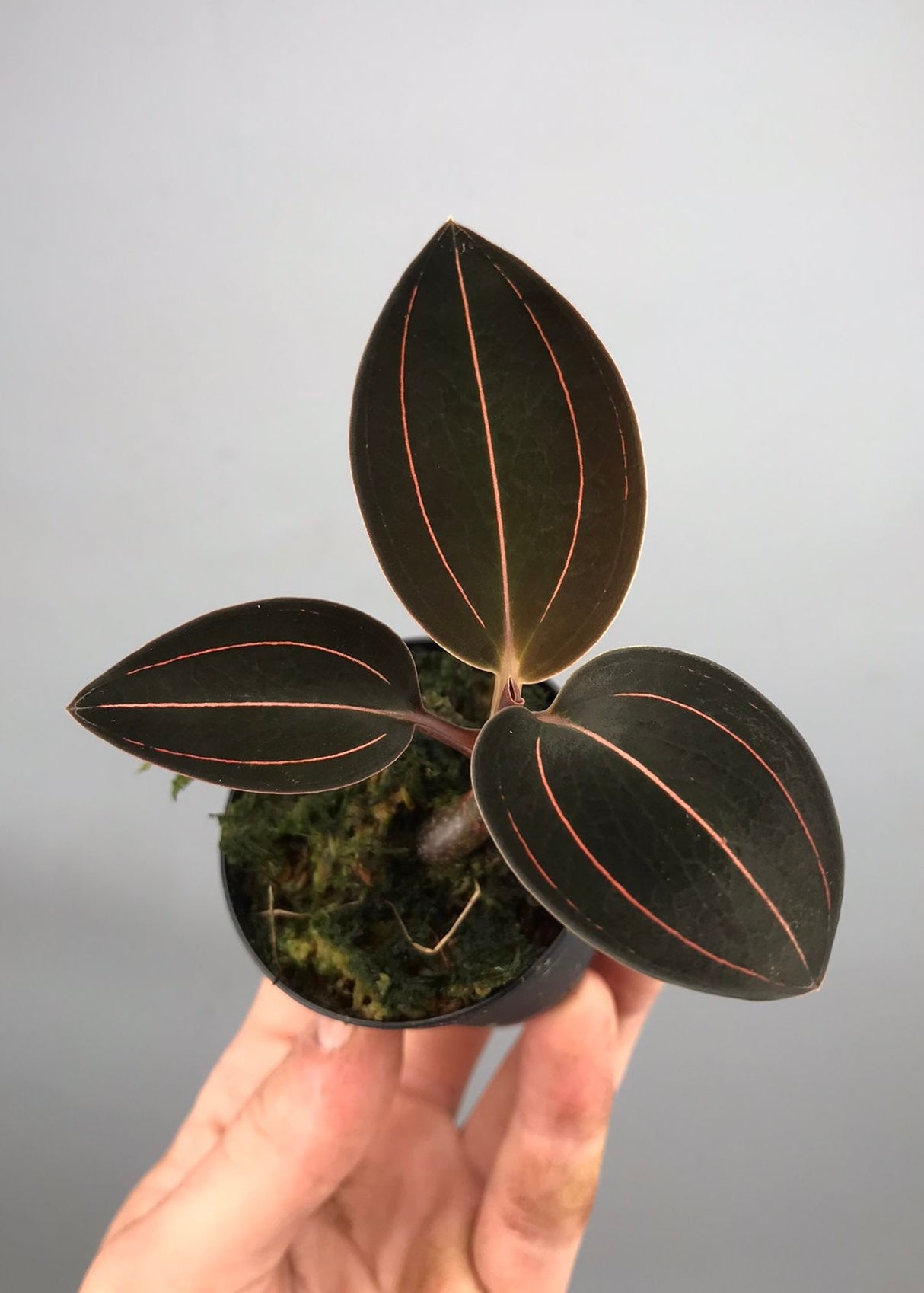
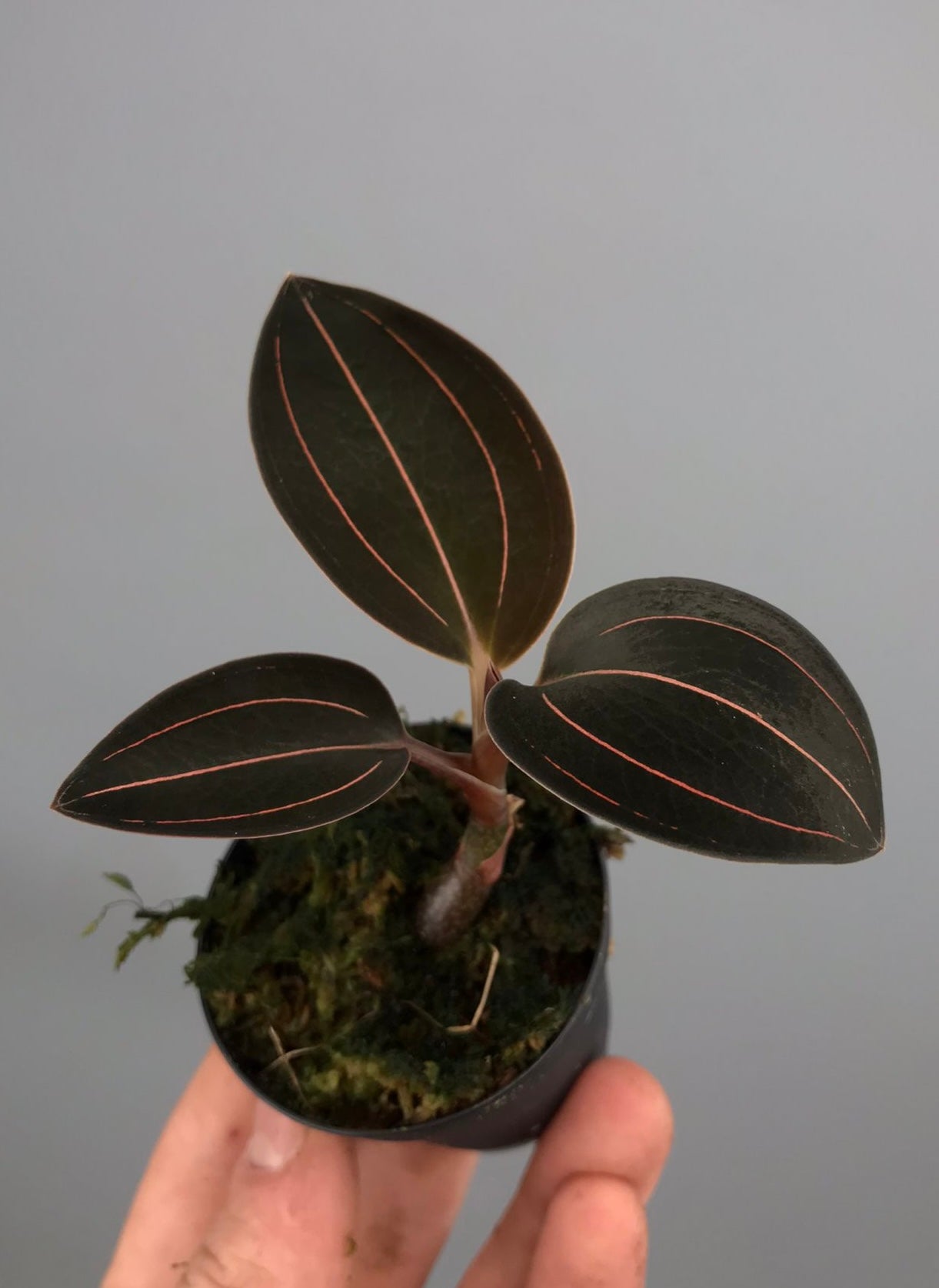
Ludisia discolor var. dawsoniana ‘Red Strip’ is a compact jewel orchid with nearly black-green, velvety leaves. Each leaf features a few fine, coral-red to copper-pink longitudinal veins, while the petioles and undersides may also display a warm red hue. As a result, this selection has a more graphic and subdued appearance than Ludisia varieties with a dense network of silver or gold veins.
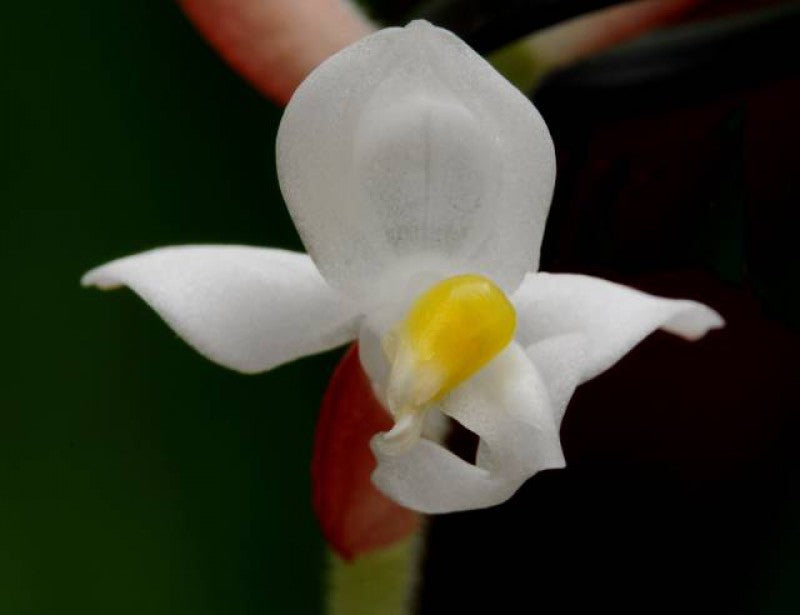
Its ornamental value lies primarily in the foliage, which remains visible year-round. However, the plant can also produce upright flower stalks in winter bearing small white flowers with a bright yellow center.
Name and Taxonomy
Ludisia discolor is the accepted botanical species name. The name Ludisia discolor var. dawsoniana was published in 2020, but is currently treated by Kew as a synonym of Ludisia discolor. Botanically, the plant can therefore be more accurately referred to as Ludisia discolor ‘Red Strip’.
However, the longer common name remains useful, as collectors often still recognize the dark-leaved, red-veined form as dawsoniana. Older names such as Ludisia dawsoniana, Haemaria dawsoniana, and Goodyera dawsoniana may also appear in literature and older collections.
Origin
Ludisia discolor has a large natural range extending from southern China to Southeast Asia, Sumatra, Borneo, and the Philippines. The species grows terrestrially on shaded tropical forest floors, where its creeping stems spread through a loose layer of humus, moss, and decomposed leaf litter.
It is precisely this growth habit that sets Ludisia apart from many well-known orchids. The plant does not grow with thick aerial roots on tree branches, but forms finer roots from nodes that make contact with a moist, aerated soil layer. As a result, ‘Red Strip’ does not belong in a mixture consisting exclusively of coarse orchid bark.
Characteristics
The leaves are oval to broadly lanceolate and have a dark brownish-green to nearly black base color. Particularly striking are the narrow reddish-pink longitudinal stripes that run from the base of the leaf toward the tip. Depending on the light, these veins can appear bright coral red, copper-colored, or soft pink.
In addition, the leaf has a soft, velvety texture. As a result, light is not reflected smoothly, but creates a dark depth in which the fine veins stand out even more sharply. As a leaf ages and fully hardens, the contrast can become even more pronounced.
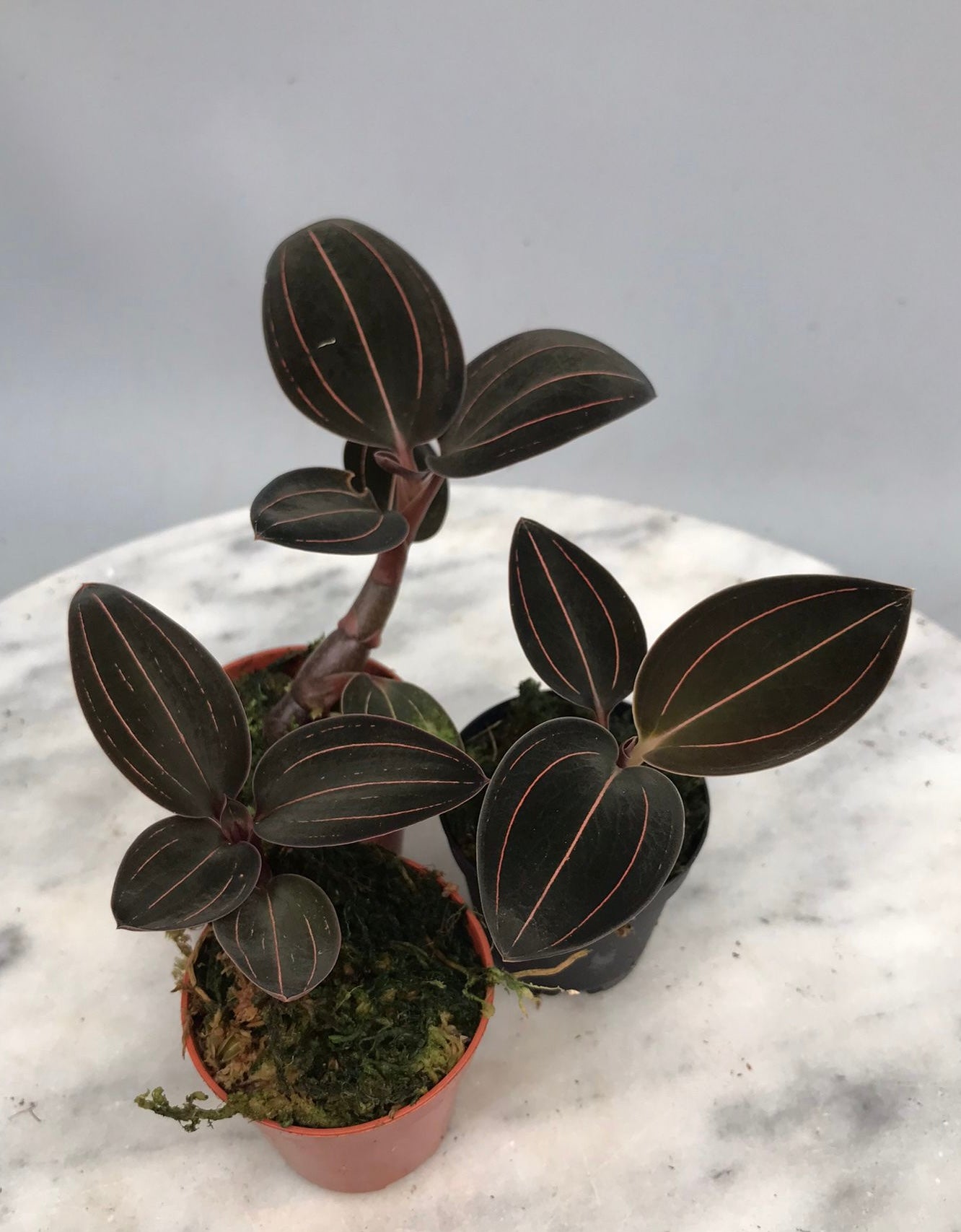
The plant grows horizontally with somewhat fleshy stems. When a node touches the substrate, a new root or shoot may develop there. As a result, a well-developed plant eventually forms a broad clump rather than a single tall stem.
The plants offered are in a 6-centimeter pot. You will therefore receive a compact plant rather than a large, fully branched clump. With enough time and a suitable location, the plant will continue to spread over the rim of the pot and across the substrate.
Care
Ludisia discolor ‘Red Strip’ is one of the easiest-to-care-for jewel orchids. The plant can grow at normal room temperature and average humidity, as long as the growing medium does not dry out completely or remain waterlogged for extended periods.
In particular, the base of the stem is sensitive to a constantly wet, oxygen-deprived environment. The goal is therefore to maintain a slightly moist root zone with sufficient air, not permanently saturated soil.
Light
Provide ‘Red Strip’ with low to moderate, filtered light. Approximately 5,000 to 12,000 lux is usually sufficient. A north- or east-facing window, a spot slightly further away from a bright window, or a shaded position under grow lights works well.
Although the leaves can become very dark in low light, this does not mean the plant prefers a completely dark corner. Too little light results in longer internodes, smaller leaves, and looser growth. Furthermore, the likelihood of flowering decreases.
Too much light, on the other hand, makes the leaves paler and can cause brown or reddish-bleached spots. Direct midday sun is therefore not suitable for this variety. The reddish-pink veins stand out most beautifully in stable, bright but indirect light.
Temperature
Normal room temperature suits the needs of this Ludisia well. During the day, a temperature of about 20 to 26 °C is suitable, while at night the temperature may drop to 17 to 21 °C.
The plant can tolerate slightly cooler temperatures for short periods, but prolonged exposure to temperatures below 15 °C is not recommended. Cold, wet potting mix, in particular, increases the risk of root and stem rot.
On hot summer days, the plant can tolerate temperatures of about 28 °C, provided it is kept out of direct sunlight and the air is not completely still. A spot directly above a radiator or next to a warm air current is less suitable, as the tender leaves will dry out quickly there.
Substrate and Cultivation Method
Because Ludisia is terrestrial, it requires a different substrate composition than epiphytic orchids. A suitable mixture contains both fine organic components and airy mineral components. For example, you can use a combination of a light, low-humus potting mix or coconut fiber, fine orchid bark, perlite or pumice, and a small amount of loose sphagnum moss.
The growing medium must absorb water but remain crumbly and oxygen-rich after watering. A mixture consisting solely of coarse bark often dries out too quickly for the fine roots. Conversely, tightly packed sphagnum or heavy potting soil tends to stay wet for too long.
Initially, do not use a pot much larger than the current 6-centimeter one. Too much moist substrate around a small root ball dries out unevenly. Once the plant forms multiple creeping stems, a wider, relatively shallow pot is more suitable than a deep one.
Place the stems on top of the substrate and do not bury them completely. The nodes must be able to make contact with the surface, while the leaf bases remain exposed and well-ventilated.
Humidity
A humidity level of about 50 to 75% is sufficient. This makes it easier to keep ‘Red Strip’ in a normal living room than the much more sensitive jewel orchids of the genera Macodes and Anoectochilus.
In a plant cabinet or terrarium, the humidity may be higher. At the same time, ventilation becomes more important, because the dark, velvety leaves and creeping stems grow close to the moist substrate. Stagnant air can therefore cause mold and soft rot.
Daily misting is not necessary. Droplets that remain on the velvety leaves for an extended period can leave spots. Therefore, it is best to water directly onto the substrate.
Watering
Keep the substrate evenly slightly moist and water again when the top layer begins to dry out. Do not let the root ball become bone-dry for long periods, as this will cause the fleshy stems and leaves to lose their turgor.
However, slightly too dry is usually safer than constantly too wet. A soft, glassy stem base, yellowing leaves, or a musty odor coming from the pot often indicate a lack of oxygen around the roots.
Because a 6-centimeter pot has a small volume, the growing medium can dry out relatively quickly on hot days. Therefore, check the plant regularly, but do not automatically water it according to a fixed weekly schedule.
Preferably use rainwater, reverse-osmosis water, or other relatively soft water. Allow excess water to drain completely and do not leave the inner pot permanently sitting in a layer of water.
Fertilizer
During active growth, apply a low dose of orchid fertilizer or balanced houseplant fertilizer about once every three to four weeks. A quarter of the recommended concentration is usually sufficient.
Ludisia is not a heavy feeder. Too much fertilizer can damage the delicate roots and also leaves salts in the moisture-retaining substrate. Therefore, rinse the pot occasionally with clean water.
During the dark winter months, you can reduce the amount of fertilizer, especially when the plant isn’t producing new leaves or roots. As soon as new shoots appear in the spring, you can resume regular fertilization.
Flowering
Ludisia discolor typically blooms between late fall and early spring. A slender, upright flower stalk with several small white flowers then grows from the tip of a mature stem.
The individual flowers have an asymmetrical orchid-like shape and a striking yellow center. They are smaller and less showy than the flowers of many epiphytic orchids, but their light color creates a refined contrast with the nearly black foliage.
The entire flower stalk can grow considerably taller than the leaf rosette. As a result, the plant temporarily takes up more vertical space during flowering. Under cool, stable conditions, the flowers can remain attractive for several weeks.
After flowering, cut away only the spent flower stalk. The underlying stem can still produce side shoots and new roots afterward and therefore does not need to be removed entirely.
Care Level
The care level is beginner to intermediate. Ludisia discolor ‘Red Strip’ is more forgiving than many other jewel orchids and does not require a sealed terrarium to grow well. At the same time, a well-aerated substrate remains essential, as overly wet roots and stems are the main cause of plant loss.
The plants offered here are imported and may first develop new roots after arrival. Keep conditions stable during this phase and do not repot the plant immediately if the current substrate is still airy and fresh. Once new growth becomes visible, it is clear that the plant has adapted to its new environment.
Who is this plant suitable for?
Ludisia discolor ‘Red Strip’ is particularly well-suited for enthusiasts seeking a dark jewel orchid with a subtle, graphic leaf pattern. While some jewel orchids display a dense network of shimmering veins, this selection features just a few narrow reddish-pink lines against a nearly black background.
In addition, the plant is suitable for someone who wants to try their first jewel orchid without having to use a fully regulated terrarium right away. Because the plant is sold in a compact form and gradually spreads out, it is also appealing to collectors who enjoy growing a small plant into a full clump themselves.
On the other hand, ‘Red Strip’ is less suitable for a sunny windowsill or a closed, permanently wet terrarium. Similarly, those primarily seeking large, showy orchid flowers are less likely to appreciate this plant’s ornamental value than someone who collects specifically for its unusual foliage.
Experience growing indoors, in a plant cabinet, or in a terrarium
Indoors, ‘Red Strip’ thrives near a north- or east-facing window or slightly further away from a bright west- or south-facing window. Due to its low light requirements, the plant thrives in spots where many flowering orchids would not receive enough light. However, daylight must still be readily available to maintain compact growth.
In a plant cabinet, there is often a strong contrast between the dark leaves and the red veins. Do not place the plant directly under a powerful lamp, and ensure that a fan provides gentle air circulation without constantly drying out the leaves.
In a ventilated terrarium, the plant can be used as a terrestrial foreground or midground plant. It can either remain in its own inner pot or be planted directly into a well-aerated layer of substrate. In the latter case, excess water must be able to drain away, and the base of the stem must not end up in a waterlogged area.
In a paludarium, the plant should always be positioned well above the permanent waterline. A humid atmosphere is beneficial, but wet feet are not.
Additional Care Tip
As a stem grows longer, you can gently guide it horizontally across the substrate. Press the nodes lightly against the surface and do not cover the leaf bases. New roots and shoots can develop at these points, allowing the plant to grow into a wider clump without drastic pruning.
Short product description
Ludisia discolor var. dawsoniana ‘Red Strip’ is a compact jewel orchid with nearly black-green velvety leaves and a few fine coral-red to copper-pink longitudinal veins. The accepted botanical name is Ludisia discolor, while var. dawsoniana remains the recognized common name. This easy-to-care-for variety is suitable for a bright spot in the home, a well-ventilated plant cabinet, or a terrarium that isn’t too damp.