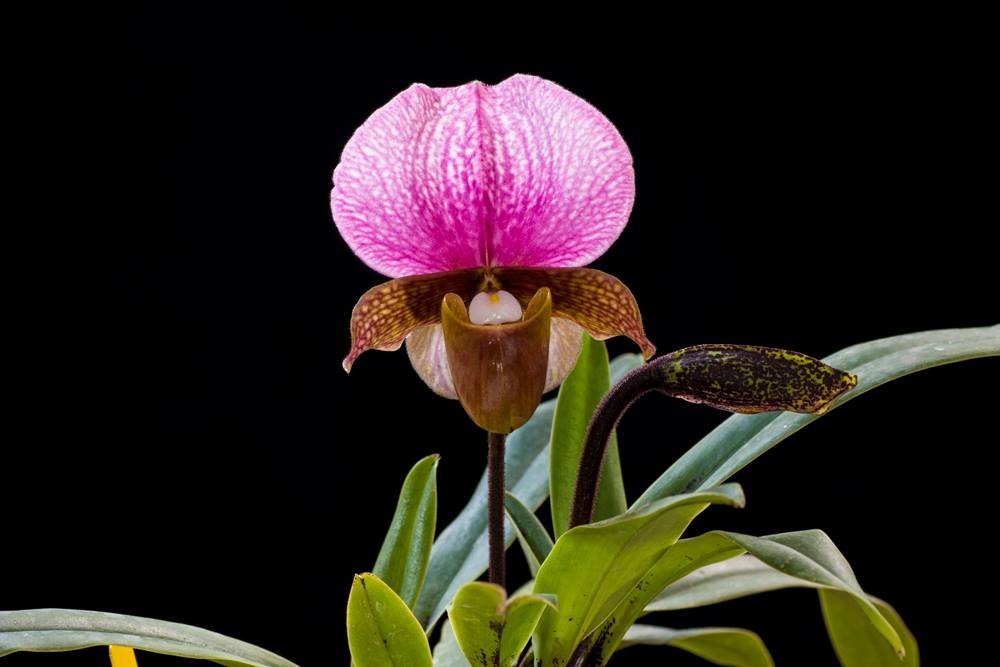
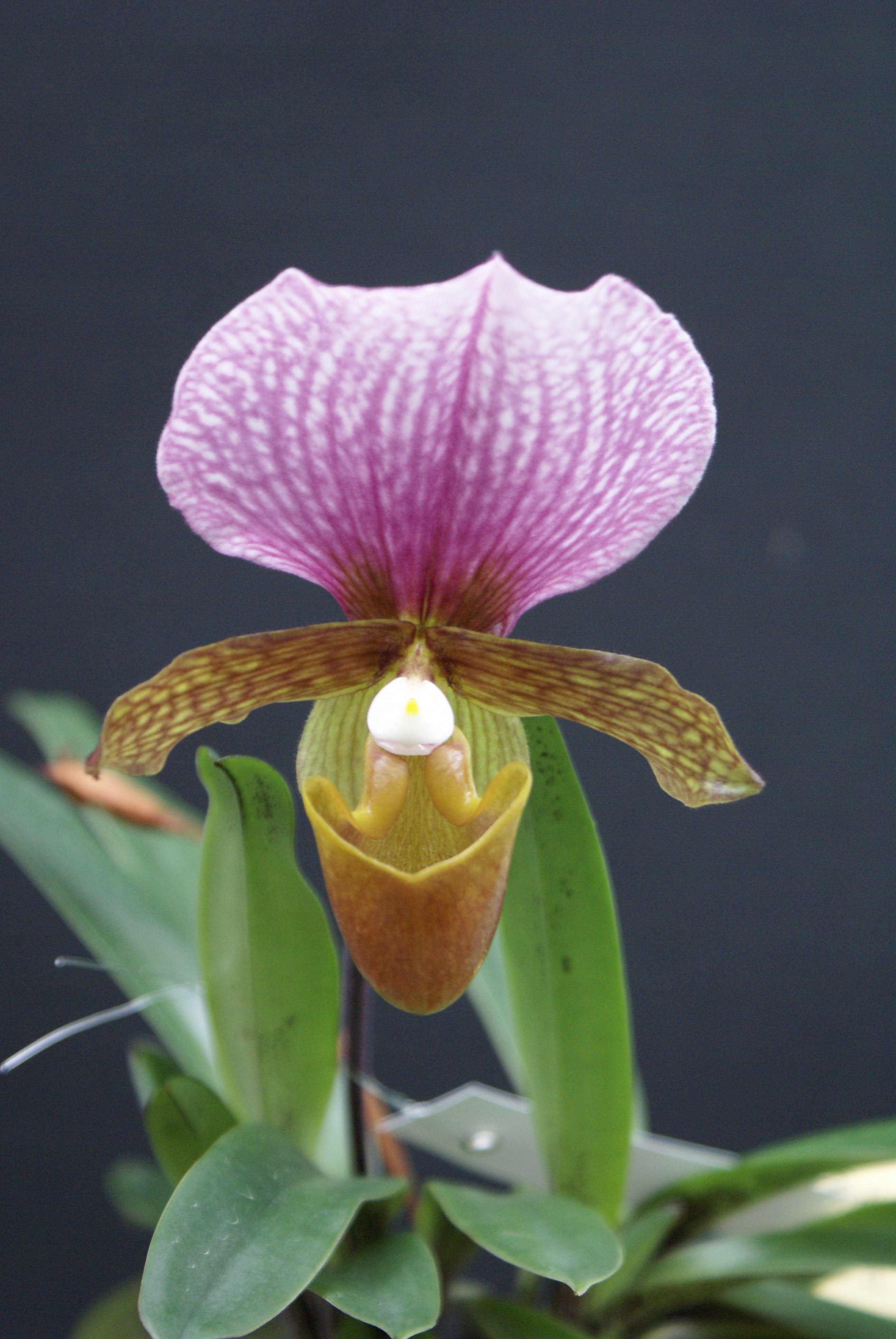
Paphiopedilum charlesworthii is a compact botanical orchid in which the proportion between the plant and the flower is immediately striking. Above the modest rosette, a single, relatively large flower emerges, dominated by a broad, almost round dorsal sepal. The pink color and dark veins give the flower a graphic character that clearly differs from many other green-leaved Paphiopedilum species.
The designation “Compact Type” refers to a selected, compact-growing form within the species. It is not a separate botanical variety. Individual plants may therefore vary slightly in growth habit, color intensity, and the precise pattern of the flower.
Origin
Paphiopedilum charlesworthii is native to an area stretching from Assam and Myanmar to Thailand and western Yunnan in China. There, the species grows primarily in sheltered locations in moist mountainous regions.
Its natural habitats are at higher elevations than those of many heat-loving Paphiopedilums. The plants grow among moss and organic matter in shady spots where the roots find moisture but also receive sufficient oxygen. Temperatures there are moderate, and nights in particular can cool down significantly.
This origin explains why the species responds well in cultivation to a combination of moderate temperatures, filtered light, a consistently slightly moist substrate, and fresh air circulation.
Characteristics
The plant forms compact fans of sturdy, uniformly green leaves. On the underside, purplish spots may be visible around the base of the leaves. Due to its short leaf length, this species takes up little space and fits well into a specialized Paphiopedilum collection.
A mature growth shoot usually produces a single flower. The flower can reach about eight centimeters in width and is borne on a relatively short flower stalk. As a result, the flower remains close above the foliage, creating a concentrated, almost monumental appearance.
The most striking feature is the broad dorsal sepal. It is pink to light pink and marked with darker longitudinal veins. The yellow-green petals bear a fine, brownish, net-like pattern. The shoe-shaped lip is generally pinkish-brown with subtly darker veins. Because of the large dorsal sepal, the flower appears to change shape slightly when viewed from different angles.
In young plants that have not yet bloomed, the exact floral pattern remains unknown. Color, veining, and flower shape may vary slightly from one individual to another.
Care
Light
Place this Paphiopedilum in a bright spot with bright, filtered light. An east- or north-facing window, or a sheltered spot near a west-facing window, is usually suitable. Direct, hot midday sun can damage the leaves.
A healthy plant has fresh green leaves. Very dark leaves and a lack of blooms may indicate insufficient light. Leaves that turn yellow-green or reddish, on the other hand, may mean that the light intensity is too high. Always allow a newly acquired plant to gradually acclimate to a brighter location.
Temperature
As a green-leaved alpine species, Paphiopedilum charlesworthii prefers moderate to cool conditions. Daytime temperatures of approximately 18 to 25 °C are suitable. A nighttime temperature of about 13 to 18 °C helps mimic the natural temperature difference.
Short-term higher temperatures are possible when humidity and air circulation are sufficient. Prolonged heat, especially combined with stagnant air and wet potting mix, can weaken the plant. In winter, the plant can be kept in a cooler location, but protect it from cold drafts and leaves that remain wet for extended periods.
Substrate and Cultivation Method
Use an airy, moisture-retaining orchid potting mix based on fine to medium-coarse bark, possibly combined with coconut fiber and a small amount of sphagnum moss. The mixture should retain moisture evenly without becoming compacted.
A relatively small pot is preferred. In a pot that is too large, the center of the growing medium can easily remain wet for too long. Position the base of the leaves just above the growing medium and do not bury the center of the plant. A rosette planted too deeply is more susceptible to rot.
Replace the growing medium when it loses its airy structure. It is best to do this when the plant shows signs of new root growth. Healthy Paphiopedilum roots are firm and usually light brown to cream-colored.
Humidity
A humidity level of about 50 to 70 percent is suitable. The plant can thrive in a normal living room as long as it is not placed directly above a radiator and the growing medium does not dry out completely.
At higher humidity levels, gentle air movement is important. The air does not need to flow strongly past the plant, but it should not remain completely still either. Moisture that lingers in the center of the plant for a long time can cause problems.
Watering
Keep the growing medium evenly slightly moist, but never constantly soggy. Paphiopedilum charlesworthii has no pseudobulbs in which water can be stored and therefore cannot tolerate prolonged, complete drying out. At the same time, the roots need oxygen.
Water again when the top layer begins to dry out and the pot feels noticeably lighter. Preferably use demineralized water at room temperature. Water in the morning so that any moisture between the leaves can dry off during the day.
Allow a newly received plant to acclimate for a few days first. Do not water it immediately; instead, check first how moist the substrate inside the pot still is.
Fertilizer
During active growth, regularly apply a low-dose orchid fertilizer. A low concentration is safer than an occasional high dose. Rinse the potting mix periodically with demineralized water to remove accumulated nutrient salts.
When growth slows during the cooler and darker months, the amount of fertilizer can also be reduced. Never apply fertilizer to a severely dried-out plant or to roots that have been damaged by repotting.
Flowering
This species usually blooms in late summer or fall, though the exact timing may vary under Dutch growing conditions. A mature fan typically produces a single flower. At moderate temperatures, this flower remains attractive for a relatively long time.
After flowering, the old fan does not produce a second flower stalk. The plant develops new shoots from the base, which can bloom again after sufficient growth. A bright location, moderate fertilization, and a noticeable difference between day and night temperatures support the development of sturdy, flowering shoots.
Care Level
The care level is moderate. The plant’s compact growth makes it easy to place, but the combination of moist roots, a well-aerated growing medium, and moderate temperatures requires some attention. Growing the plant in conditions that are too warm or too wet poses a particular risk.
Anyone accustomed to checking the moisture level of orchid potting mix before watering will be able to care for this species well.
Who is it suitable for?
Paphiopedilum charlesworthii ‘Compact Type’ is particularly well-suited for collectors who appreciate botanical Paphiopedilums but have limited space. This species features a large, distinctive flower on a plant that remains compact.
It’s also an interesting choice for enthusiasts who enjoy growing their plants from seed to their first bloom. The moment when the still-unknown color pattern and veining become visible is a major part of its appeal.
Growing Experience Indoors or in a Greenhouse
Indoors, this species grows well on a bright, not-too-warm windowsill. A cooler bedroom, study, or unheated sunroom can be very suitable, provided the temperature doesn’t drop too low and there’s plenty of daylight.
In a greenhouse, the plant is best placed in a cooler, shaded area. Ensure adequate ventilation there, especially during hot periods. Due to its compact growth habit, the plant can easily be placed among other Paphiopedilums, but make sure larger plants do not block all the light.
Additional Care Tip
With this compact growth habit, check regularly to ensure no water pools deep between the leaves. Water preferably early in the day and avoid pouring water directly into the center of the rosette. A dry leaf crown combined with slightly moist, well-aerated roots significantly reduces the risk of rot.
Short product description
Paphiopedilum charlesworthii ‘Compact Type’ is a compact-growing botanical orchid with a strikingly large, single flower. The broad pink dorsal sepal with dark veins forms a beautiful contrast with the yellow-green petals and pink-brown labellum. A unique choice for collectors seeking a distinctive Paphiopedilum that doesn’t take up much space.