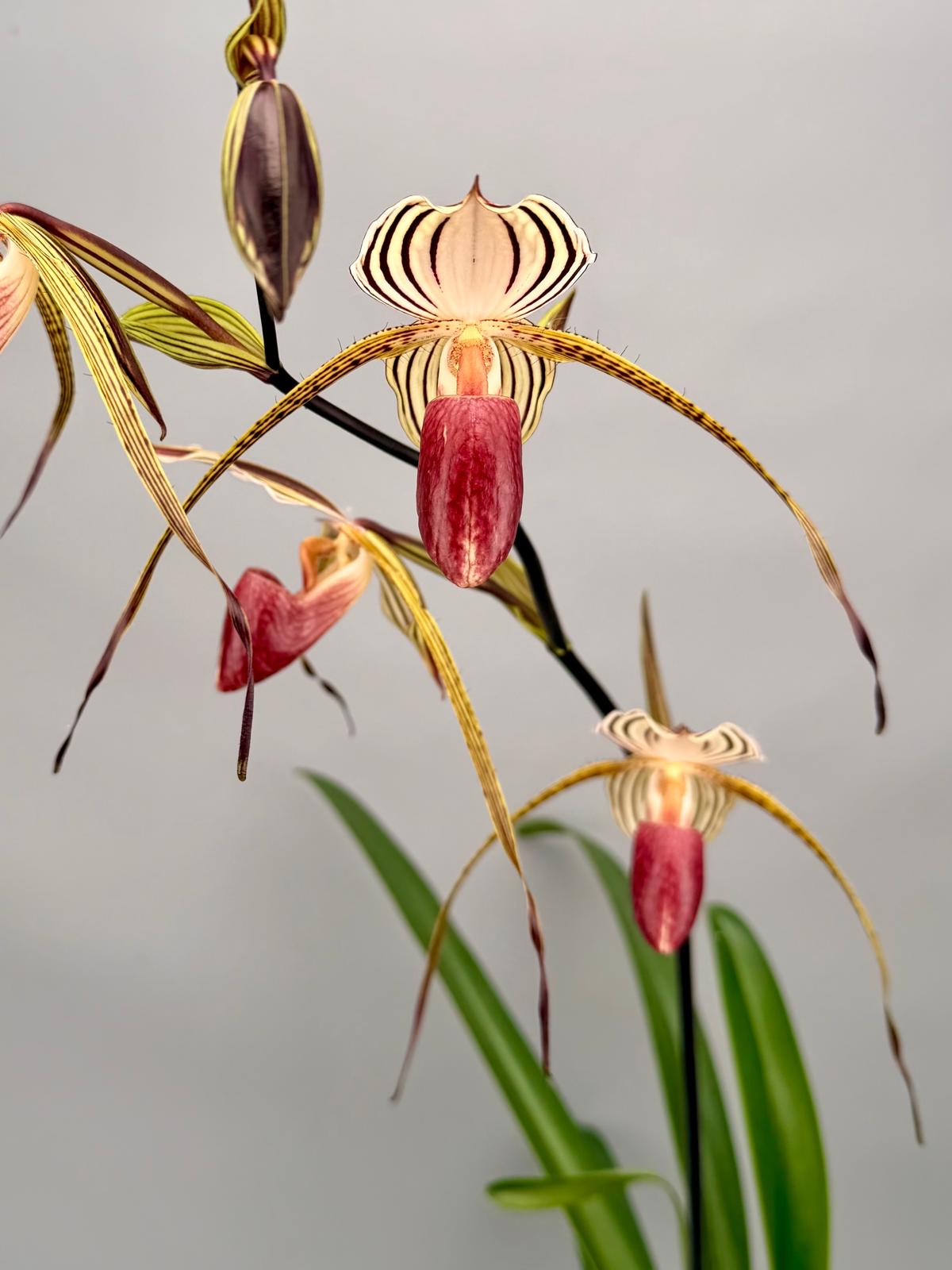
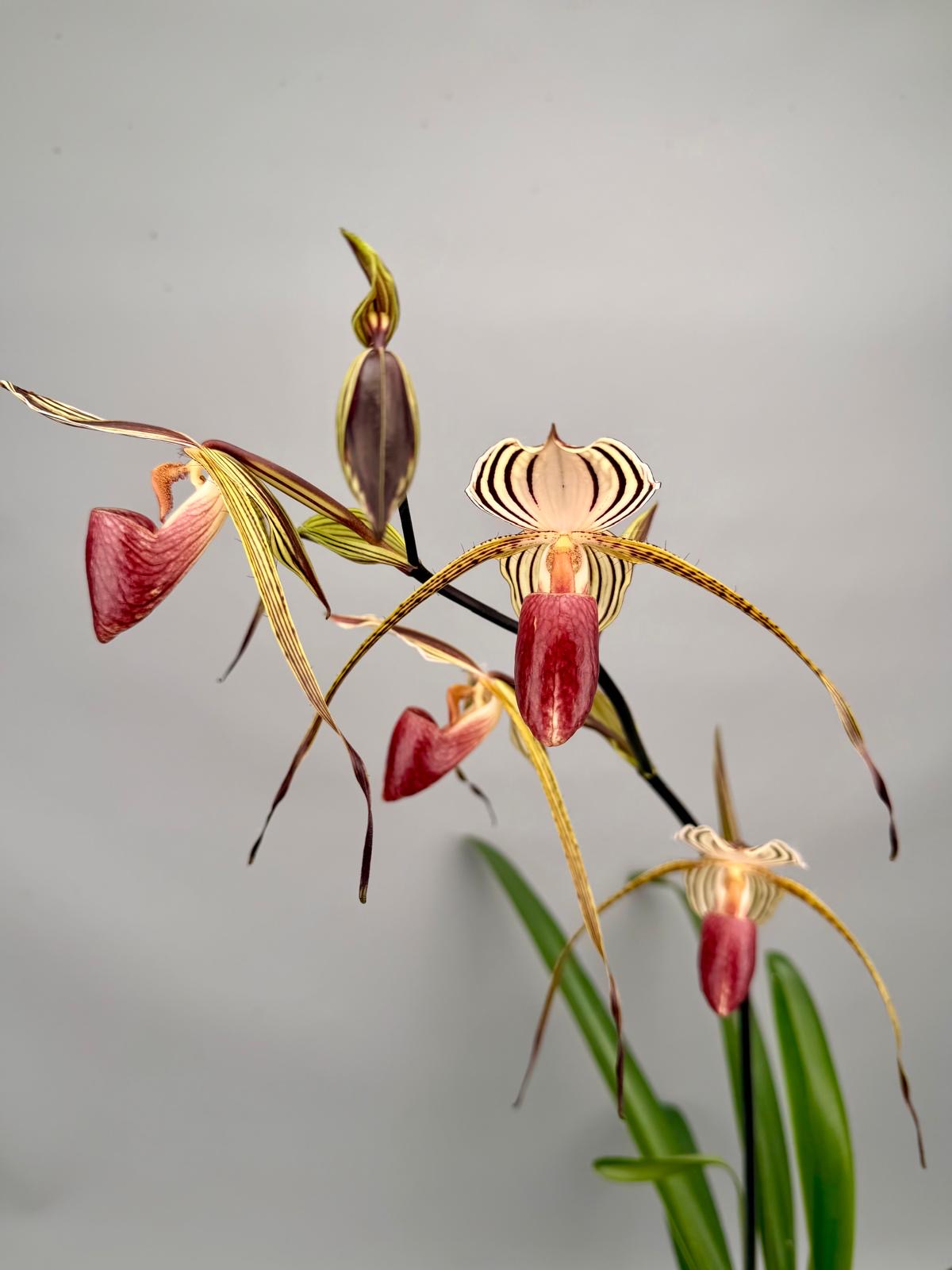
Paphiopedilum Lady Isabel is one of the most iconic primary Paphiopedilum hybrids ever created. This historic cross was registered as early as 1897 and combines two of the most impressive species from Borneo: Paphiopedilum rothschildianum and Paphiopedilum stonei. More than a century later, this hybrid is still considered a benchmark for multifloral Paphiopedilums.
What makes this hybrid so special is that both parents remain highly recognizable. The long, elegant petals of rothschildianum are combined with the graceful form and flower structure of stonei, resulting in a plant that immediately catches the eye as soon as it blooms.
Origin
Paphiopedilum Lady Isabel is a primary hybrid between Paphiopedilum rothschildianum and Paphiopedilum stonei. Both parents are endemic to Borneo, where they grow in warm, humid areas with filtered light and constant air movement.
The hybrid was registered by Thomas Statter in 1897, making it one of the oldest Paphiopedilum hybrids still in cultivation. For many years, the name was originally spelled “Lady Isabel,” but today the spelling “Lady Isobel” is often used officially.
Due to the close relationship between the two parents, the hybrid retains many characteristics of the original species but is often more vigorous and more prone to flowering.
Characteristics
Paphiopedilum Lady Isabel forms vigorous plants with long, uniformly green leaves. As the plant matures, it develops increasingly larger growth points that can eventually produce impressive flowering stems.
The flowers are among the most spectacular within the genus. Characteristic features include:
- long, horizontally protruding petals
- a broad dorsal sepal with distinct striations
- colors in shades of green, cream, brown-red, and chestnut brown
- a large, contrasting shoe-shaped lip
What we often observe with this hybrid is that mature plants become increasingly impressive. The flower stalks grow longer, the flowers larger, and the overall presentation more striking as the plant builds up more vigor.
Like both of its parents, Lady Isabel belongs to the multiflora group, in which multiple flowers appear on the same flower spike either simultaneously or in succession.
Care
:
Light
This hybrid grows best in bright, indirect light.
We’ve noticed that multifloral Paphiopedilums generally perform better when they receive slightly more light than many other Paphiopedilum groups, without exposing the leaves to direct, bright sunlight.
Temperature
Ideal temperatures range from approximately 18 to 28 °C. A slight drop in temperature during the night is generally beneficial.
Growing Medium
Use an airy orchid growing medium based on fine to medium-sized bark. Good drainage is important, but the medium should never dry out completely.
Humidity
A humidity level of 60 to 80 percent generally yields the best results. Good air circulation is just as important as high humidity.
Watering
Keep the substrate slightly moist, but avoid prolonged wet conditions around the roots. Preferably use demineralized water.
Fertilization
During the growing season, a lightly diluted orchid fertilizer can be applied regularly.
Flowering
A mature plant can have a long They produce flower stalks with multiple flowers at once. The flowers often remain attractive for weeks and are among the most impressive specimens within the genus Paphiopedilum.