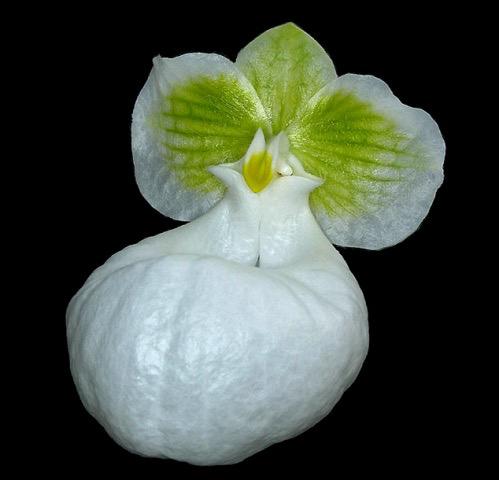
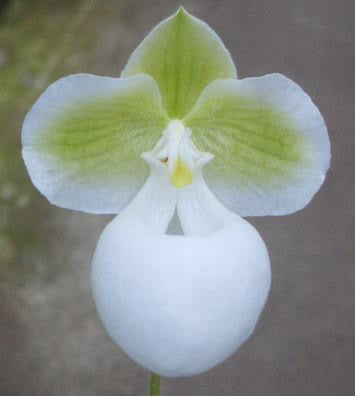
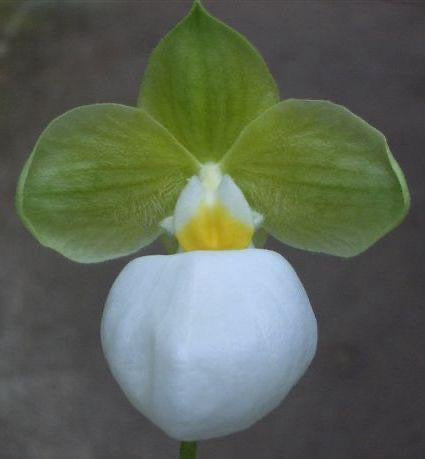
Paphiopedilum micranthum Alba is an extremely rare, low-pigment form of one of the most distinctive botanical lady’s slippers. Whereas the common form is known for its pink to purplish-pink labellum, this Alba form blooms almost entirely in white, cream, and light green. The broad white labellum is surrounded by pale-colored floral parts with fine green veins and a yellow-green center.
The flower is strikingly large in proportion to the compact leaf rosette. This creates precisely the contrast for which Paphiopedilum micranthum is prized among collectors: a small plant with a single, disproportionately large, almost round flower.
This is not an orchid that is purchased for rapid growth or a large number of flowers. Its value lies in the exceptionally rare flower color, its botanical origin, and the difficulty of getting a good Alba form to mature and bloom.
Name and Taxonomy
The accepted botanical species name is Paphiopedilum micranthum Tang & F.T.Wang. The species was scientifically described in 1951.
Over the years, various names have been published for white and low-pigment forms, including Paphiopedilum micranthum f. alboflavum and Paphiopedilum micranthum f. glanzeanum. Modern taxonomic sources generally treat these names as synonyms within Paphiopedilum micranthum.
The designation “Alba” for this plant is a recognizable horticultural trade name. It is neither a registered grex nor a clone name. The name indicates that the flower lacks the pink to purple anthocyanin pigment found in the normal form.
Based solely on the trade name, it cannot be determined with certainty from which of the historically described white forms the plant was originally selected. Therefore, Paphiopedilum micranthum Alba remains the clearest and most commercially available name for the product title.
What does “Alba” mean in the context of this plant?
“Alba” does not mean here that the entire plant is albino. The leaves contain normal chlorophyll and can photosynthesize as usual. Only in the flower is most of the red and purple pigment absent.
As a result, parts that are pink or purple in the common form become white, ivory, light yellow, or greenish. The veins of the flower may remain green, and the staminode at the center of the flower is typically yellow to yellow-green.
The exact shade may vary slightly depending on temperature, light, and the flower’s age. A newly opened flower may appear greener, while it later develops a softer cream or ivory hue. ‘Alba’ guarantees the low-pigment color form, but not that every flower will have exactly the same shape or size.
Origin
Paphiopedilum micranthum occurs naturally in limestone regions of southern and southwestern China. Specialized orchid literature also mentions populations from northern Vietnam.
The species grows at elevations of approximately 600 to 1,700 meters. It is primarily found on steep limestone slopes, in rock crevices, and in small accumulations of humus, clay, and decomposed leaf material. Sometimes it grows among moss on rocks or low on moss-covered trees.
These habitats experience distinct seasonal variations. During the warmer growing season, moisture is abundant. Winter is cooler and drier, but fog and high ambient humidity prevent the plants from drying out completely.
In terms of care, this means that the roots need air, moisture, and some calcareous material. In addition, a mild, cool, and somewhat drier winter period aids in flower bud formation.
Characteristics
The plant forms compact fans with typically three to five sturdy leaves. These leaves are light to medium green with an irregular dark green marbling pattern. The underside may be speckled with reddish-purple, although this coloration may be less pronounced in plants with low pigment levels.
The leaves usually remain about five to fifteen centimeters long. Even without flowers, the plant is therefore attractive and easy to incorporate into a collection of compact Paphiopedilums.
An upright, finely hairy flower stalk emerges from a mature leaf rosette. This stalk usually bears a single flower. Very occasionally, a vigorous plant may produce two flowers on a single stalk, but this is exceptional and should not be expected as the norm.
The flower has a broad, inflated shoe-shaped lip. In this Alba form, the lip is white to ivory white. The dorsal sepal and the lateral petals are white, cream, or pale yellow-green with green veins. The flower generally has no detectable scent.
Growth habit
Paphiopedilum micranthum grows sympodially and does not form pseudobulbs. Each leaf rosette first grows to full size and can then bloom once. Afterward, a new shoot takes over growth.
The species can form short to strikingly long underground runners. As a result, a new leaf rosette does not always appear directly next to the mother plant. Sometimes it emerges a few centimeters away at the edge of the pot.
This behavior is normal and not a sign that the plant has been potted incorrectly. For a well-established plant, preferably use a slightly wider pot that is not unnecessarily deep. Do not try to bend young runners back, as the connection to the mother plant is easily damaged.
The plant offered is in a 9-centimeter pot and is sold as mature. Mature means that the plant is sufficiently developed to bloom under suitable conditions. It is not a guarantee that a non-Blooming specimen will produce a flower stalk immediately upon receipt.
Care
This species requires more precision than a standard Paphiopedilum hybrid. In particular, the combination of an airy root environment, consistent moisture, and a distinct winter season is important.
The greatest risk is a growing medium that remains cold, compact, and constantly wet at the same time. In such conditions, the thick roots can quickly lose their active tips. However, allowing the medium to dry out completely is also unsuitable.
A well-cared-for plant grows slowly but steadily. Do not expect rapid production of new fronds. With this rare variety, stable growth and healthy roots are more important than rapid flowering.
Light
Provide Paphiopedilum micranthum Alba with bright, filtered light. This species can be grown in slightly brighter conditions than many dark-green marbled Paphiopedilums, but it cannot tolerate scorching afternoon sun.
An east-facing window is often suitable. A west-facing or slightly filtered south-facing window can also be used. On hot summer days, direct sunlight should be softened by a windowpane.
Under grow lights, approximately 12,000 to 20,000 lux is a useful guideline. The plant must receive enough light to form a compact mature rosette and flower bud without the leaves turning yellow or getting too hot.
Very dark green, elongated leaves may indicate insufficient light. Pale, yellow-green, or dry spots are more likely caused by overheating or excessive direct sunlight.
Temperature
During active growth, a moderate climate is best. Daytime temperatures of approximately 18 to 25 °C are suitable. At night, the temperature may drop to about 14 to 19 °C.
Prolonged temperatures above 28 °C are less well tolerated, especially when the air is stagnant and the nights remain warm as well. During hot spells, ensure extra ventilation, shade, and a consistent supply of moisture.
In the fall and winter, the plant should be kept in a noticeably cooler location. Nighttime temperatures of about 10 to 15 °C and daytime temperatures around 16 to 20 °C provide a beneficial seasonal variation. The combination of cooler nights, plenty of light, and less water can promote flower bud formation.
An established plant can withstand lower temperatures in the wild, but with a valuable, recently imported specimen, it’s not wise to test the lower limit of its tolerance. Protect the plant from frost and keep it on the drier side at low temperatures.
Winter dormancy
Paphiopedilum micranthum does not have a completely dry dormant period, but it does benefit from cooler and slightly drier winter care.
Starting in late fall, watering can be gradually reduced. Allow the potting mix to dry out more between waterings than during the summer, but prevent the leaves from wilting or the roots from shriveling for extended periods.
Stop or significantly reduce fertilization as long as no active root or leaf growth is visible. Do continue to place the plant in a bright spot. A dark, warm, and damp winter is a common reason why a healthy plant fails to bloom or develops root problems.
As soon as a flower stalk, new shoot, or fresh root tip appears, watering can be carefully increased.
Substrate
This species grows naturally near limestone and prefers an airy, mineral-rich growing medium that does not become highly acidic. A suitable mixture can consist of fine to medium-sized orchid bark, pumice, perlite, and a limited amount of loose sphagnum moss or fine coconut coir.
A small amount of limestone grit, dolomite, or crushed oyster shells can be added to provide calcium and prevent excessive acidification. Use this sparingly. If your tap water is hard and calcareous, additional lime may hardly be necessary.
The substrate must be able to retain moisture without becoming compacted around the roots. Very fine, peat-rich material tends to stay wet for too long and is therefore less suitable.
A wide, shallow pot can be practical because of the creeping runners. Always ensure there are sufficient drainage holes.
Repotting
Repot only when the growing medium begins to break down, the pot becomes too small, or root problems are visible. The best time is when fresh root tips appear at the base of a new shoot.
Handle the roots gently. Healthy Paphiopedilum roots are firm and brown to light brown, often with lighter, active tips. They look different from the silvery-gray aerial roots of a Phalaenopsis and should not automatically be removed as dead.
The plants offered here are imported, and their roots are still developing. Therefore, do not repot a newly received plant as a preventive measure if the existing growing medium is still loose and fresh. A second change shortly after transport can actually slow down the plant’s establishment.
Watering
During active growth, the growing medium should remain evenly slightly moist. Water generously and allow the excess to drain completely from the pot. Then wait until the top layer begins to dry out before watering again.
Never leave the pot standing permanently in a layer of water. Despite their terrestrial and lithophytic background, the roots require plenty of oxygen.
Preferably use soft water with a low to moderate salt concentration. If only very soft rainwater or reverse-osmosis water is used, calcium and magnesium can be carefully supplemented through the substrate or fertilizer.
Water preferably in the morning. Remove any water that remains in the center of the leaf rosette, especially during the cool winter months. Cold water in the crown can cause bacterial or fungal rot.
Humidity and Ventilation
A humidity level of approximately 55 to 75 percent is suitable. In a typical living room, the plant can grow at a slightly lower humidity, but the substrate will dry out more quickly.
Higher humidity only works well when there is a constant, gentle air current. Stagnant, humid air increases the risk of leaf and crown rot.
A well-ventilated plant grow box or orchid cabinet can be very suitable. A small, completely enclosed terrarium in which the leaves and growing medium remain wet for long periods is not.
Fertilization
During active root and leaf growth, apply a highly diluted orchid fertilizer every one to two weeks. About a quarter of the normal recommended dosage is usually sufficient.
Rinse the growing medium regularly with clean water. The thick but sensitive roots react poorly to a buildup of fertilizer salts.
Reduce fertilization in the fall and stop almost entirely during the cool dormant period. Resume fertilization as soon as new root tips and active growth become visible.
Flowering
The natural flowering period occurs mainly in the spring. In cultivation, flowers may appear from late winter through early summer, depending on temperature and when the new rosette has matured.
A mature rosette usually produces a single flower. Therefore, “mature” or “ready to flower” in this species does not mean that the plant will bear a cluster of flowers. An older cluster of plants can produce multiple flowers at the same time if several fans have matured in the same season.
The flower can remain beautiful for about two to four weeks. A cool, well-lit location away from dry radiator air helps to extend the flowering period.
After the flower wilts, cut the flower stem off at the base. The spent rosette remains important for supplying energy to new shoots and should not be removed until it has died back completely on its own.
Scent
Paphiopedilum micranthum is not cultivated as a fragrant species. The flower does not normally emit a distinct scent.
This plant is therefore intended for collectors who appreciate its rare, pale flower color, large labellum, and botanical background. For someone specifically looking for a fragrant orchid, other species are more suitable.
Care Level
The care level is advanced. The plant is not extremely delicate once the roots are well established, but reliable blooming requires a better sense of the seasons than with a typical Venus slipper hybrid.
The most important considerations are a well-aerated, calcareous growing medium, consistent moisture levels during the growing season, sufficient light, and a cooler, slightly drier winter period. A permanently warm living room with no distinction between summer and winter can delay flowering for years.
Due to its rarity and value, this is not a logical first Paphiopedilum. Experience with botanical lady’s slippers—and preferably with species from the Parvisepalum group, such as P. armeniacum or P. malipoense, is highly recommended.
Who is this plant suitable for?
This Alba form is intended for the serious Paphiopedilum collector who is actively seeking an exceptional color form and wishes to build up the plant over the long term.
It suits someone who values genetic and botanical rarity, even when the plant consists mainly of one or a few compact leaf rosettes outside the blooming period. Its appeal lies not in rapid growth or abundant flowers, but in the quality and rarity of that single flower.
This plant is less suitable for a buyer looking for a profusely flowering Venus slipper for the living room right away. It also poses a relatively high risk for someone who cares for plants exclusively according to a fixed weekly watering schedule.
The plant takes up little space above ground but does require a stable, well-lit, and preferably seasonal growing environment. A climate-controlled collection, a cool greenhouse, a bright conservatory, or a suitable orchid cabinet offers the best conditions.
Experience growing at home, in a greenhouse, or in an orchid cabinet
Indoors, the plant thrives best near a bright east-facing window or a filtered south- or west-facing window. Preferably choose a room that cools down significantly at night during the winter.
In a temperate greenhouse, the plant can be placed among other lime-loving Paphiopedilums from the Parvisepalum group. Make sure it doesn’t get lost among larger plants, as sufficient winter light is important for reliable blooming.
A well-ventilated orchid cabinet allows you to control light, humidity, and air circulation. Be sure, however, that the cabinet does not remain constantly warm in winter. A slight drop in temperature can actually make the difference between just new leaves and actual flower bud formation.
Extra care tip
When repotting, it’s better to use a slightly wider pot than an unnecessarily deep one. Paphiopedilum micranthum can form a new rosette via a runner some distance from the mother plant. If this offshoot hits the side of the pot, the young growth can become misshapen or damaged.
In addition, always check the root growth first before increasing the intensity of your care. A valuable plant with few active roots does not need more water or fertilizer, but rather a stable, well-aerated root environment in which new root tips can develop safely.
Short product description
Paphiopedilum micranthum Alba is an exceptionally rare, low-pigment variety of this botanical lady’s slipper. The compact plant produces attractively marbled leaves and a large white to ivory-colored slipper flower with green veins. A mature specimen in a 9-centimeter pot, intended for the advanced enthusiast who can provide a cooler winter environment and an airy, calcareous substrate.