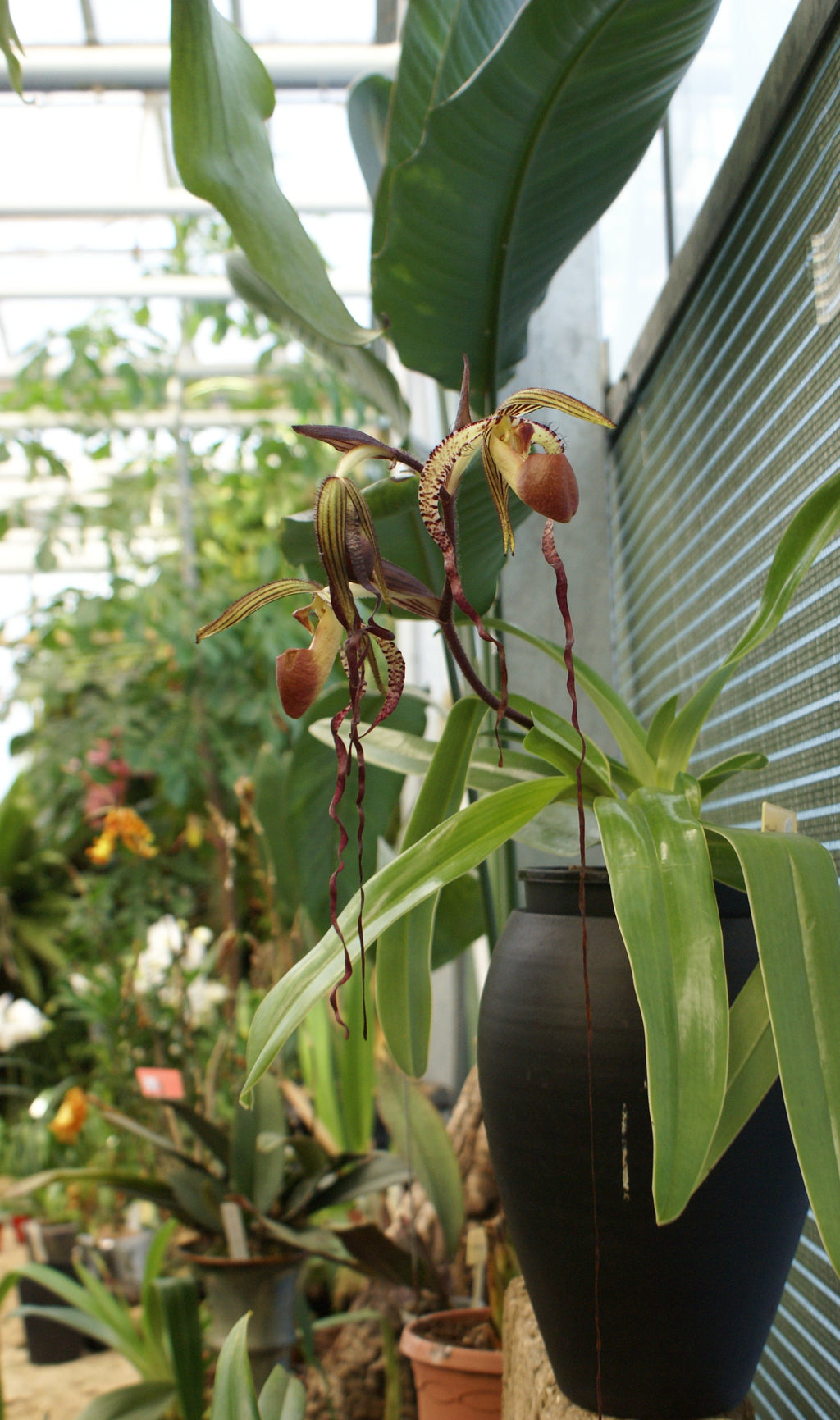
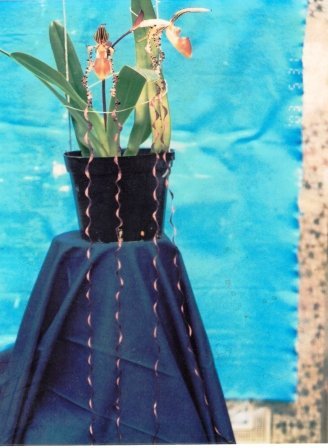
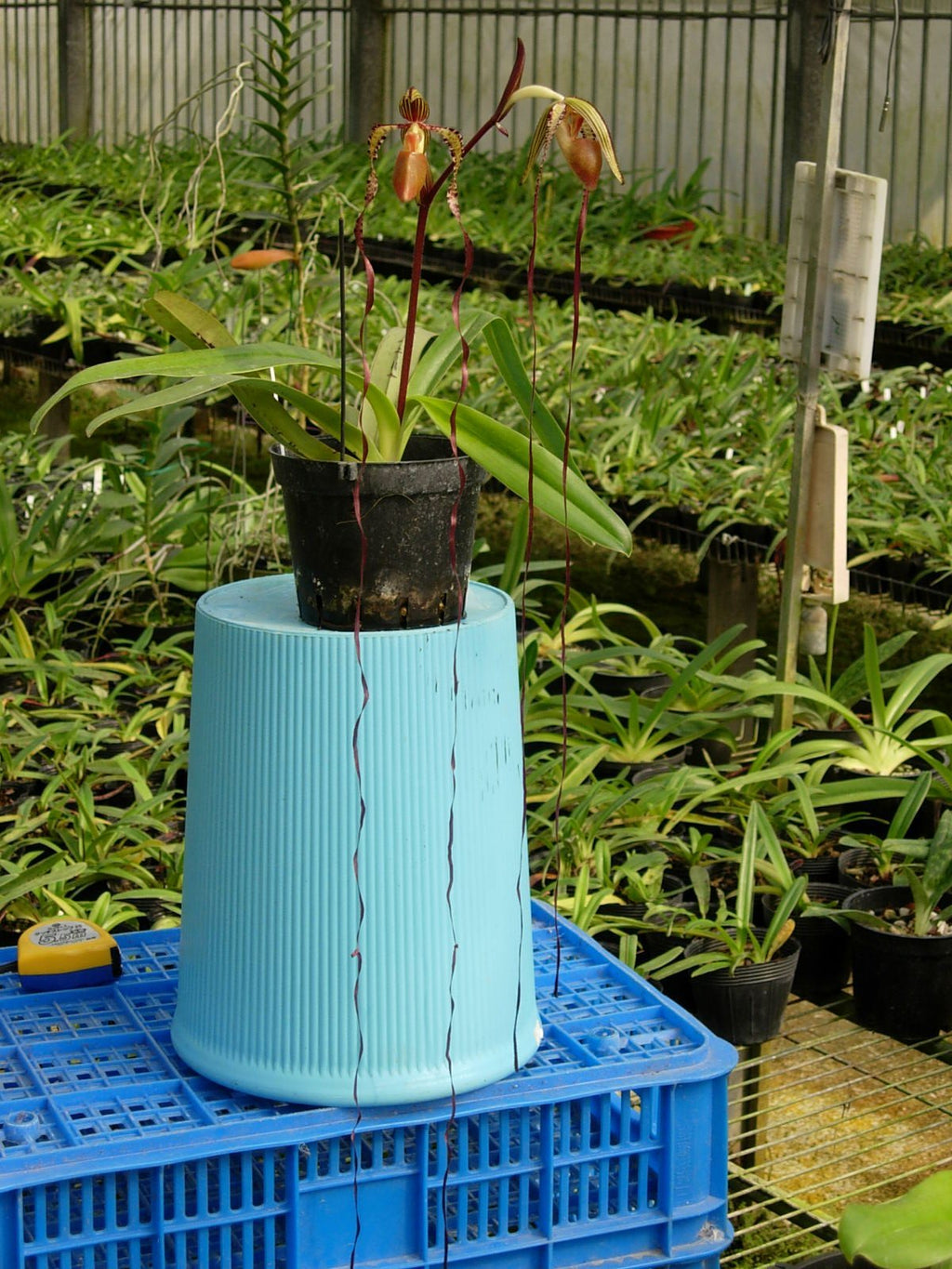
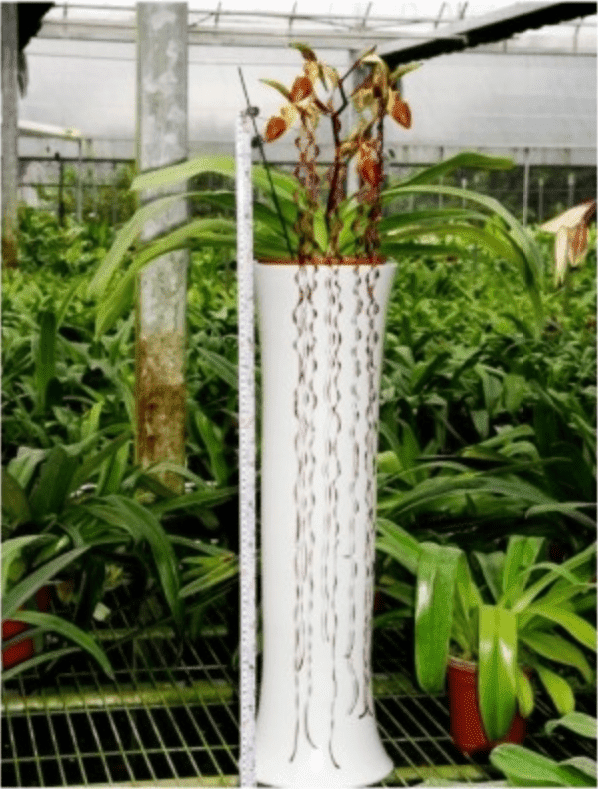
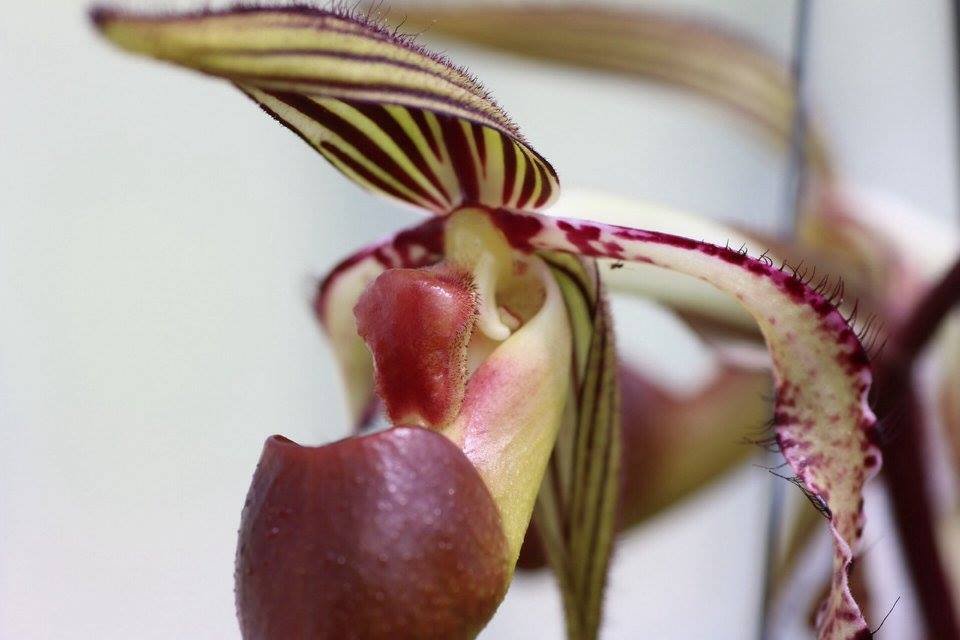
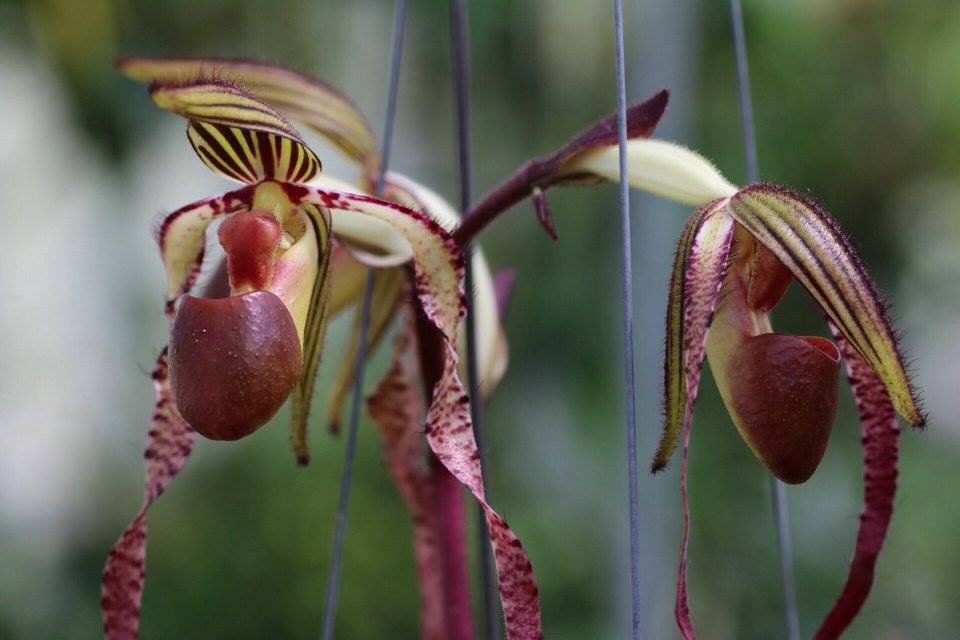
Paphiopedilum sanderianum is one of the most legendary lady's slipper orchids in the world. This botanical species from Borneo is famous for its extremely long, gracefully drooping petals, which can reach tens of centimeters in length on robust mature plants. It is precisely this unique flower shape that makes Paphiopedilum sanderianum so iconic in the orchid world.
This is no ordinary Paphiopedilum, nor is it a plant that blooms quickly. Paphiopedilum sanderianum grows slowly, requires patience, and needs time to build up its full flowering potential. On the other hand, a well-developed plant can produce blooms that are virtually unmatched by other orchids: multiple flowers at once, long, twisted petals, and an almost sculptural appearance.
Origin
Paphiopedilum sanderianum is native to Northwest Borneo, particularly the area around Gunung Mulu. In its natural habitat, the species grows on limestone cliffs and rocky areas, where the roots grow among moss, organic matter, and mineral crevices. The plant receives plenty of moisture from rain, mist, and dew, but the roots do not remain in heavy, oxygen-poor substrate for long periods.
This natural growth pattern explains a great deal about its care. Paphiopedilum sanderianum thrives in warmth, high humidity, good air circulation, and a well-aerated but evenly moist substrate. The plant should not be allowed to dry out completely, but it also cannot tolerate dense, wet potting mix.
Characteristics
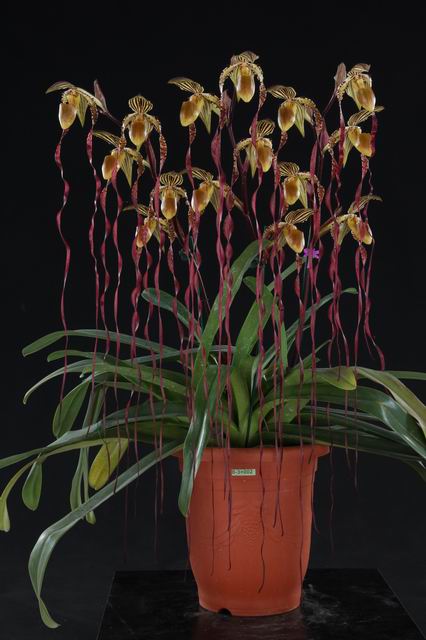
Paphiopedilum sanderianum produces sturdy, elongated green leaves arranged in fans. The plant grows slowly and builds up its flowering potential over several years. A mature, strong plant can produce an upright flower stalk bearing multiple flowers at once. Under good conditions, two to five flowers per stalk are typical.
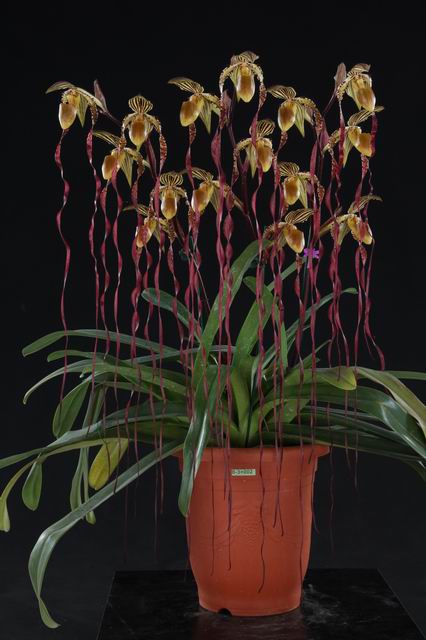
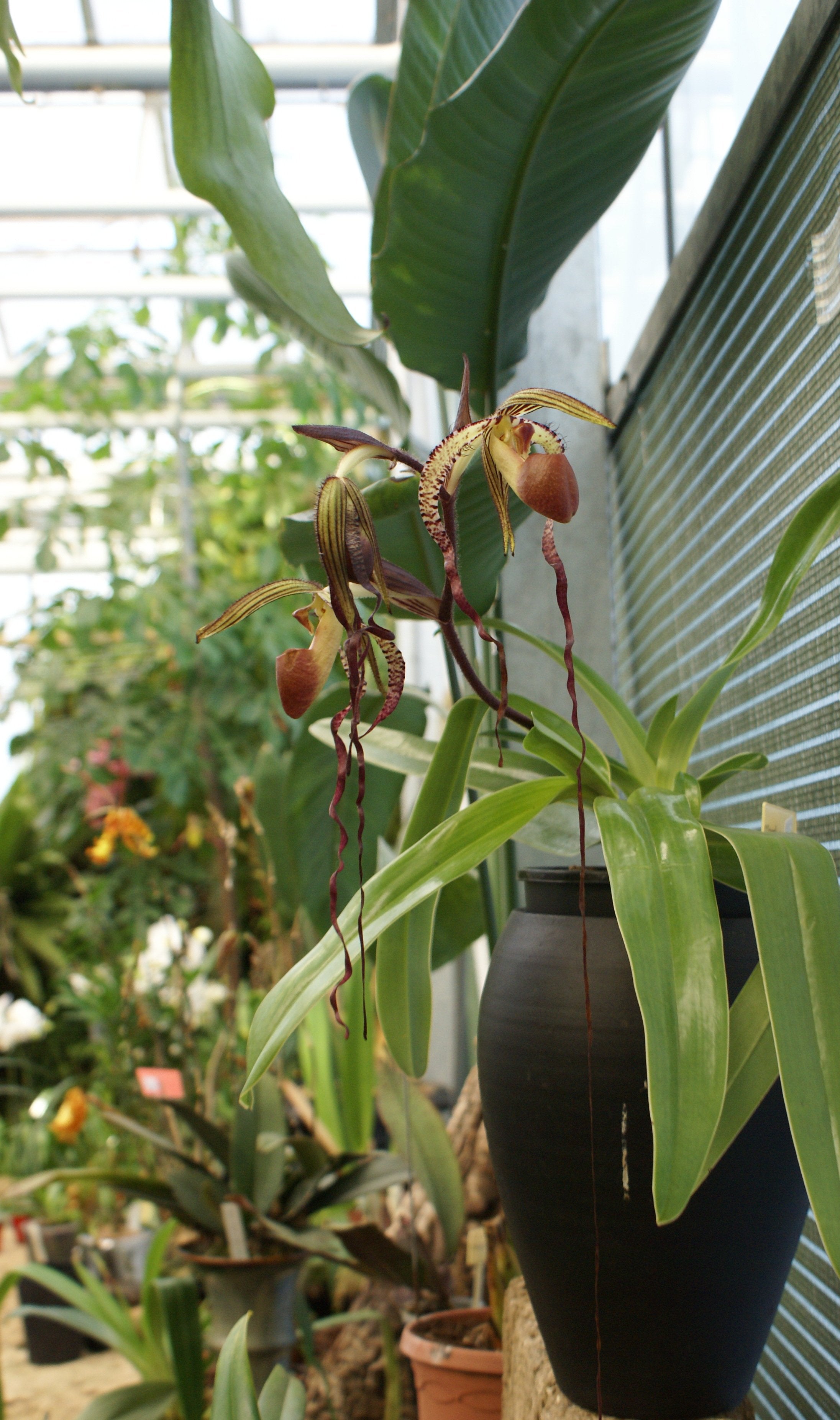
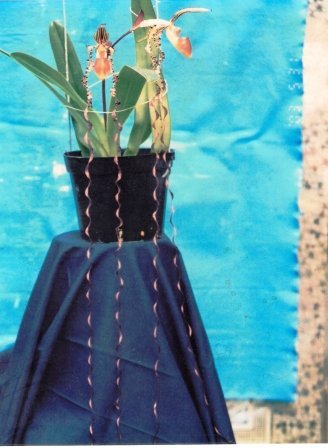
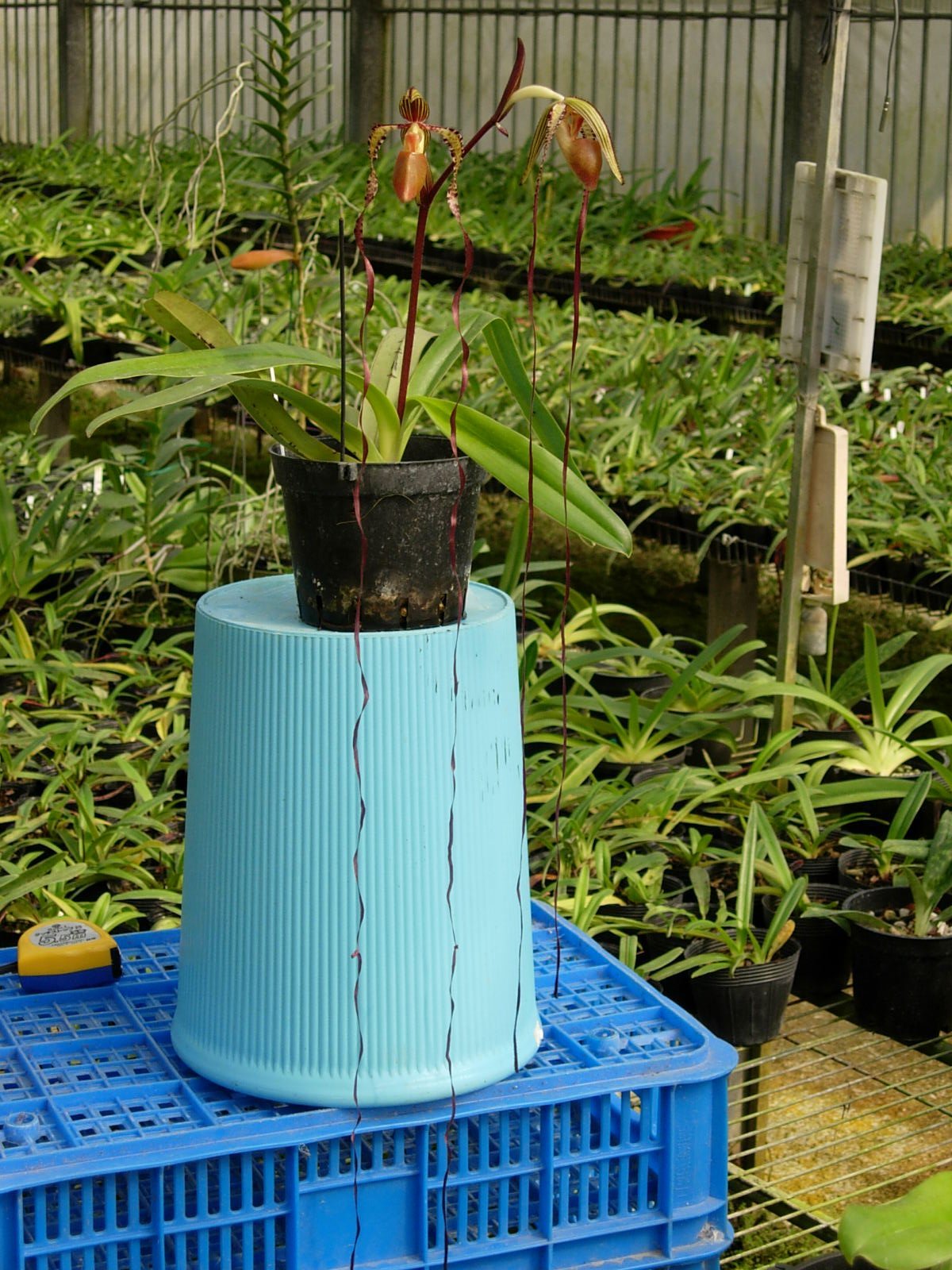
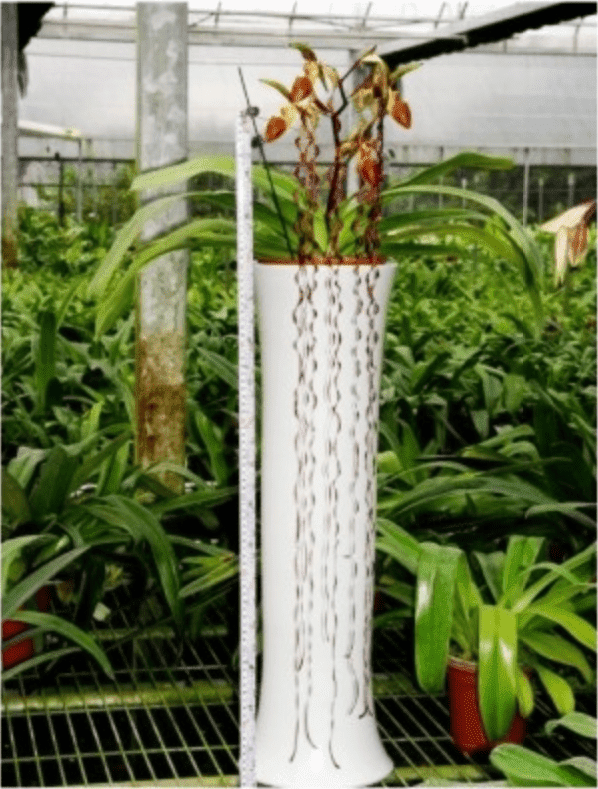
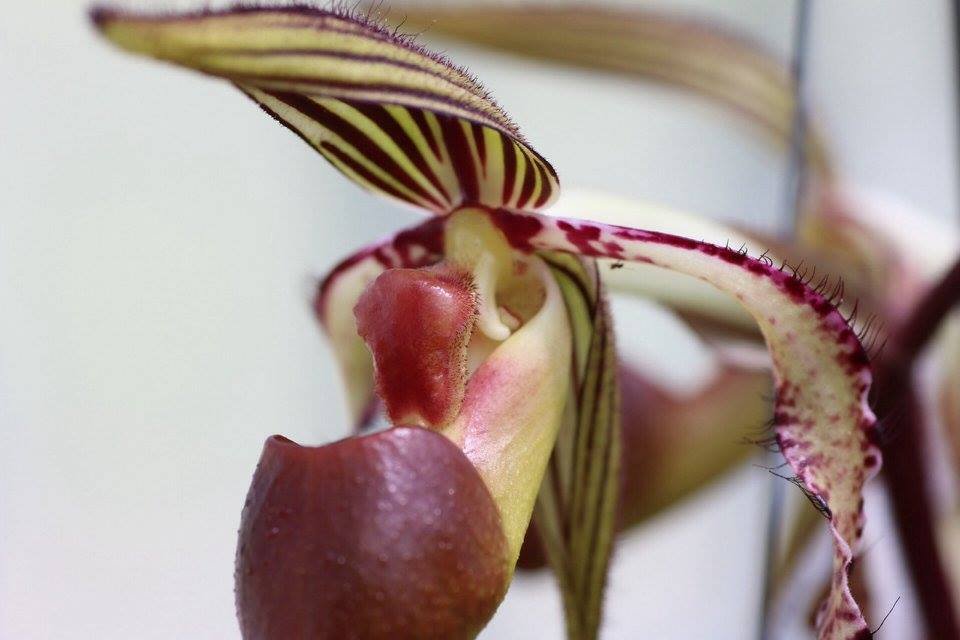
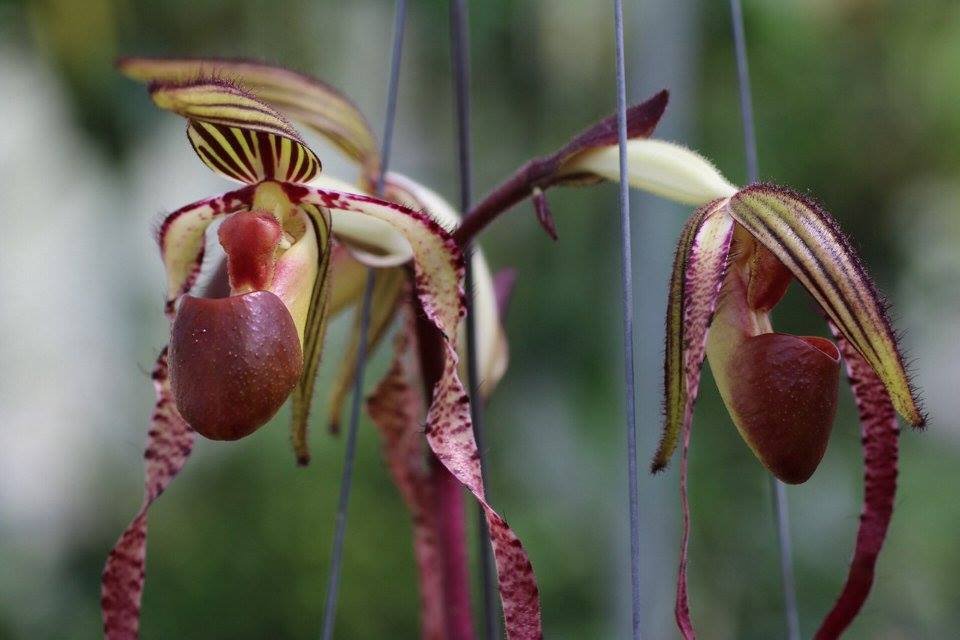
The flowers are remarkable for their extreme proportions. The dorsal sepal is striped, the lip has the typical Venus shoe shape, and the lateral petals hang down long. In mature plants, these petals can become very long. In cultivation, petal lengths of about 60 cm are commonly seen in good plants, while select varieties and exceptional specimens can reach 90 cm or more.
The flowers are usually marked with greenish, cream, brown-red, mahogany, and purple-brown hues. Their appearance is both elegant and dramatic. Paphiopedilum sanderianum is therefore not a species defined primarily by its vivid color, but rather by its form, length, rarity, and botanical status.
Why is Paphiopedilum sanderianum so valuable?
Paphiopedilum sanderianum is valuable because the species is rare, slow-growing, and highly sought after. It takes years for a plant to grow from a young seedling to a size ready to bloom. As a result, a lot of cultivation time, space, and risk goes into every good specimen.
In addition, the species is world-renowned for its extremely long petals. High-quality selections are often evaluated based on flower shape, number of flowers, vigor, and petal length. Plants from strong parent lines or with proven long petals can therefore be significantly more expensive than ordinary young seedlings.
With this species, you’re not just paying for a plant, but for time, genetics, rarity, and future flowering potential.
Blooming or non-Blooming: what does that mean for this species?
With Paphiopedilum sanderianum, the difference between a Blooming, an almost flowering-ready plant, and an adolescent specimen is significant. A flowering or flowering-ready plant is much more developed, has greater plant mass, and, with proper care, can produce flowers relatively faster. As a result, such a plant is usually significantly more expensive.
An adolescent specimen still requires patience. The plant has already passed the young seedling stage but must continue to grow before it can reliably bloom. This is normal for this species. The value lies primarily in building up a strong plant. Anyone who buys an adolescent specimen is consciously choosing a more affordable entry point into a very expensive species, with the expectation that flowering will come later.
Care
Light
Paphiopedilum sanderianum needs bright, filtered light. The plant can tolerate more light than many marbled-leaf Paphiopedilums, but should not be placed in harsh midday sun. Morning sun or late afternoon sun is often fine, especially when humidity is sufficient.
Insufficient light slows growth and makes flowering less likely. Too much direct sun can cause the leaves to turn yellow or become damaged. A bright, filtered windowsill, a sunroom, a greenhouse, or a plant room with grow lights is suitable.
Temperature
This species thrives in warm to intermediate temperatures. A daytime temperature of approximately 22 to 29°C is suitable. At night, the temperature may drop to about 17 to 21°C. A slight nighttime drop is beneficial, but prolonged cold should be avoided.
Paphiopedilum sanderianum grows naturally in a humid tropical region, but in rocky areas with good air circulation. Therefore, warmth is only beneficial when humidity, ventilation, and watering are also in balance.
Potting mix
Use a well-aerated Paphiopedilum mixture that retains moisture but remains well-aerated. A suitable mix can consist of fine to medium-coarse bark, perlite, pumice, Seramis, some sphagnum moss, and possibly a small amount of lime or minerals.
Since the species grows on limestone walls, a slightly mineral-rich, well-draining mix makes sense. The substrate must not become compacted. Old, decomposed bark retains too much water and can cause root problems. Regular repotting into fresh, airy substrate is therefore important.
Humidity
A humidity level of about 60 to 80% is ideal. The plant prefers a stable, moist environment but does not like stagnant air. Good air circulation is essential, especially in warm temperatures and higher humidity.
In dry indoor air, growth may be slow, and leaf tips or roots may develop problems more quickly. A greenhouse, conservatory, plant room, or bright spot with more stable humidity is often more favorable than a dry windowsill.
Watering
Keep the growing medium evenly and lightly moist. Paphiopedilum sanderianum does not have pseudobulbs and should therefore not be allowed to dry out completely for long periods. Water again when the top layer begins to dry out, while the mixture deeper in the pot is still slightly moist.
However, avoid letting the roots remain constantly wet and deprived of oxygen. Water preferably in the morning and use rainwater, demineralized water, or soft water at room temperature. Do not allow water to stand in the crown or leaf axils for extended periods.
Fertilization
During active growth, apply a light dose of orchid fertilizer regularly. A quarter to half the recommended dose is usually sufficient. Paphiopedilum sanderianum grows slowly and responds better to regular, light fertilization than to heavy fertilization.
Rinse the substrate occasionally with clean water to prevent the buildup of fertilizer salts. During cooler or darker periods, fertilization may be reduced.
Flowering
A mature Paphiopedilum sanderianum can bear several flowers at once. The flowers open on an upright stem and develop long, pendulous petals that can continue to grow even after opening. Give the flower stem enough space so that the petals can hang freely downward without being damaged.
Flowering requires a strong, mature plant, sufficient light, healthy roots, and stable, warm conditions. Do not expect young or adolescent plants to flower quickly. With this species, patience is part of the experience.
Care Level
Paphiopedilum sanderianum is suitable for advanced enthusiasts. The plant isn’t impossible to grow, but it grows slowly and requires stable conditions. In particular, temperature, light, humidity, substrate quality, and watering must be well balanced.
This species is generally less suitable for beginners, unless they are already willing to seriously delve into the care of Paphiopedilum. For experienced collectors, however, this is one of the most rewarding species within the genus.
Who is this plant suitable for?
Paphiopedilum sanderianum is suitable for collectors who deliberately choose a rare botanical lady’s slipper orchid with high collector’s value. The plant is a good fit for enthusiasts of multifloral Paphiopedilums, botanical species, and exclusive orchids where growth quality is more important than rapid flowering.
An adolescent specimen is particularly suitable for someone who enjoys nurturing a prized species themselves. Those who want flowers right away are better off choosing a plant that is ready to bloom or is already in bloom. Those with patience will find that Paphiopedilum sanderianum is one of the most iconic orchids in the world.
Growing Experience at Home or in a Greenhouse
In a greenhouse, conservatory, or plant room, Paphiopedilum sanderianum is usually easier to keep stable than on a dry windowsill. The plant thrives in warmth, consistent humidity, and good air circulation. On a windowsill, it will only do well if the spot is bright, warm, and not too dry.
The plant grows slowly. New leaves, sturdy roots, and healthy fronds are more important than rapid, visible changes. It can take years to build up a strong plant before it produces its first impressive bloom. That is precisely what makes this species special for collectors.
Extra care tip
Give Paphiopedilum sanderianum plenty of vertical space when it’s flowering. The petals can grow downward for a long time and need space to develop properly. Therefore, do not place a flowering plant directly on a low shelf or up against other plants.