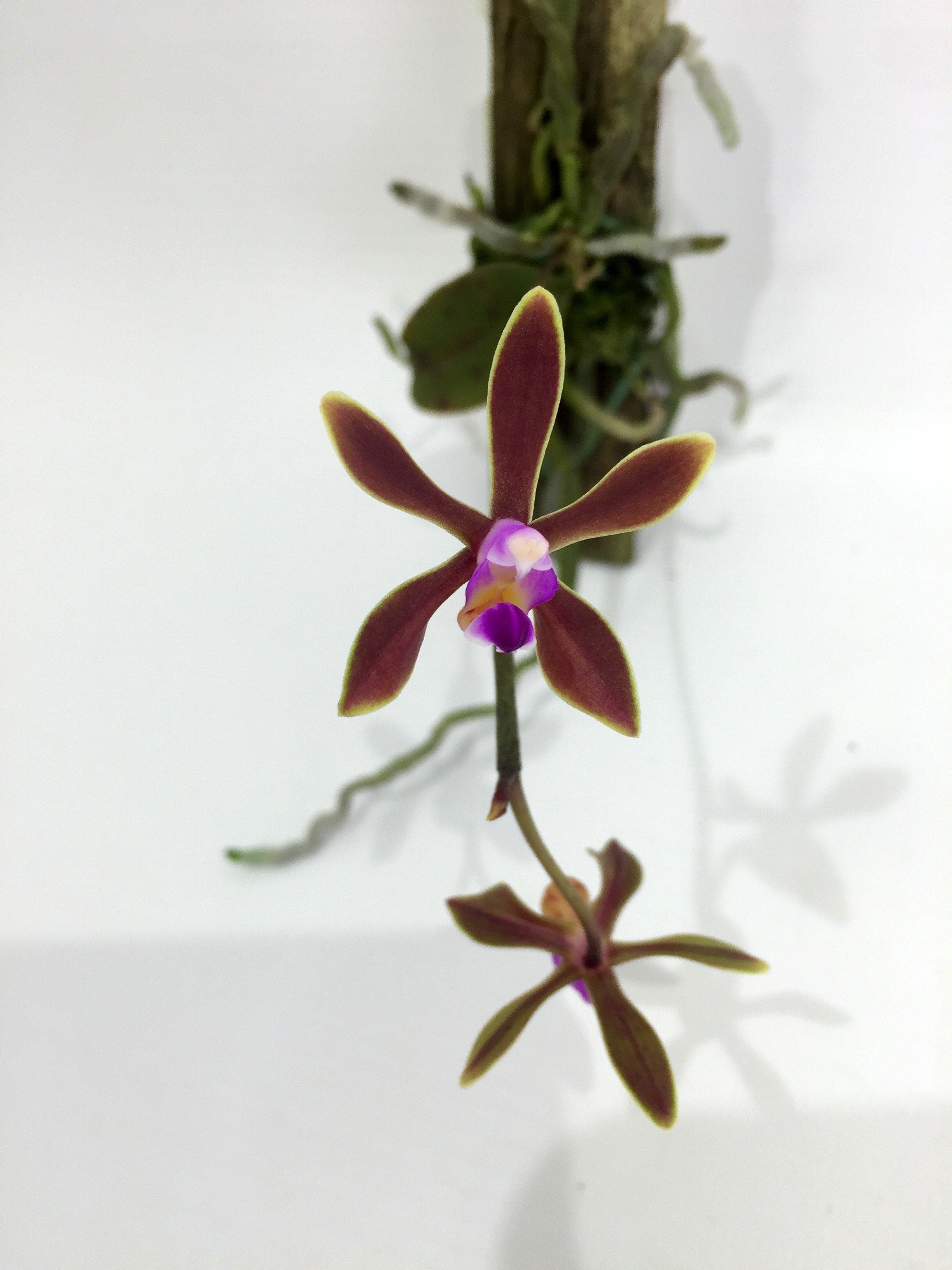
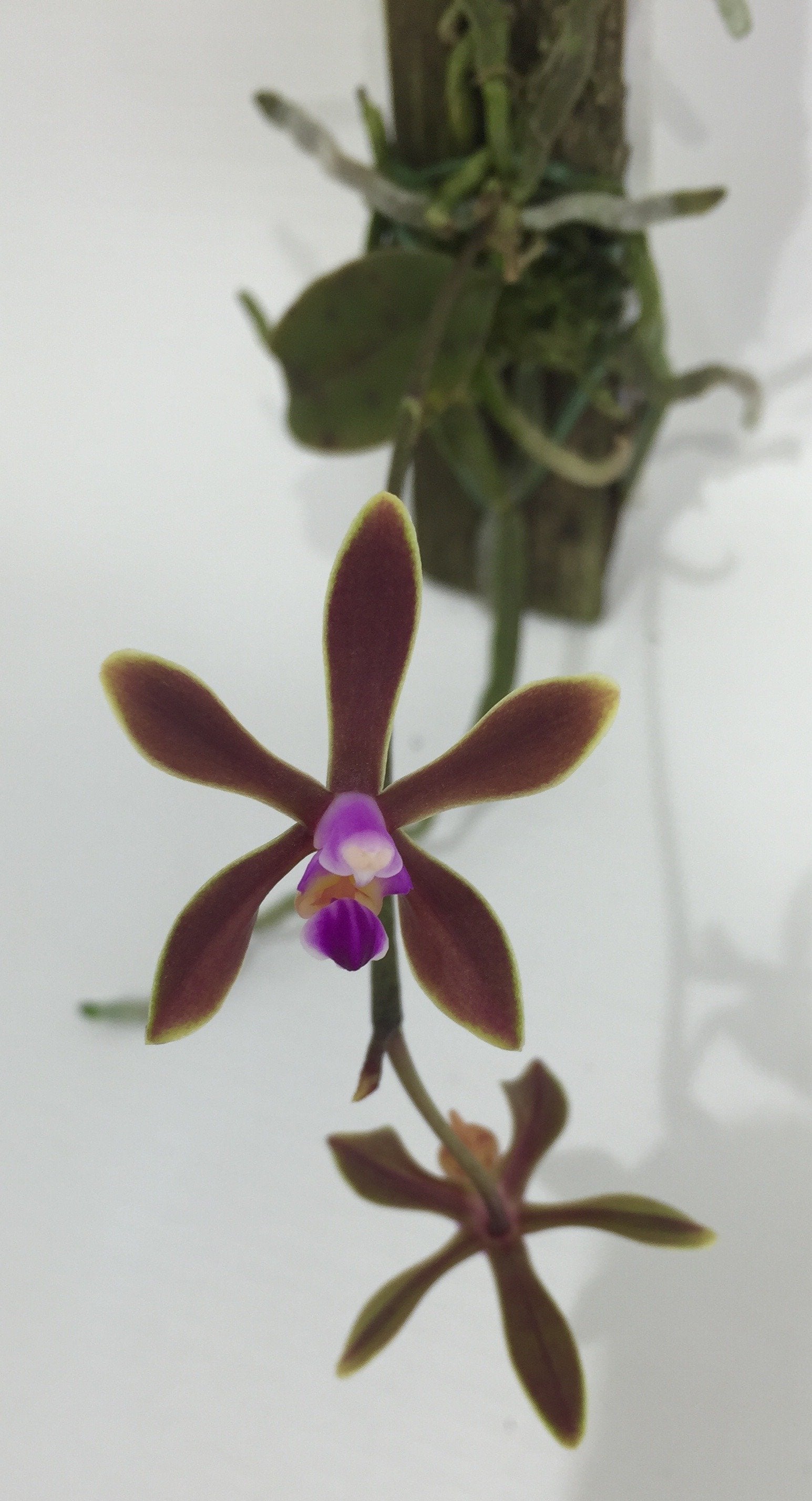
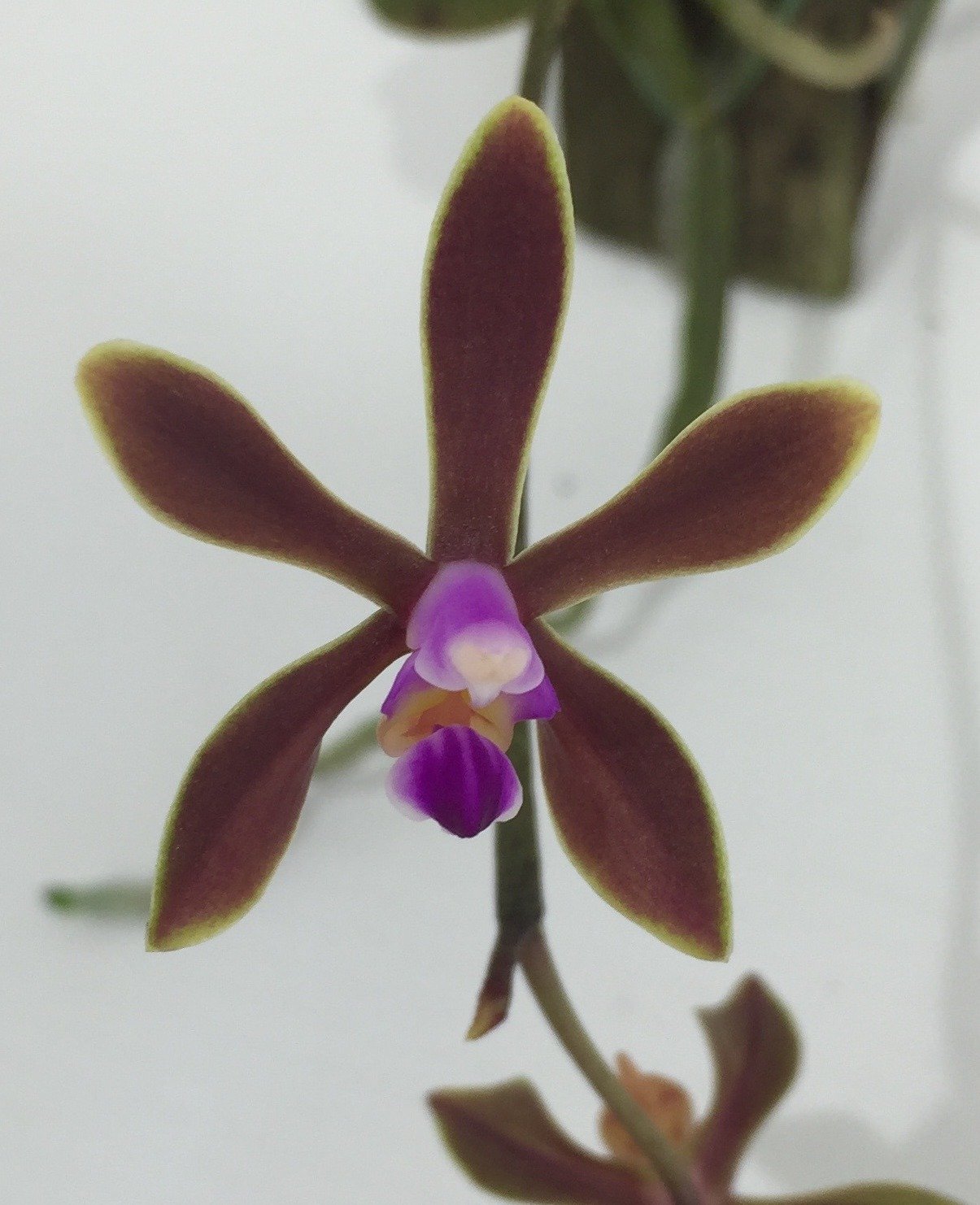
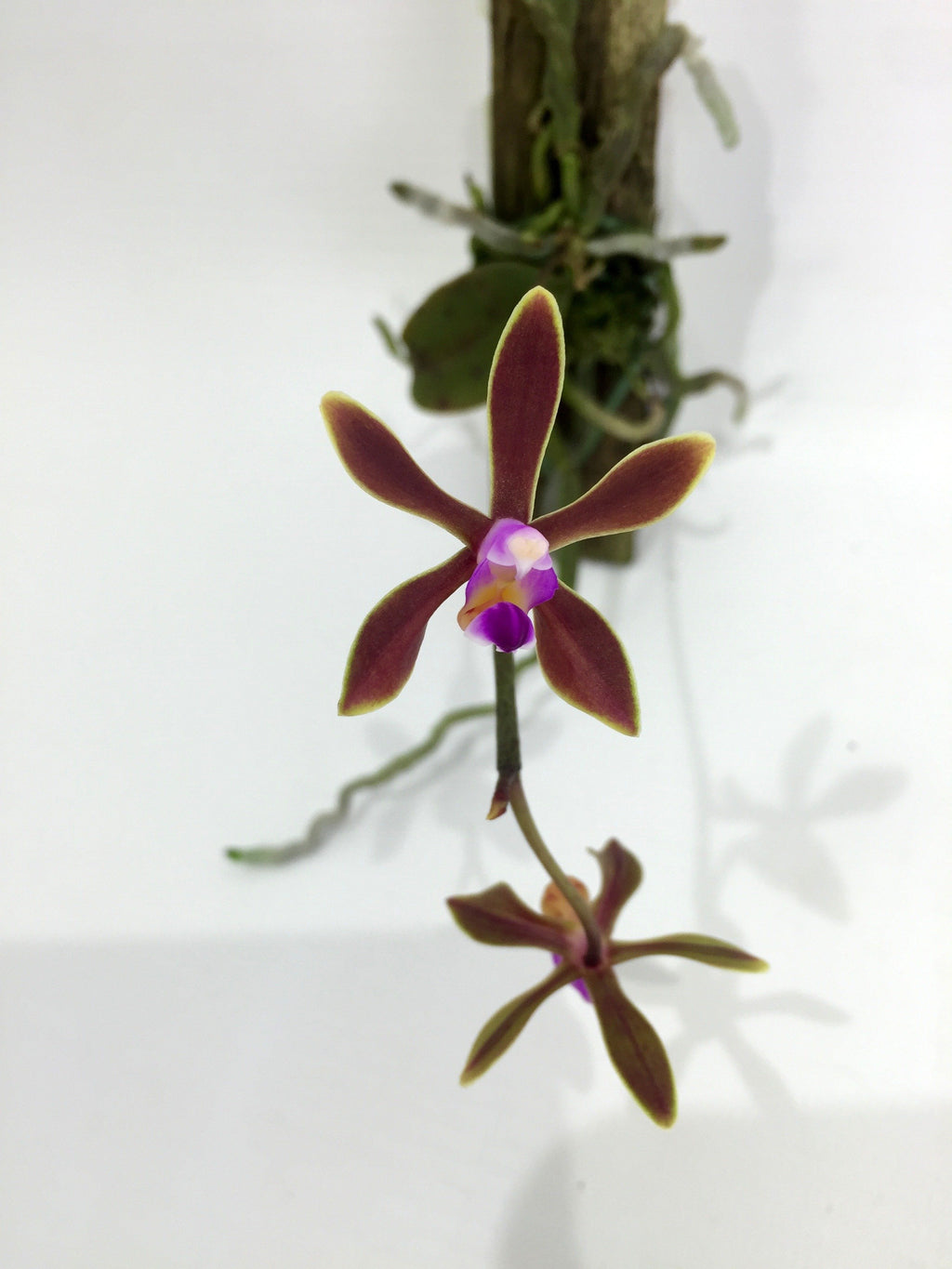
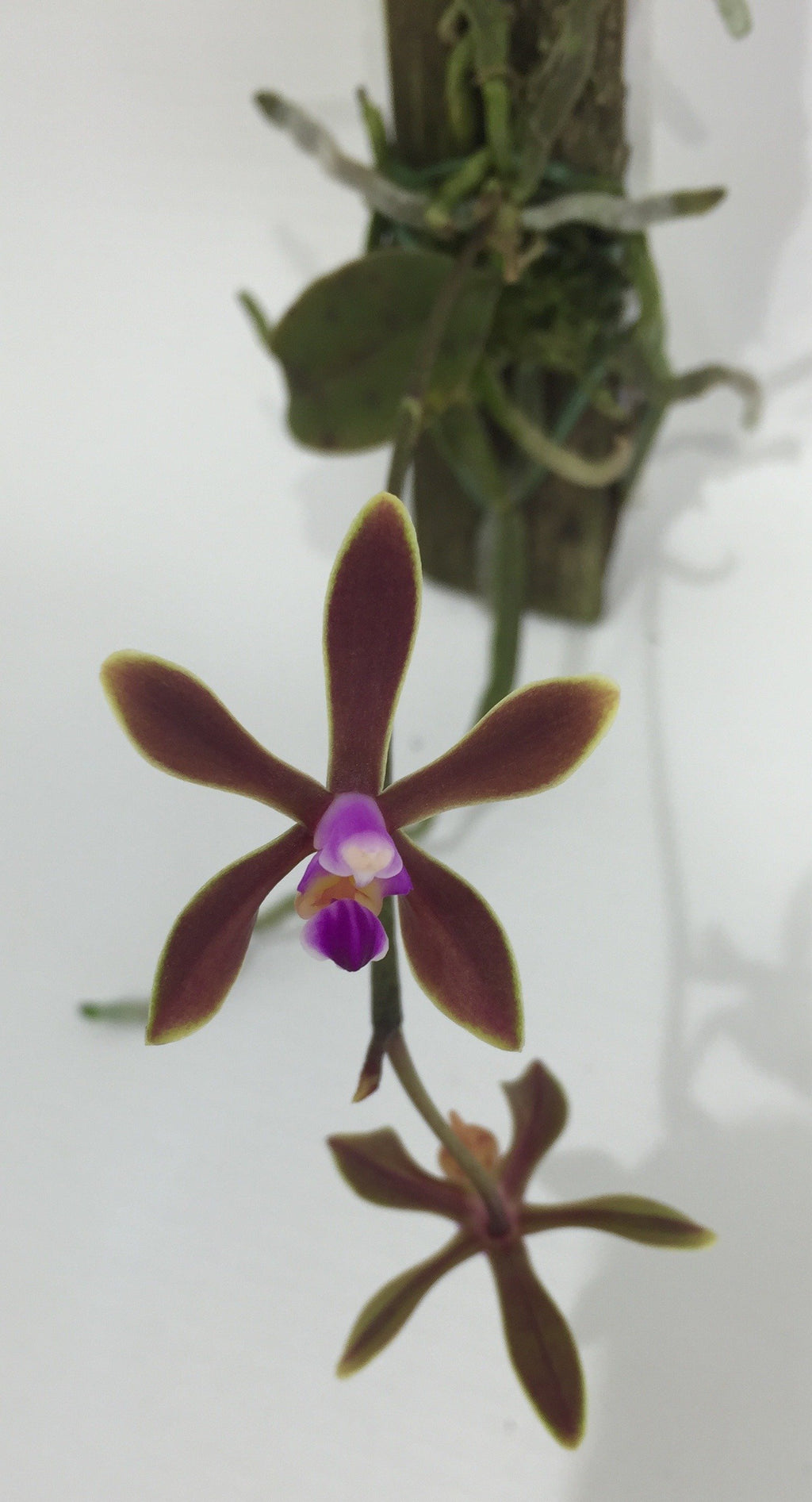
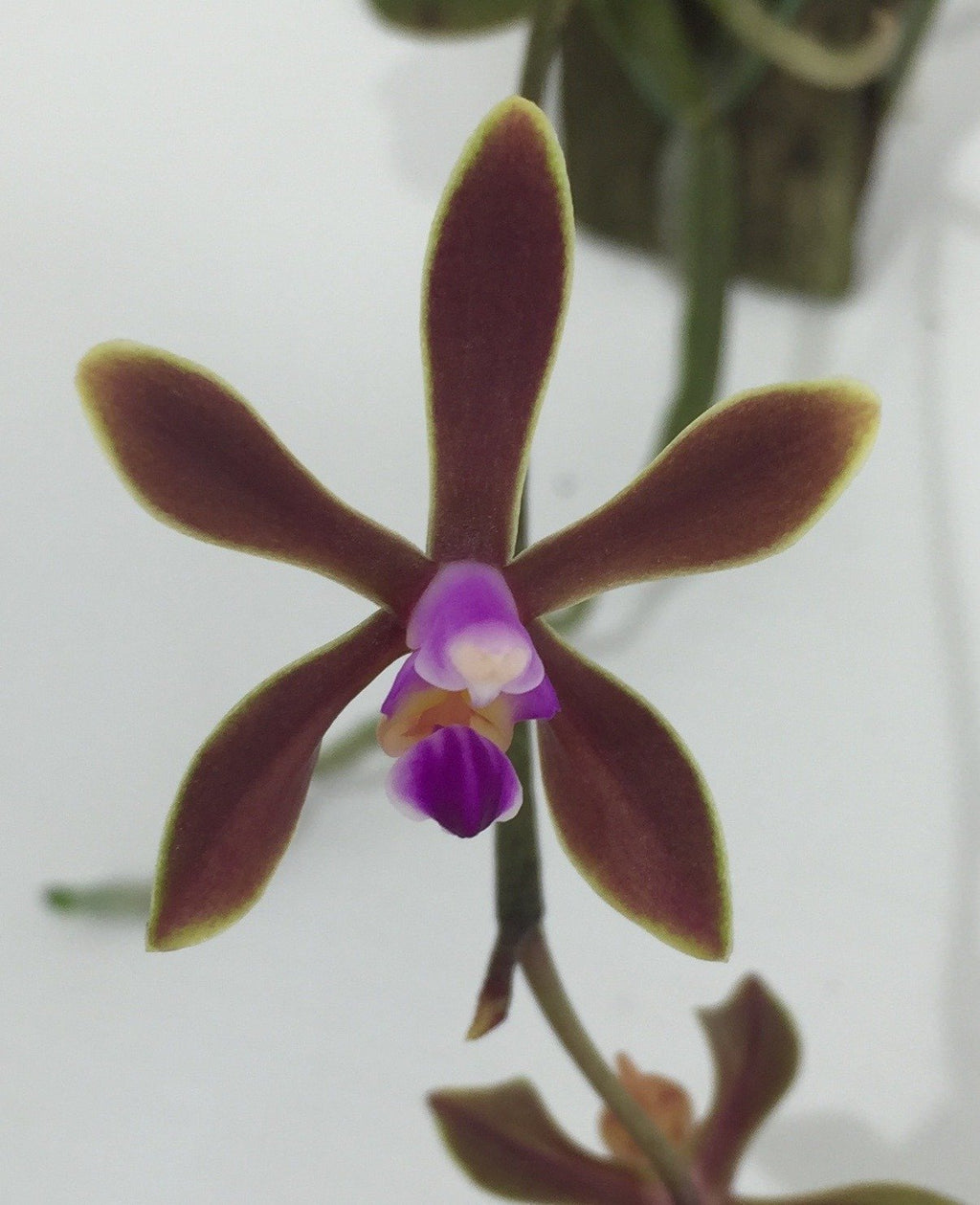
Phalaenopsis stobartiana is a compact botanical Phalaenopsis with a surprisingly mature root system and delicately shaped, apple-green to olive-green flowers. The bright pink to purplish-pink lip and column create a striking color contrast that is rarely seen in the well-known living-room hybrids.
This species is particularly appealing to collectors seeking a true miniature without sacrificing a recognizable Phalaenopsis appearance. Furthermore, the plant exhibits an interesting seasonal rhythm. During a drier period, it may lose some of its leaves, while the thick, photosynthetic roots remain visibly active.
Name and Taxonomy
Phalaenopsis stobartiana was described in 1877 and remains the accepted botanical name. Older names that may appear on plant labels and in collections include Phalaenopsis hainanensis, Kingidium stobartianum, Polychilos stobartiana, and Doritis stobartiana.
The name Phalaenopsis hainanensis, in particular, is still commonly used, as it refers directly to Hainan, the island where the species occurs naturally. Botanically, however, this name is now treated as a synonym of Phalaenopsis stobartiana.
The species belongs to a group of compact Phalaenopsis species that exhibit a more distinct seasonal rhythm than most modern hybrids. This explains why the plant can be partially deciduous under certain conditions.
Origin
Phalaenopsis stobartiana is native to Hainan, a tropical island in southern China. There, the species grows as an epiphyte on tree trunks in humid forests, including areas near waterways. The plant benefits from high ambient humidity, filtered light, and plenty of air movement around its roots.
At the same time, the climate exhibits seasonal variations. During the warmer growing season, more moisture is available, while the winter months are relatively drier. The plant responds to this by slowing its growth and sometimes shedding some of its leaves.
However, this does not mean that Phalaenopsis stobartiana should be treated as a cool, completely dry-resting orchid. The roots remain alive even during the dormant period and should not be allowed to shrivel for long periods.
Characteristics
The plant produces a very short, monopodial stem with typically a few elongated to elliptical leaves. These leaves grow to about seven to eleven centimeters in length. As a result, the above-ground portion of the plant remains compact, making the species well-suited for a collection of miniature orchids.
In proportion to the small leaves, the root system can become strikingly large. The thick roots are covered with a silvery-gray velamen and can cover a considerable area of the pot, cork board, or other substrate. They not only store moisture but also contribute to photosynthesis due to their green inner layer.
The unbranched flower stalks grow upright to slightly curved and can protrude clearly above the leaves. A single flower stalk usually bears a few flowers. These open wide and typically have a diameter of about three to four centimeters.
The flower parts range in color from fresh apple green to dark olive green. In contrast, the lip and column are a striking pink to purplish-pink. The exact shade of green, shape, and amount of pink can vary from plant to plant. Some plants also emit a light fragrance, but the intensity varies and is sometimes barely perceptible. Therefore, choose this variety primarily for its botanical appeal and color contrast, not for a guaranteed strong scent.
Care
Although Phalaenopsis stobartiana can grow well in a bright living room under stable conditions, the species requires a bit more care than a standard Phalaenopsis hybrid. In particular, its extensive root system and seasonal variations in water requirements deserve attention.
During active growth, the plant requires regular watering and a well-aerated, slightly moist root zone. In winter, watering should be reduced, but the roots must not be allowed to dry out completely for extended periods. Those who learn to recognize this transition will be rewarded with a compact and exceptionally floriferous botanical orchid.
Light
Provide Phalaenopsis stobartiana with bright, filtered light. An east-facing window is often ideal, as the plant receives gentle morning sun there without getting scorched during the hottest hours of the day. A west- or south-facing window is also suitable if the bright midday sun is filtered.
The leaves should be fresh green to slightly yellow-green. Very dark green, limp leaves and new leaves that keep getting longer may indicate that the plant is in a location that is too dark. Too much direct sunlight, on the other hand, can cause pale, dry, or sunken spots.
During the Dutch winter, the plant should be placed in a relatively bright spot. This aids both photosynthesis in the leaves and in the green roots. When the plant becomes partially leafless, these roots remain particularly important for energy supply. Therefore, do not completely cover them with dark or dense substrate.
Temperature
This species thrives in warm to moderate temperatures. During the active growing season, a daytime temperature between approximately 22 and 28 °C is suitable. At night, the temperature may drop to about 17 to 21 °C.
In the fall and winter, the plant can be kept slightly cooler, with nighttime temperatures around 16 to 19 °C providing a natural seasonal variation. However, avoid temperatures below about 14 to 15 °C, especially when the roots are wet. Phalaenopsis stobartiana does benefit from a slight drop in temperature, but it is not a plant that thrives in cold conditions.
During hot summer days, temperatures above 30 °C are better tolerated when humidity, ventilation, and watering are properly balanced. Stagnant, hot air increases the risk of dehydration and damage to young leaves.
Substrate and Cultivation Method
Due to its robust root system, this small plant primarily needs space and oxygen around its roots. A small open pot or net pot filled with medium-coarse orchid bark, charcoal, and possibly some perlite or pumice is suitable. In a dry living room, a small amount of loose sphagnum moss can be added, as long as the mixture does not become compacted or constantly wet.
Mounting the plant on cork or hardwood also aligns well with its natural growth habits. If desired, use a thin layer of sphagnum moss under the roots to help retain moisture slightly longer. A mounted plant does, however, need to be watered considerably more often during warm growing periods than a potted plant.
Never choose a deep pot filled with fine substrate just because the plant has many roots. The roots prefer to grow over an open surface rather than in an oxygen-deprived, wet core. Repot when the substrate begins to decompose or as soon as new active root tips appear.
Humidity
A humidity level of approximately 55 to 75 percent is suitable. In an orchid cabinet or greenhouse, this level may be higher, provided the air is constantly circulating gently.
Good ventilation is especially important around the crown and between the roots. High humidity without air movement can lead to leaf spots, crown rot, and damaged root tips. Therefore, do not mist late in the evening and do not allow water to pool in the center of the plant.
In a normal living room, the plant can also grow when the humidity is slightly lower. A potted plant with a limited amount of moisture-retaining material is often more practical there than a fully mounted plant.
Watering
During the formation of new leaves and roots, Phalaenopsis stobartiana should be watered regularly. Thoroughly wet the roots and allow the excess water to drain completely. Water again as soon as the roots are mostly silver-gray again and the growing medium begins to dry out slightly.
Green, wet roots have absorbed enough moisture. Silver-gray roots indicate that it’s time to water again. Also pay attention to the weight of the pot and the condition of the growing medium.
Starting in the fall, you can gradually reduce watering. Allow the root zone to dry out more noticeably, but prevent all the roots from becoming thin and shriveled for extended periods. A plant that loses its leaves evaporates less water and therefore automatically needs to be watered less often.
Water preferably in the morning and use soft, lukewarm water. Remove any water that remains in the crown with a piece of absorbent paper. Especially during cooler nights, standing water can quickly lead to crown rot.
Fertilization
During active root and leaf growth, apply a highly diluted orchid fertilizer once every one to two weeks. A quarter of the normal recommended dosage is usually sufficient. Rinse the substrate regularly with clean water to prevent a buildup of fertilizer salts.
During the quieter winter period, fertilization can be greatly reduced or temporarily stopped. Resume fertilizing as soon as fresh green root tips or a new leaf become visible.
Flowering
The natural flowering period is usually in late spring and early summer. One or sometimes several slender flower stalks emerge from the short stem, bearing a few widely open flowers.
The combination of green sepals and petals with an intense pink lip is its most distinctive ornamental feature. Although the flowers are smaller and fewer in number than those of modern Phalaenopsis hybrids, their natural form and distinctive colors give them significant collector’s value.
A mature plant can bloom regularly if it receives sufficient light in the winter and experiences a moderate reduction in watering. Do not cut back a spent flower stalk until it has turned completely brown and dry.
Care Level
Phalaenopsis stobartiana has a moderate care level. This species thrives in a bright living room, a plant grow box, or a warm greenhouse, but requires more attention than a typical butterfly orchid. Watering, in particular, must be adjusted according to the amount of foliage, active root growth, and the season.
The plants offered are mature and were recently imported; they have since been further acclimated at our facility. The visible active root growth indicates that they are re-establishing themselves. Therefore, after receiving the plant, give it some rest and a stable location. Do not repot it immediately if the current growing medium is still loose and usable.
Depending on the variety chosen, the plant will be delivered as Blooming or non-Blooming. A non-Blooming specimen may first produce new roots or leaves after being moved to a new environment before the next flower stalk appears.
Who is this plant suitable for?
This species is suitable for enthusiasts who want to look beyond the well-known large-flowered Phalaenopsis hybrids. Collectors of botanical miniatures, green orchid flowers, and seasonal varieties will particularly appreciate this plant.
It’s also a good fit for someone who has limited space for large leaves but can accommodate a relatively extensive aerial root system. The plant itself remains small, but the roots shouldn’t be constantly confined to a pot that’s too small.
For an absolute beginner who wants to care for an orchid according to a fixed weekly schedule, this species is less straightforward. However, those who regularly check the root color and active growth will find it easy to monitor and quite interesting.
Experience growing indoors, in a greenhouse, or in an orchid cabinet
Indoors, Phalaenopsis stobartiana prefers a bright east-facing window or a filtered south- or west-facing window. Make sure the plant is kept warm enough, but not directly above a hot radiator. An open orchid pot makes it easier to monitor the condition of the roots.
In a warm to moderate greenhouse, this species can be placed among the smaller Phalaenopsis species. Provide it with sufficient shade from the bright midday sun, but do not place it deep beneath larger plants where hardly any light reaches it.
This species also thrives in a well-ventilated orchid cabinet or plant climate cabinet. There, the roots can grow over cork or in an open basket. However, a permanently wet and virtually enclosed terrarium is less suitable. The plant does require a humid environment, but it also needs a good airflow and a root zone that can dry out somewhat during the winter months.
Extra care tip
Don’t panic immediately if a healthy specimen loses one or more leaves during the drier season. For Phalaenopsis stobartiana, this can be part of its natural seasonal rhythm. In that case, be sure to check the roots. As long as they remain firm and turn green after watering, the plant is still active.
If, on the other hand, the leaves suddenly turn yellow during warm, active growth and the roots are brown or soft, this is more likely a sign of a substrate that is too wet or lacks oxygen. Leaf loss must therefore always be assessed in conjunction with the condition of the roots and the season.
Short product description
Phalaenopsis stobartiana is a compact botanical miniature orchid from Hainan with apple-green to olive-green flowers and a striking pink lip. The plant develops an extensive root system relative to its small leaves and may shed some of its leaves during drier periods. A unique species for a bright windowsill, warm greenhouse, or well-ventilated orchid cabinet.