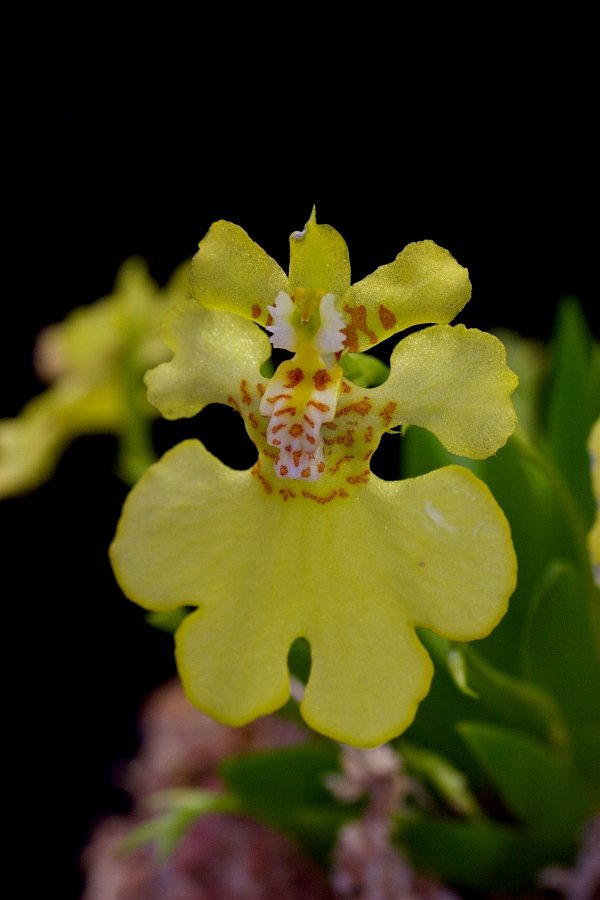
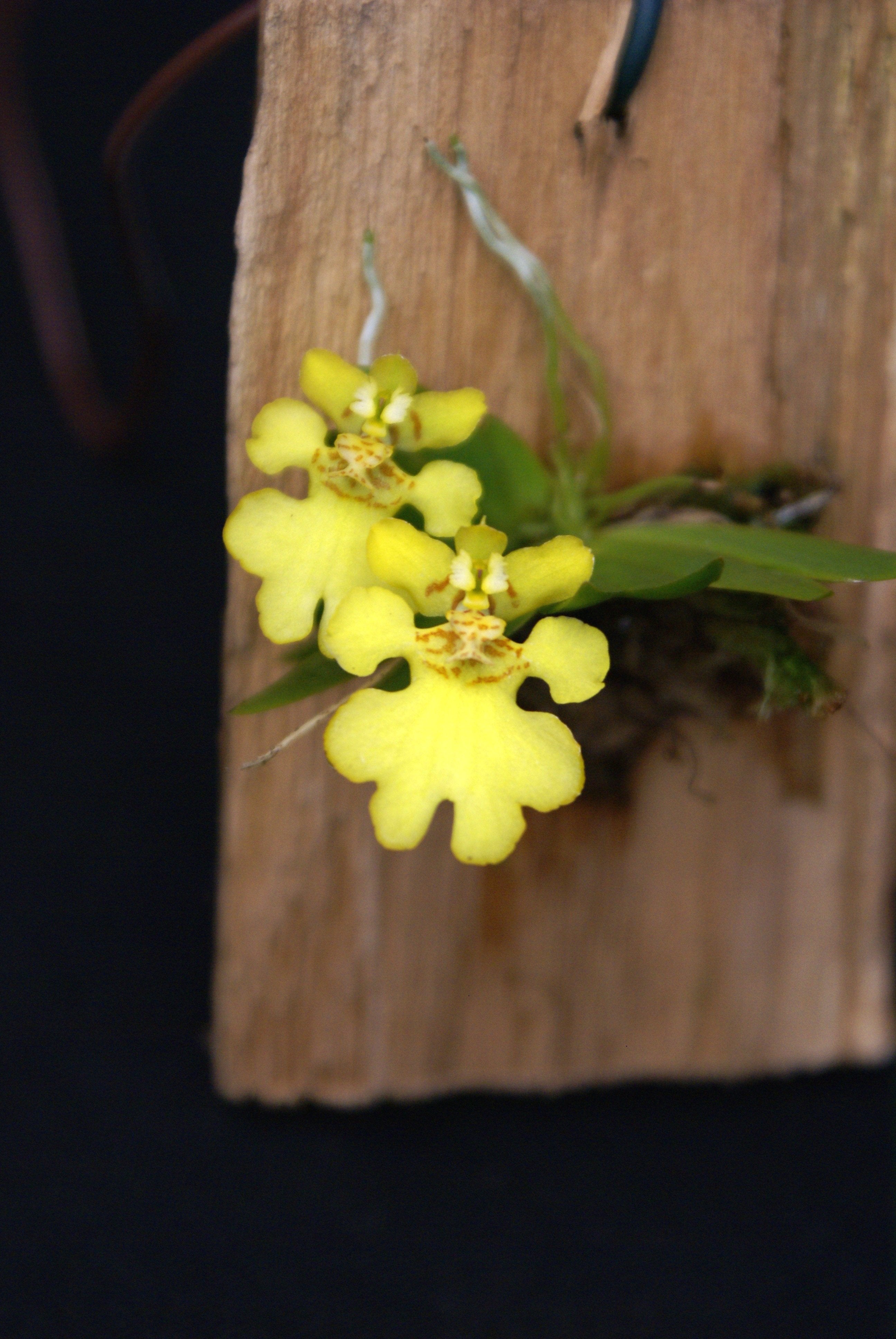
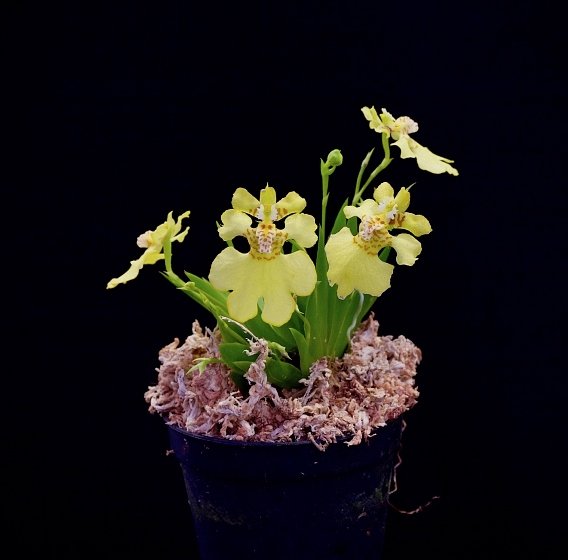
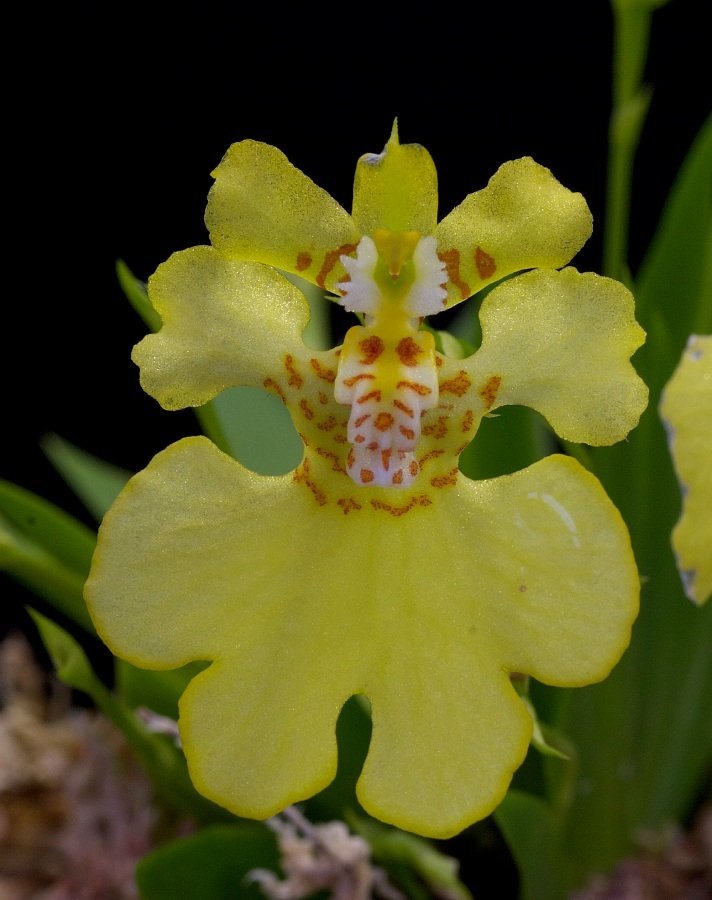
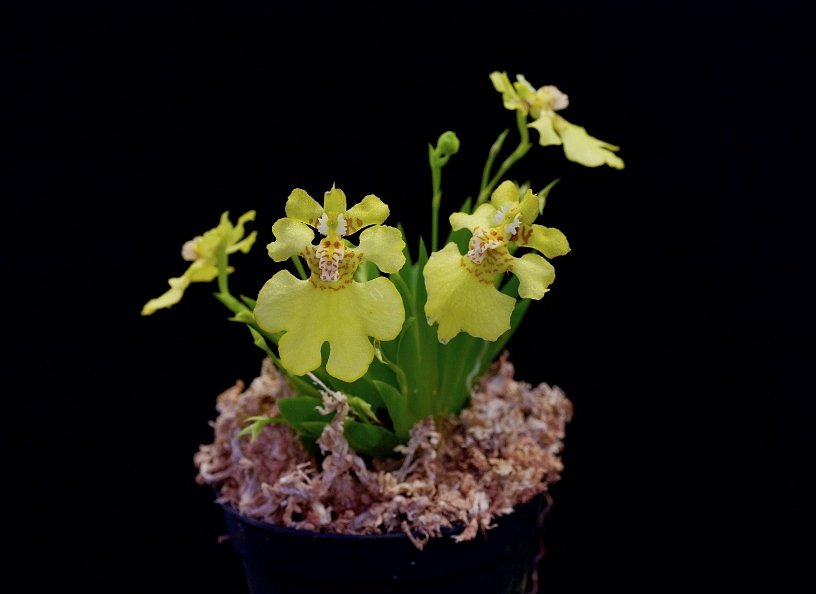
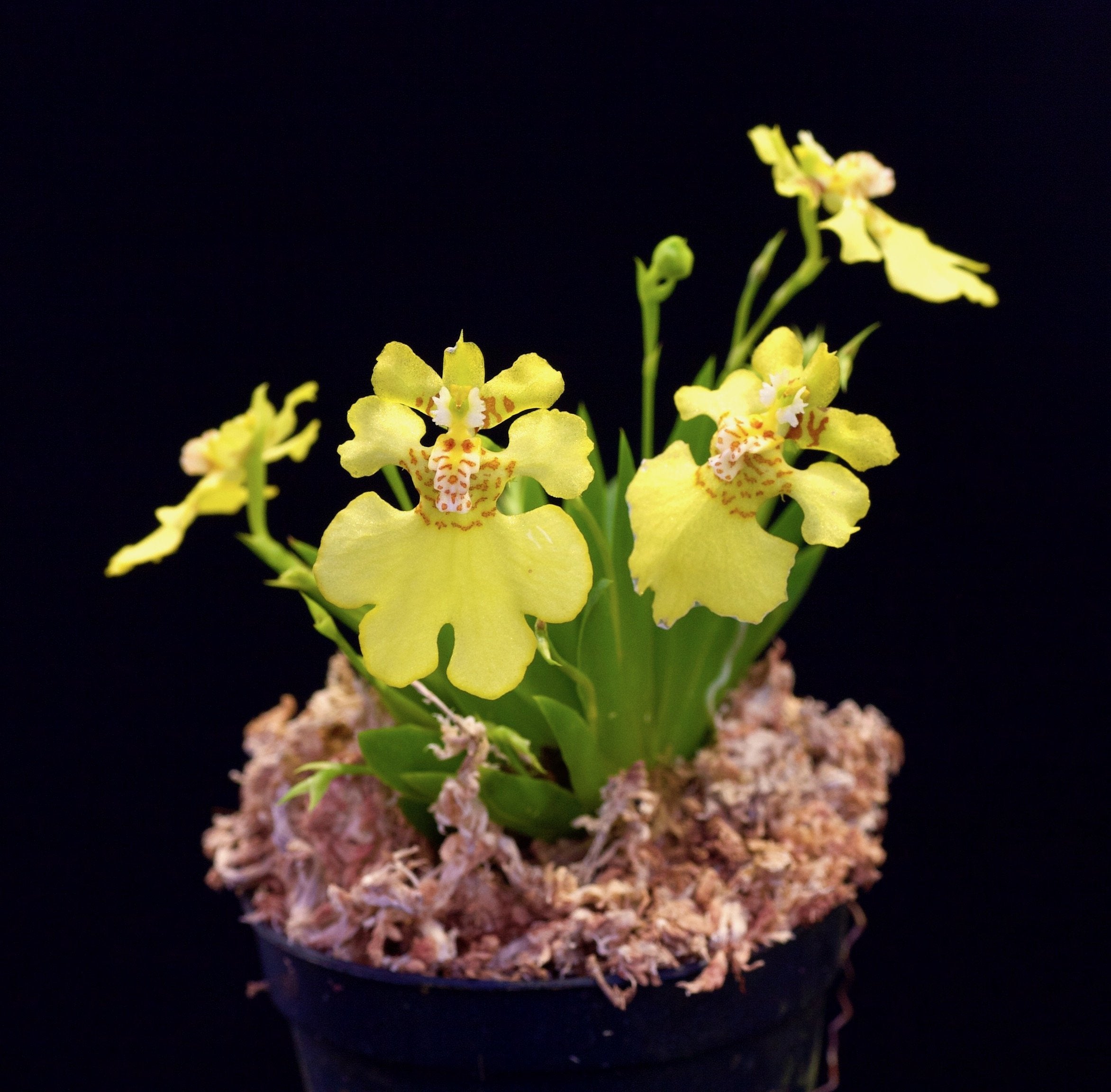
Psygmorchis pusilla, now also known botanically as Erycina pusilla, is a true miniature orchid with a surprisingly striking presence. The plant remains very small, but blooms with striking yellow flowers that are large and expressive in relation to the leaves. Thanks to its fan-shaped growth habit, delicate leaves, and bright flower color, this is a particularly charming species for terrariums, paludariums, display cases, and small orchid collections.
This species is particularly interesting for enthusiasts who have limited space but still want to grow a botanical orchid with character. Psygmorchis pusilla is not a plant for a dry windowsill in full sun, but thrives in a warm, humid, and well-ventilated environment where its delicate roots do not dry out.
Origin
Psygmorchis pusilla is native to an area stretching from southern Mexico to tropical South America and Trinidad. There, the plant grows as an epiphyte on branches and thin twigs in warm, humid tropical conditions. Instead of growing in soil, the plant attaches itself with fine roots to bark, where it absorbs moisture from rain, mist, and humidity.
This natural growth habit explains why Psygmorchis pusilla is so well-suited for mounting on cork, wood, or a thin twig. The roots need air but must not be allowed to dry out for long periods. In a consistently moist terrarium or paludarium, this miniature plant often thrives much better than in a typical dry living room.
Characteristics
Psygmorchis pusilla grows as a small fan of narrow, laterally flattened leaves. The plant remains truly miniature and therefore takes up hardly any space. It is precisely this compact growth that makes it popular for small display cases, terrariums, and paludariums, where larger orchids quickly become too dominant.
The flowers are bright yellow to golden yellow, often with brown or reddish-brown markings in the center. They appear on short flower stalks emerging from the base of the leaf fan. In proportion to the plant, the flowers are strikingly large, making a flowering plant immediately noticeable despite its miniature size.
Under good conditions, Psygmorchis pusilla can bloom regularly. The plant does not produce large pseudobulbs and therefore has few reserves. As a result, it reacts quickly to drying out, but also responds positively to stable warmth, humidity, and light.
Care
Light
Provide Psygmorchis pusilla with bright, filtered light. The plant prefers a bright spot but does not like harsh direct sunlight. In a terrarium or display case, it thrives under grow lights, as long as the lights do not get too hot and the leaves do not dry out.
Too little light can result in slow growth and sparse flowering. Too much direct sunlight or excessively dry heat can damage the delicate leaves. A bright, sheltered spot with stable humidity is ideal.
Temperature
Psygmorchis pusilla grows best in warm to hot conditions. A daytime temperature of about 22 to 30°C is suitable. At night, the temperature may drop to about 18 to 22°C. Short-term fluctuations are usually not a problem, but prolonged cold is unfavorable.
Because this species originates from a humid tropical region, it grows best in stable warmth. A cool windowsill in winter is usually less suitable, especially when the plant is mounted and dries out quickly.
Substrate and Cultivation Method
This miniature orchid looks its best on cork, wood, or a thin twig. A small amount of sphagnum moss around the roots can help retain moisture, especially when the humidity isn’t consistently high. In a terrarium or paludarium, the plant can be placed on a branch or against the back wall.
Potted cultivation is possible, but less natural and often more difficult to manage with such a small plant. If kept in a pot, the mix must be extremely airy, such as fine bark with some sphagnum moss and perlite. The substrate must not become compacted.
Humidity
A humidity level of about 70 to 90% is ideal, especially for mounted plants. The fine roots dry out quickly when the air is too dry. At the same time, air circulation is important: a warm, humid terrarium without ventilation can cause mold problems.
This species can be successfully kept in a paludarium or terrarium, provided there is gentle ventilation. The plant prefers humid air but does not tolerate stagnant, damp conditions.
Watering
Psygmorchis pusilla must be kept moist regularly, especially when mounted. Do not allow the roots to dry out completely for long periods. In a warm display case or on cork, light daily misting may be necessary, depending on temperature, ventilation, and humidity.
Preferably use rainwater, demineralized water, or soft water at room temperature. Water preferably in the morning or early in the day so that excess moisture does not remain stagnant for long periods. The roots may become moist but must also retain oxygen.
Fertilization
During active growth, apply a very light dose of fertilizer. A quarter of the recommended dose of orchid fertilizer—or even less—is usually sufficient. Because the plant is small and has delicate roots, over-fertilization can quickly cause damage.
For mounted plants, fertilizer washes away quickly, but salt residues may still remain on the roots or sphagnum moss. Therefore, rinse regularly with clean water.
Flowering
Psygmorchis pusilla can produce relatively large yellow flowers for its size. The flowers often have a brownish-red or darker pattern near the center, making them particularly striking. Under good conditions, the plant can bloom several times a year or regularly produce new flower spikes.
Flowering is supported by stable warmth, sufficient filtered light, high humidity, and healthy roots. Because the plant is so small, even a single flower can make a striking impression in a terrarium or miniature collection.
Care Level
Psygmorchis pusilla is of moderate difficulty. The plant is small and can grow well when conditions are right, but it has little tolerance for error. Drying out, cold, or over-fertilization can cause problems more quickly than with larger orchids.
It isn’t necessarily difficult, but it does require more specialized care than a typical living-room orchid. This species is best suited for growers who can provide a warm, humid environment, such as a terrarium, paludarium, display case, or small greenhouse.
Who is this plant suitable for?
Psygmorchis pusilla is suitable for enthusiasts of miniature orchids, terrarium plants, and botanical species. The plant is a perfect fit for customers looking for a small orchid to mount on cork, wood, or a branch in a warm, humid setup.
This species is less suitable for a dry windowsill or for someone who doesn’t want to pay much attention to humidity. For terrarium enthusiasts and collectors of miniature orchids, Psygmorchis pusilla is actually an excellent choice: small, botanical, strikingly yellow Blooming, and well-suited to limited space.
Experience growing it indoors or in a greenhouse
Psygmorchis pusilla is often easiest to care for in a terrarium or paludarium. The plant remains small, takes up little space, and can grow beautifully on a branch or the back wall. Thanks to its yellow flowers, it stands out immediately among moss, ferns, and other small plants when in bloom.
In a greenhouse or display case, mounted cultivation also works well, as long as humidity remains high and there is gentle air circulation. On a regular windowsill, this species is more challenging to grow, as the roots and leaves can dry out quickly.
Additional care tip
Avoid placing Psygmorchis pusilla in a spot that’s too dry or too bright. The plant grows best when the roots are kept slightly moist but never left sitting in standing water. A thin layer of sphagnum moss around the roots can help, but keep it well-aerated. Active root tips and firm, fresh-green leaves are the best signs that the plant is thriving.
Short product description
Psygmorchis pusilla, now also known as Erycina pusilla, is a miniature botanical orchid with fan-shaped leaves and striking yellow flowers that are large in proportion to the plant. This epiphytic species is ideal for terrariums, paludariums, and display cases, where it can grow in warm, humid, and well-ventilated conditions on cork, wood, or a branch. If no Potsize is listed, this product will be shipped without a pot, but mounted on a small block.