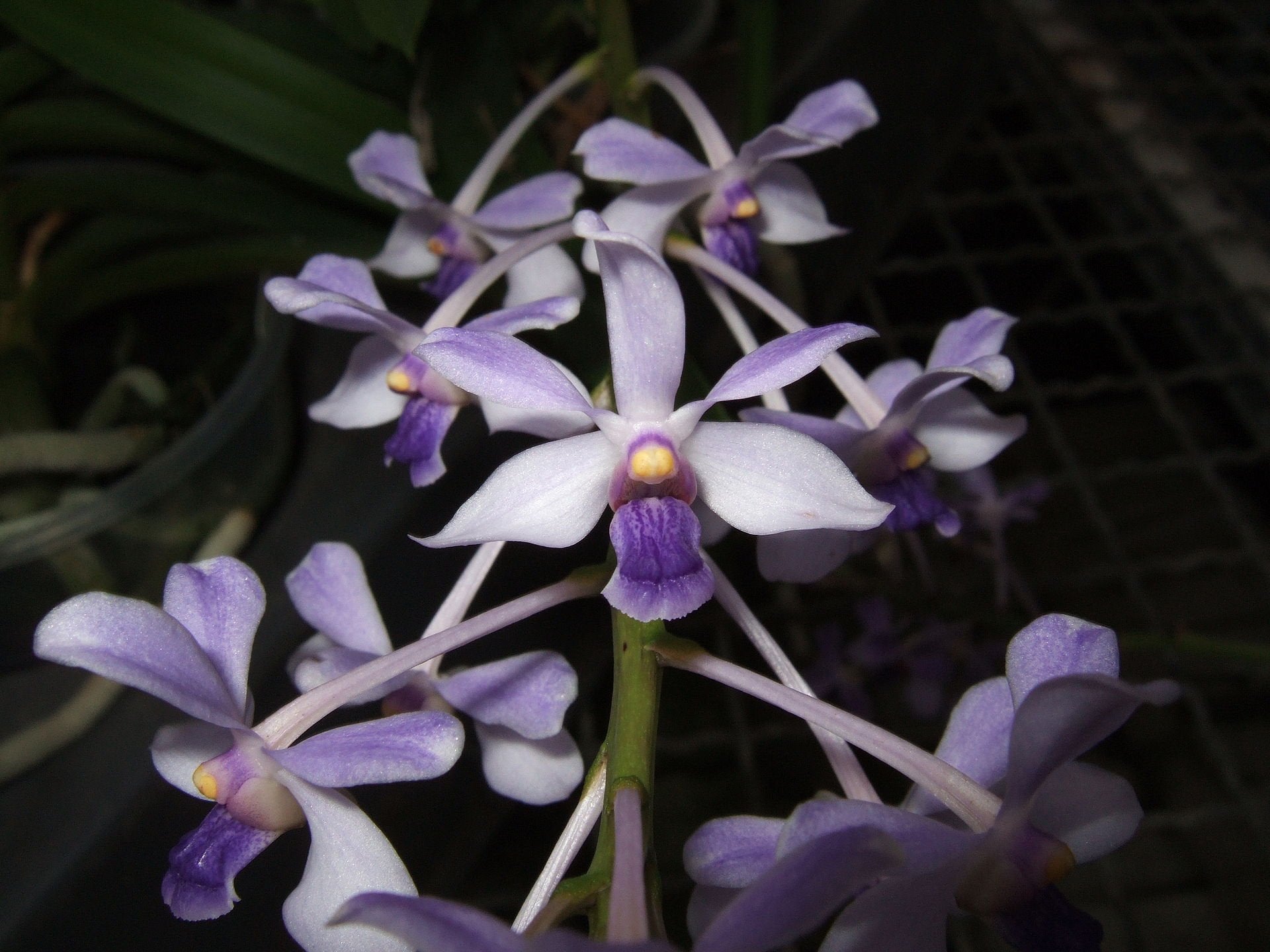
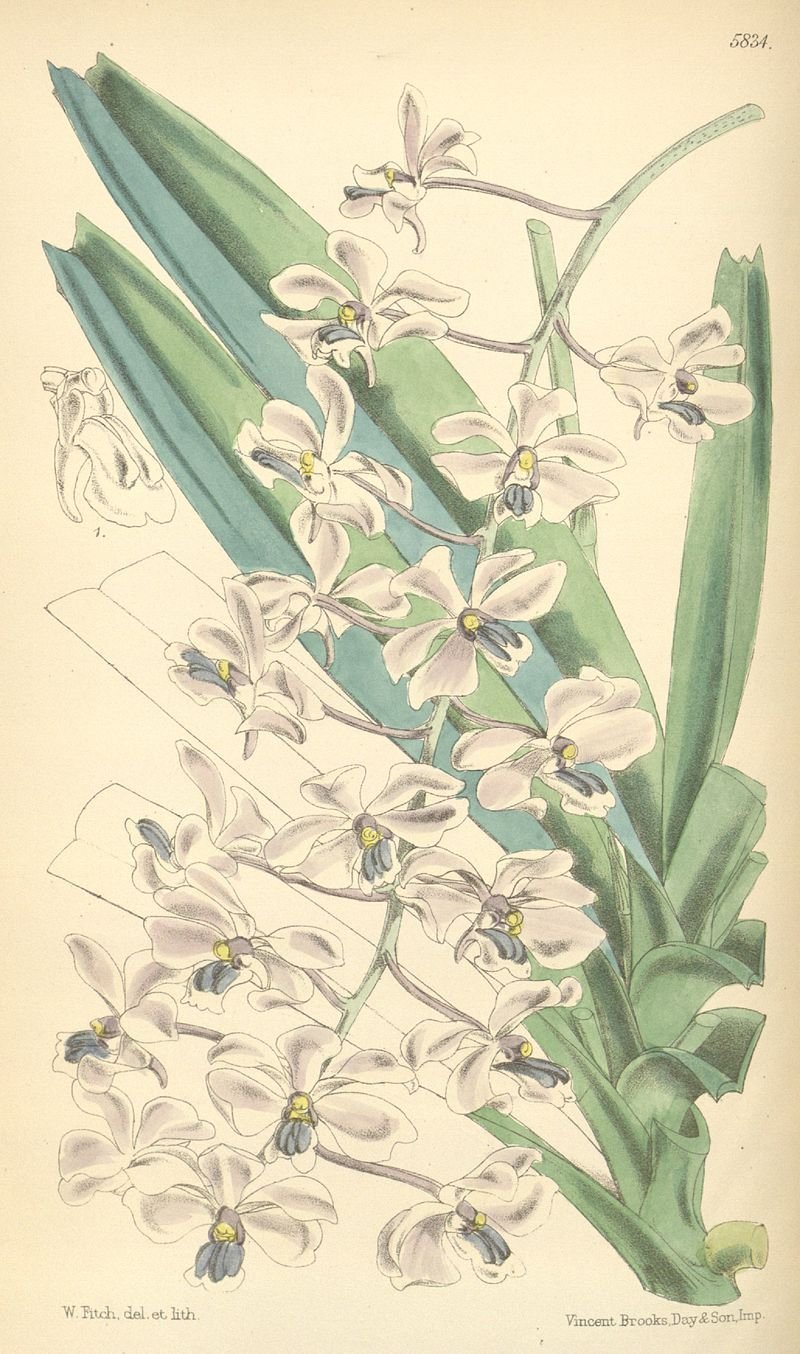
Vanda coerulescens is a compact botanical Vanda that doesn’t impress with a few enormous flowers, but rather with long, graceful clusters full of small lavender-blue flowers. It also has a pleasant sweet fragrance that is often compared to grapes or grape candy. This scent is particularly noticeable during the warmer, sunnier parts of the day.
For collectors, this is an interesting species because it combines several desirable traits: a true botanical origin, a relatively manageable plant size, blue-violet flower colors, and fragrance. At the same time, it requires different growing conditions than the large, warm-climate Vanda hybrids. Thanks to its origin at medium elevations, Vanda coerulescens actually prefers cooler nights and a more distinct seasonal rhythm.
Name and Taxonomy
Vanda coerulescens Griff. is an accepted botanical species and was described in 1851 by the British botanist William Griffith. On older labels, the spelling variant Vanda caerulescens may appear. Names such as Vanda confusa and various former variety names are also treated as synonyms today.
This species should not be confused with Vanda coerulea. Although both Vanda species have blue pigments and a similar Asian origin, they are distinct species. Vanda coerulescens generally remains more compact and produces smaller but significantly more numerous flowers on a longer, sometimes branching inflorescence.
Origin
This species occurs naturally from northeastern India and the eastern Himalayas to Bangladesh, Myanmar, southern Yunnan in China, and northern Thailand. There, it grows as an epiphyte on tree trunks and branches, often in open or seasonally forested areas at elevations of approximately 300 to 1,200 meters.
During the wet and warmer growing season, the roots receive regular rainfall, yet they dry out quickly thanks to their exposed position. In the cooler winter months, precipitation decreases, and as the canopy thins, more light reaches the plant. Nevertheless, dew, fog, and moderate humidity remain present. In cultivation, this means that watering can be reduced in winter, but a prolonged, severe drought is not advisable.
Characteristics
Vanda coerulescens grows monopodially. This means that the plant grows upward from a single central stem and does not produce pseudobulbs. Along this stem, narrow, somewhat trough-shaped leaves are arranged in two opposite rows. The leaves are generally finer and less coarse than those of many commercial Vanda hybrids.
A mature plant usually reaches a height of about 30 to 60 centimeters. This keeps the foliage compact for a Vanda, although the aerial roots and flower spikes can grow considerably longer. Therefore, consider not only the height of the plant itself but also the available space beneath and beside the basket.
The flower spike emerges from a leaf axil and may start out upright before sagging slightly due to its length and the weight of the flowers. Well-developed plants can bear ten to fifteen or more flowers. The flowers are typically about 3 to 5 centimeters wide and display soft shades of lavender, lilac, and blue-violet. A delicate network of darker veins gives the flower parts extra depth, while the lip is usually a more intense violet-blue with yellow, orange, or white accents.
Since this is a botanical species, some natural variation may occur. Some plants bloom a more distinct blue, while other flowers tend more toward lilac or soft pink. The number of flowers, the branching of the flower cluster, and the intensity of the fragrance may also vary from plant to plant.
Care
Care revolves around a combination of bright light, well-aerated roots, regular watering, and cooler nights. The latter, in particular, distinguishes this species from many heat-loving Vanda hybrids. A plant can continue to grow healthily under consistently warm conditions but may still struggle to form flower buds.
The plants offered are mature, but flowering always depends on the season, the plant’s condition, and the specific variety. Furthermore, these are imported plants whose roots may continue to develop after arrival. Therefore, first provide the plant with stable conditions and assess its recovery based on the appearance of new green root tips and a new leaf emerging from the center.
Light
Provide Vanda coerulescens with plenty of bright, filtered light. A window facing east, southeast, or a slightly filtered south-facing window is suitable. Gentle morning sun and winter sun are usually well tolerated, while bright summer afternoon sun through a window can cause the leaves to fade or burn.
This species can tolerate brighter conditions than a Phalaenopsis, but due to its relatively narrow, belt-shaped leaves, it does not have the same need for extreme sunlight as some Vandas with nearly pencil-shaped leaves. Approximately 25,000 to 40,000 lux is a useful starting point under controlled conditions.
Dark green, increasingly elongated leaves combined with a lack of flowering often indicate insufficient light. Yellow-green foliage, severe reddish-purple discoloration, or dry, scorched spots, on the other hand, may mean that the transition to brighter light was too rapid. Therefore, always allow the plant to gradually acclimate to a brighter location.
Temperature
This Vanda grows best under moderate to moderately warm conditions. During the day, a temperature of about 20 to 27 °C is suitable, while at night the temperature should preferably drop to 14 to 18 °C. A difference of about 5 to 8 degrees between day and night supports robust growth and aids in flower formation.
During the summer, the plant can temporarily tolerate temperatures around 30 °C, provided it receives extra air circulation, humidity, and water. Prolonged hot nights are less favorable. They not only increase the risk of stress but can also disrupt the seasonal signal for flowering.
An established plant can tolerate cooler conditions for short periods. However, stable temperatures are more important for an imported specimen that is still developing new roots. Therefore, do not immediately expose such a plant to cold nights and a significant reduction in watering.
Substrate and Cultivation Method
The roots must receive plenty of air and be able to dry out relatively quickly after each watering. A wooden or plastic Vanda basket without growing medium is therefore suitable for a humid greenhouse where daily watering is possible. Mounting on cork or hardwood is also an option, although the plant will dry out very quickly in this case.
In a normal living space, a small open basket with a few pieces of coarse bark and charcoal is often more practical. This retains moisture around part of the root system slightly longer without cutting off the roots. Do not use fine orchid potting mix, and do not wrap the roots in compact sphagnum moss. Constantly wet material around the base of the stem can quickly lead to root loss or rot.
Never remove healthy aerial roots simply because they grow outside the basket. It is precisely these freely hanging roots that are adapted to the plant’s epiphytic lifestyle. Repot only when the growing medium begins to decompose or when a damaged basket needs to be replaced.
Humidity
A humidity level of about 60 to 80 percent is ideal. This prevents the freely hanging roots from drying out too quickly after watering and allows new root tips to grow more easily. In a living space, a slightly lower humidity level is possible, but in that case, watering must be better adjusted to the rate at which the roots turn silver.
High humidity should never mean that the air is stagnant. Therefore, ensure a gentle, constant airflow around the leaves, roots, and base of the stem. Especially after misting, the plant should be able to dry off for the most part before evening.
Watering
During active growth, regularly wet the entire root system. Roots that hang freely may need daily watering in a warm, bright environment. A plant in an open basket with coarse bark is usually watered less frequently, as the material around the roots remains moist longer.
Pay close attention to the color of the roots. Dry Vanda roots are silver-gray, while healthy roots turn green after absorbing water. Water for long enough to allow the roots to actually turn green, and then let the water drain out freely. A brief misting that only moistens the surface often does not reach enough of the root tissue.
During the cooler, darker winter months, you can reduce the frequency of watering. Allow the roots to remain dry a bit longer, but prevent them from shriveling for extended periods. The goal is a more relaxed rhythm with rapid wet-dry cycles, not an artificial drought that causes the plant to lose reserves and roots.
Preferably use rainwater, reverse-osmosis water, or other low-mineral water at room temperature. Cold water can damage warm root tips, while hard water can leave a gray mineral deposit on the roots over time.
Fertilizer
During active growth, regularly apply a low dose of balanced orchid fertilizer. About one-quarter of the recommended concentration, once a week or every other watering, is usually sufficient. This provides the plant with a steady supply without allowing harmful salts to accumulate quickly on the exposed roots.
Rinse the roots with clean water in between feedings. Reduce fertilization in the fall as soon as growth slows down, and apply only limited amounts of fertilizer during the cooler winter months. Resume the normal schedule when new green root tips and active leaf growth appear.
Flowering
In cultivation, flowering usually occurs from late winter through spring. However, the exact timing may vary depending on the plant’s origin, climate, and growing conditions. The long flower spikes may grow upright, curved, or slightly pendulous and sometimes branch out.
Each cluster bears several small flowers that, together, create a lighter and more natural appearance than the heavy flowers of modern Vanda hybrids. The lavender-blue color is particularly visible in bright, natural light. Under warm artificial light, the flowers may appear significantly more purple.
The fragrance is typically described as sweet grape, grape candy, or grape lemonade. It is usually most pronounced during the day as light and temperature increase. However, the intensity can vary from plant to plant, and a newly opened flower may not immediately release its full fragrance.
Care Level
The care level is moderate. Thanks to its more compact size, this variety is more practical than many large Vandas, but the exposed roots still depend on consistent care. In addition, sufficient light and cooler nights are important when the plant needs to not only grow but also bloom.
The first few months after import require extra attention. Provide a plant with few active root tips with high humidity, gentle ventilation, and regular but short wet-dry cycles. Avoid trying to compensate for root loss by keeping the plant constantly wet. New green root tips are a more reliable sign of recovery than just sturdy-looking leaves.
Who is this plant suitable for?
Vanda coerulescens is particularly well-suited for collectors who appreciate botanical Vandas and are looking for a smaller species with abundant flowers. Enthusiasts of fragrant orchids and natural blue-violet flower colors will also find this an interesting plant.
For an absolute beginner, this species is less straightforward, especially when grown entirely without a growing medium. Those who already have experience with Vandas, mounted orchids, or plants in a ventilated display case will find it easier to gauge water requirements. This species is also appealing to those who find large Vanda hybrids too bulky but are looking for the characteristic free-hanging roots and long flower spikes.
Growing Experience at Home, in a Greenhouse, or in an Orchidarium
Indoors, this Vanda can grow near a very bright window, provided the roots can be moistened regularly and allowed to drip freely. A small open basket with coarse bark is often more practical here than completely bare roots. Do keep in mind the long aerial roots and flower spike, even though the plant itself remains relatively compact.
A moderately warm greenhouse offers the best combination of light, humidity, air circulation, and cooler nights. This allows the plant to grow vigorously while also experiencing a distinct seasonal rhythm.
The statement that this species is suitable for a terrarium requires some clarification. V. coerulescens is best suited for a tall, spacious, and actively ventilated orchidarium or a large plant cabinet. A low, enclosed terrarium with stagnant air and constantly wet roots is unsuitable. Furthermore, the flower spike and aerial roots can take up much more space than the compact foliage would suggest.
Additional care tip
In the fall and early winter, provide the plant with brighter light, cooler nights, and slightly longer dry intervals for a few weeks. This helps keep the roots healthy and prevents them from shriveling. This combination more closely mimics the natural seasonal signal than letting the plant dry out completely and increases the likelihood that a mature plant will produce a flower stalk.
Brief product description
Vanda coerulescens is a compact botanical Vanda with long clusters of small lavender-blue flowers and a sweet, often grape-like fragrance. This species thrives in bright light, with well-aerated roots and cooler nights. A distinctive collector’s orchid for a bright living space, greenhouse, or well-ventilated orchidarium.