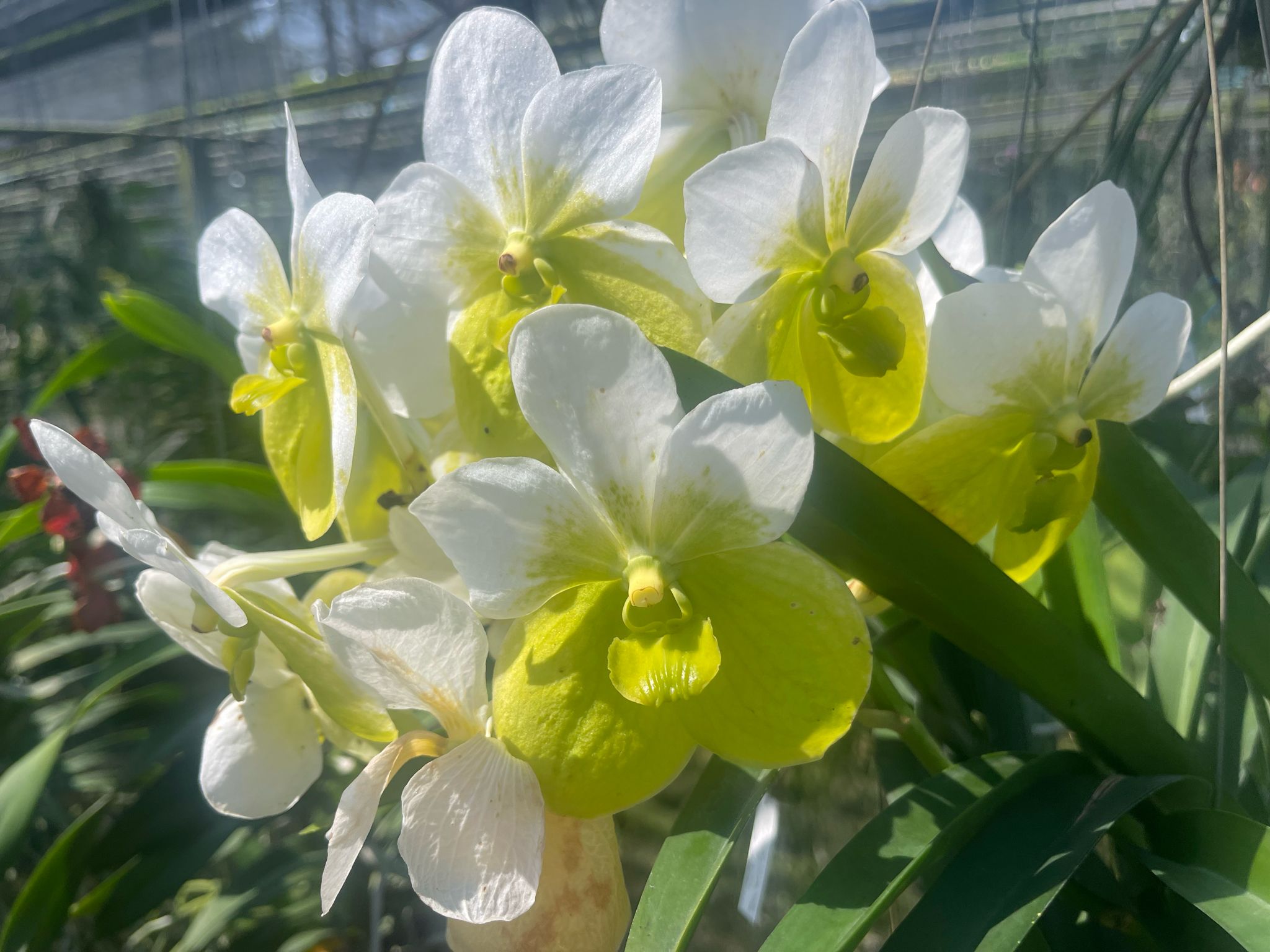
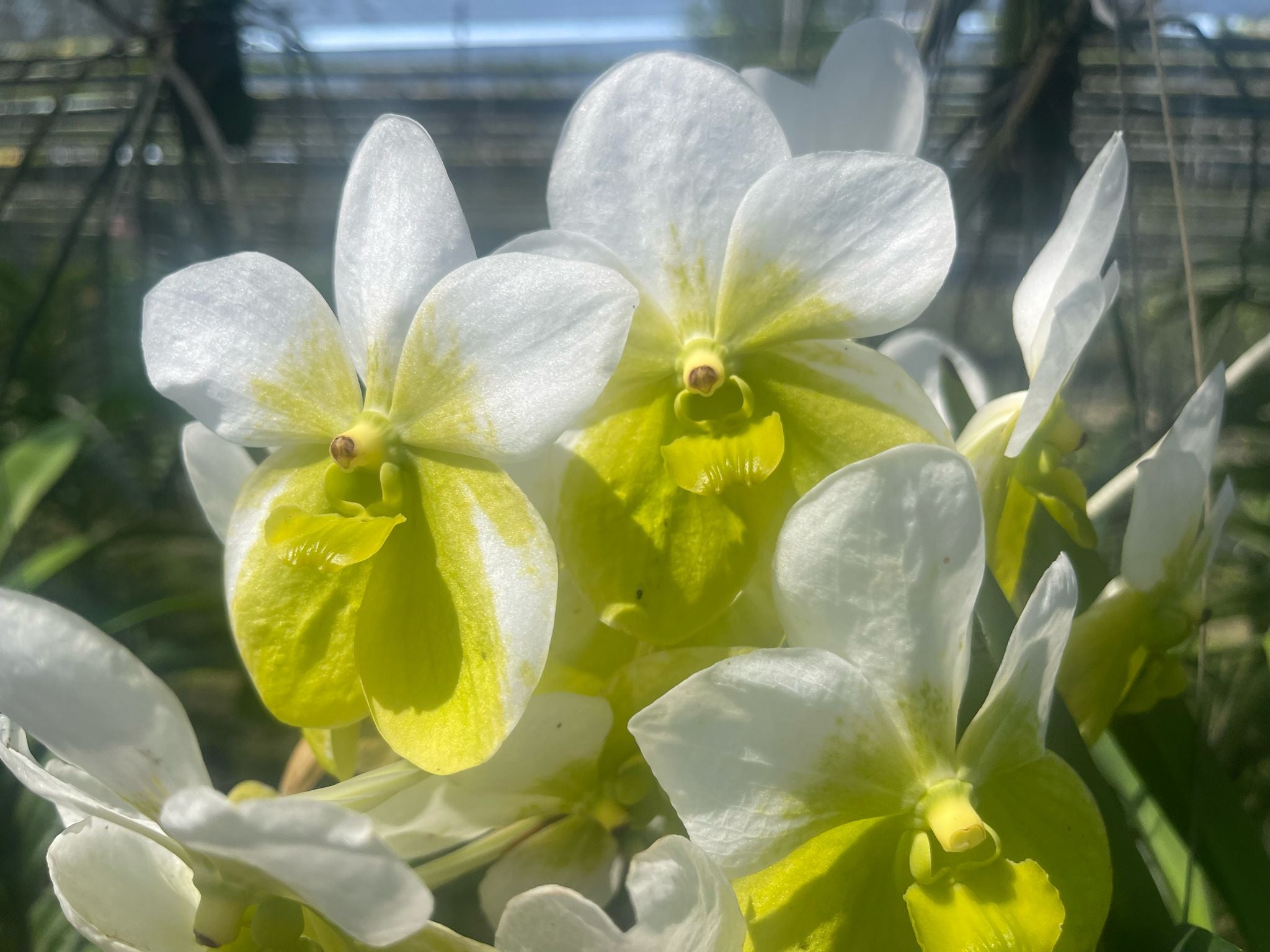
Vanda sanderiana var. alba is a rare and very elegant form of the famous Vanda sanderiana, also known as the Waling-waling from the Philippines. Whereas the common form usually has flowers marked with pink, brownish-pink, or purple, the alba form stands out for its light, delicate appearance. The flowers are large, flat-opening, and usually white to cream-white with a greenish-yellow to yellowish-green sheen. As a result, this orchid appears calmer and more refined than many brightly colored Vandas, but is certainly no less impressive.
This is an orchid for enthusiasts who consciously choose a true species with history, character, and a cultivation challenge. Vanda sanderiana var. alba is not a plant for someone who only wants to water it occasionally; it requires plenty of light, warmth, air around the roots, and consistent care. For collectors with experience with Vandas or tropical orchids, this is precisely one of those species that provides great satisfaction once the plant is growing well.
Origin
Vanda sanderiana is native to Mindanao in the Philippines, where the species grows as an epiphyte on trees in warm, humid conditions. In its natural habitat, the plant receives plenty of light, regular humidity, and constant air movement around the roots. Understanding this combination is key to proper care: this Vanda does not thrive in dark rooms or compact, wet substrate, but rather in light, warmth, air, and a consistent routine.
The alba form is particularly popular because it retains the monumental flower shape of Vanda sanderiana, but with a much lighter color. It is precisely this combination of large flowers and soft white to greenish-yellow hues that makes it appealing to collectors seeking something rare but not flashy.
Characteristics
Vanda sanderiana var. alba grows monopodially, with sturdy, leathery leaves arranged in two rows along the stem. The plant produces thick aerial roots that absorb moisture and nutrients directly from the air and water. A healthy plant has firm leaves, active green root tips, and a distinct upright growth habit.
The flowers are large and wide open, with rounded sepals and petals that give the species its distinctive, almost stately appearance. In the alba form, the color usually ranges from white, cream, light green, to yellow-green. The markings are more subtle than in the common form, but it is precisely this that makes the flower’s shape stand out even more.
This plant has significant collector’s value. Not because it is easy or fast to grow, but because it represents a rare color form of an iconic Philippine Vanda. For customers who already have experience with Vandas, warm greenhouse cultivation, or bare-root orchids, this is a much more interesting choice than a standard flowering hybrid from the store.
Care
Light
Vanda sanderiana var. alba needs plenty of light to grow vigorously and eventually bloom. A very bright location with filtered sunlight is ideal. Morning sun or late afternoon sun can be good, but harsh midday sun through a window can damage the leaves.
In a typical living room, light is often the limiting factor. This plant is therefore best placed near a very bright window, in a sunroom, a warm greenhouse, or under strong grow lights. Insufficient light will result in leaf growth, but rarely in good flowering.
Temperature
This Vanda thrives in warm conditions. During the day, a temperature of about 22 to 30°C is suitable. At night, the temperature may drop slightly, but prolonged cold should be avoided. Keep the plant preferably above 18°C, especially when the roots are wet.
A slight drop in temperature at night can help the plant grow more naturally, but cold drafts or large temperature fluctuations are unfavorable. This species is better suited to a warm, stable environment than to a cool windowsill.
Growing Medium and Care
Vanda sanderiana var. alba grows best with plenty of air around the roots. Bare-root cultivation, a wooden basket, or a very open Vanda basket are suitable options. A closed pot with standard orchid potting mix is not suitable, as the roots will remain wet and oxygen-deprived for too long.
If you keep this plant indoors, you’ll need to consider the practical aspects: bare-root Vandas require more frequent watering and take up more space than many other orchids. On the other hand, you can easily check the roots. Healthy roots turn green when wet and silvery when dry.
Watering
Water generously when the roots are dry. Allow the roots to become completely wet and then dry out thoroughly again. With bare-root cultivation, this may be necessary several times a week during warm periods, sometimes even daily in high temperatures and bright light. Water less frequently during cooler or darker periods.
Preferably use rainwater, demineralized water, or other soft water at room temperature. Hard tap water can leave lime and salt deposits on the roots over time. Always allow the plant to drain thoroughly after watering and ensure that no water remains in the leaf axils for extended periods.
Humidity
A humidity level of about 60 to 80% is ideal. At high temperatures and with plenty of light, the humidity may be higher, as long as there is sufficient air circulation. Dry indoor air makes care more difficult, especially for plants without a growing medium.
Good air circulation is essential. Warm, humid, but stagnant air can cause mold and rot. The best results are usually achieved in a bright room where heat, humidity, and air movement are in balance.
Fertilization
During active growth, Vanda sanderiana var. alba can be lightly fertilized on a regular basis. Use an orchid fertilizer at a low dosage, such as one-quarter to one-half the recommended amount. With plenty of light, warmth, and active root growth, the plant can tolerate more fertilizer than during a dark winter period.
Rinse the roots regularly with clean water to prevent the buildup of fertilizer salts. For Vandas, constant, light feeding is often better than occasional heavy fertilization.
Flowering
A robust Vanda sanderiana var. alba can produce large, impressive flowers ranging in color from soft white to greenish-yellow. Flowering usually requires a mature plant, plenty of light, healthy roots, and stable, warm care. This is not a species that flowers quickly under moderate conditions; the plant really needs to build up its strength.
When the plant is thriving, the blooms are well worth the effort. The combination of large, flat-opening flowers and the rare alba color makes this Vanda particularly suitable for collectors seeking something exclusive within the Vanda alliance.
Difficulty and Growing Experience
Vanda sanderiana var. alba is suitable for advanced enthusiasts or motivated collectors who are willing to actively monitor light, water, and humidity. The plant isn’t difficult because it’s sensitive or fragile, but because it quickly runs low on light and humidity indoors. Those who can keep it warm, bright, and well-ventilated will be rewarded with a strong and impressive orchid.
This plant is a good fit for customers with a sunroom, warm greenhouse, plant room, grow lights, or experience with bare-root Vandas. It’s not an ideal choice for a dark living room or someone looking for a low-maintenance orchid.
Who is this plant suitable for?
Vanda sanderiana var. alba is particularly suitable for experienced orchid enthusiasts or collectors who are already familiar with Vandas, bare-root cultivation, or warm greenhouse conditions. This plant requires more attention than a standard living room orchid: plenty of light, warm temperatures, regular watering, high humidity, and good air circulation are essential to keeping it healthy.
This Vanda is a good fit for someone with a sunroom, warm greenhouse, plant room, grow lights, or a bright space where humidity levels are well maintained. It is not an ideal choice for a dark windowsill, a dry living room, or someone looking for a low-maintenance orchid.
Choose Vanda sanderiana var. alba especially if you are specifically looking for a rare botanical Vanda with genuine collector’s value. The plant is prized for its Philippine origin, large flower shape, and distinctive white-to-greenish-yellow alba color. This is not a plant to buy on a whim, but an exclusive variety for enthusiasts who can provide it with the right conditions.
Extra care tip
Pay special attention to the roots of this Vanda. Active green root tips are a good sign. If the roots become dull, hollow, or brown, the balance between water, air, and temperature is usually off. A healthy Vanda sanderiana var. alba grows best with plenty of light, warm days, gentle watering, and sufficient drying time around the roots.