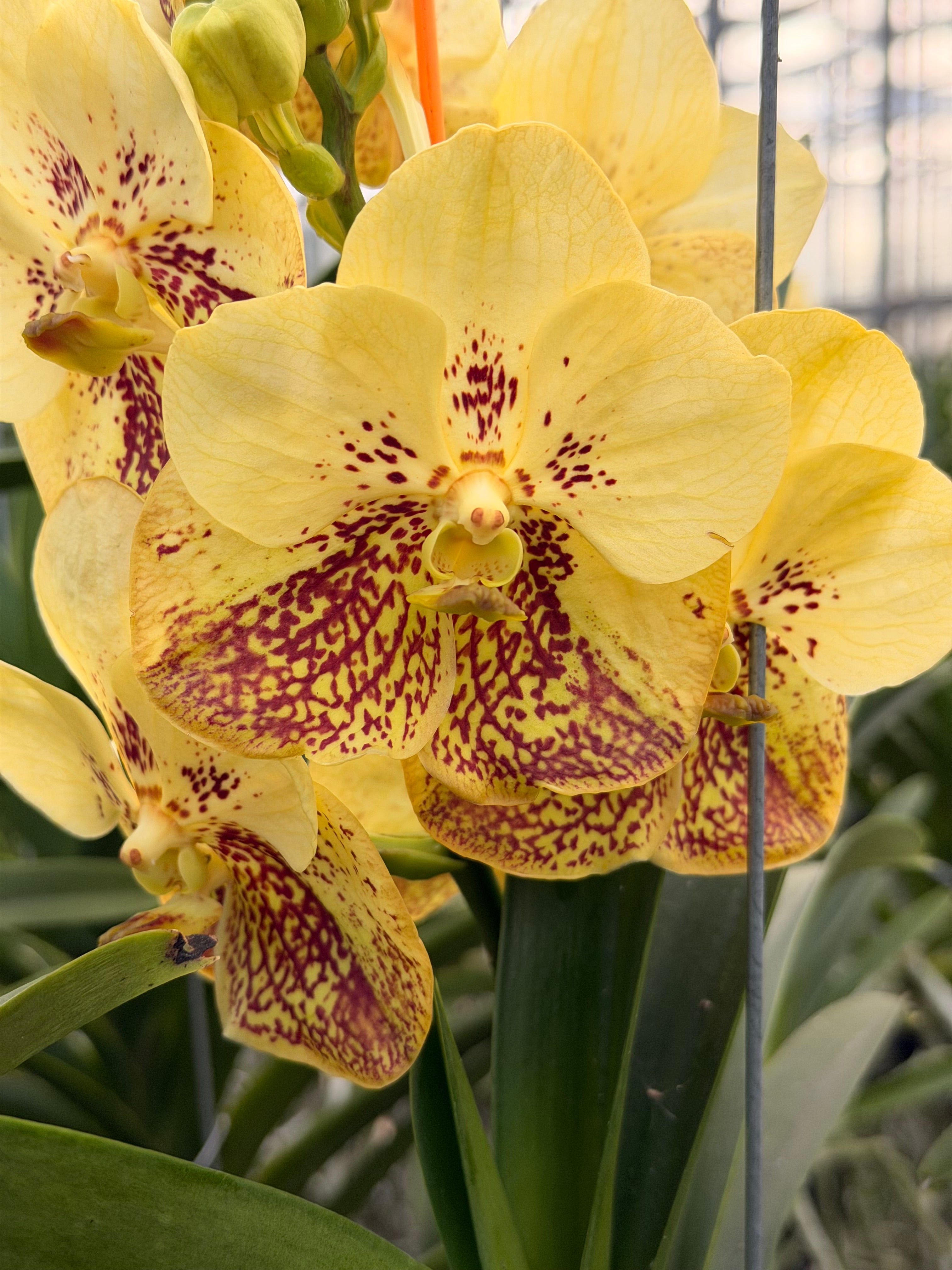
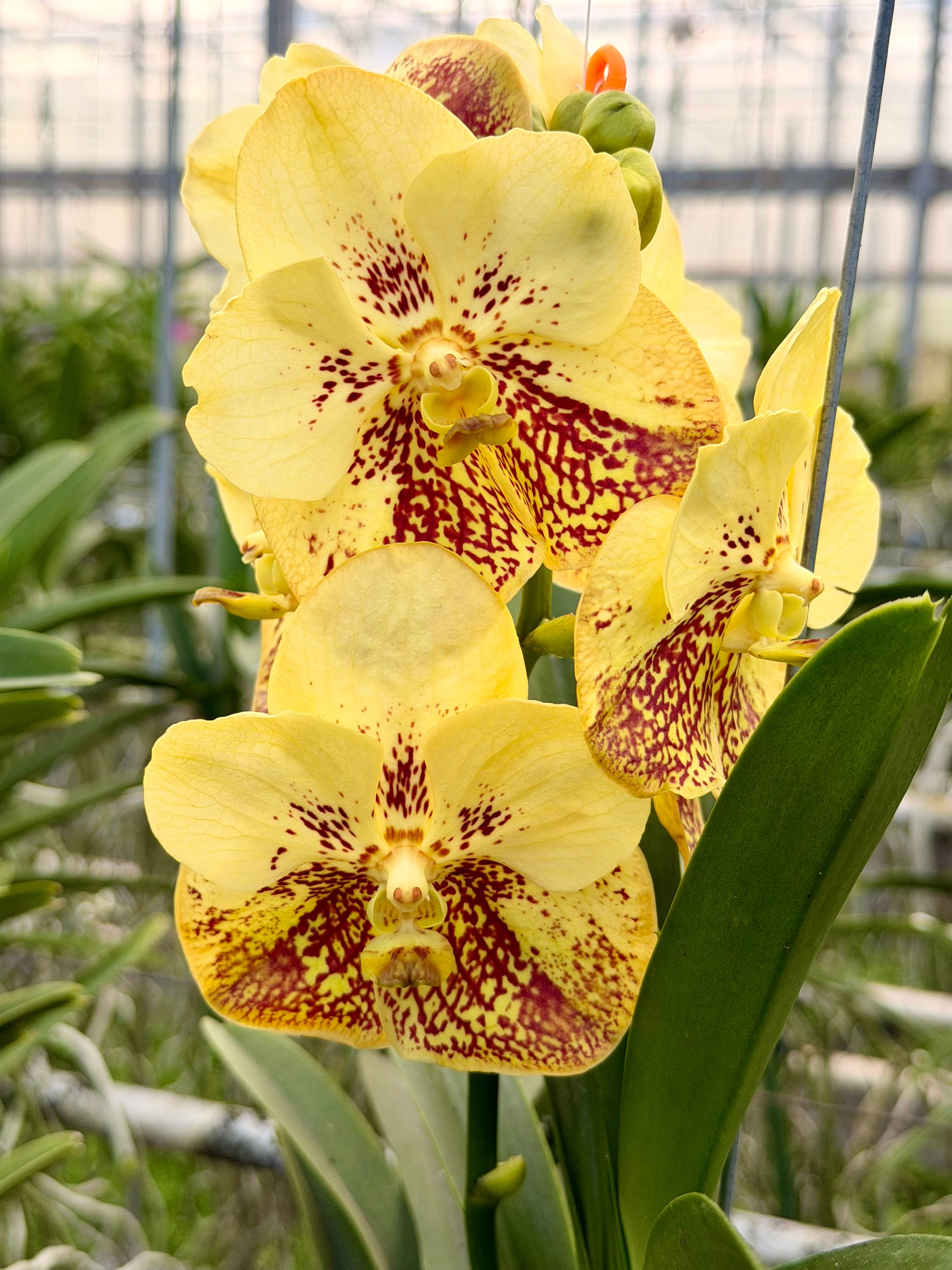
Vanda ‘Yellow Magic’ is a selected Vanda hybrid that stands out for its large flowers in shades ranging from bright yellow to warm golden yellow. The sturdy, slightly waxy flowers give the plant the luxurious look for which modern Vandas are beloved, while the sunny color clearly sets it apart from the better-known blue and purple hybrids.
Moreover, it’s not just the blooms that are decorative. The upright-growing plant develops sturdy, ribbon-like leaves and long silver-gray aerial roots, giving even a specimen without flowers a distinctly tropical appearance. However, this growth habit requires sufficient vertical space and a location where the roots can breathe freely.
Origin
Vanda ‘Yellow Magic’ is not a botanical species with its own natural range, but a cultivated hybrid marketed under this commercial name. The name has been in use for some time within the Dutch Vanda trade, but no publicly documented grex registration or reliable parent combination has been found.
Therefore, it would be incorrect to name specific species as parents. For care, the plant is best treated as a modern, ribbon-leaved Vanda hybrid: warm-growing, requiring plenty of light, and adapted to an airy growing method in which the roots get wet quickly but can then dry out again.
Characteristics
Vanda ‘Yellow Magic’ grows monopodially. This means that the plant grows upward from a single central stem, with new leaves forming at the top. Flower stalks may emerge from the leaf axils, while thick aerial roots develop along the lower part of the stem.
The flowers are large, sturdy, and round to slightly star-shaped. Their color can range from bright lemon yellow to a warmer golden yellow, with the center sometimes appearing slightly deeper in color. Lighting, temperature, the age of the flower, and screen settings can influence the perceived shade. The product photo therefore primarily reflects the expected color range rather than a single, precisely defined color value.
A mature flower spike can bear multiple flowers, but the final number depends on the size and condition of the plant. Furthermore, over time, a Vanda will grow considerably larger than a compact windowsill orchid. The aerial roots, in particular, can grow long and should be allowed to grow freely outside a pot or basket.
No reliable information on scent is available for this selection. Vanda ‘Yellow Magic’ should therefore be chosen primarily for its striking flower color and not as a guaranteed fragrant orchid.
Care
Although Vanda ‘Yellow Magic’ does not require a complicated dormant period, it does need consistent care. Sufficient light, regular watering, and plenty of air around the roots are key to ensuring the plant continues to grow actively and blooms again.
The plant lacks pseudobulbs capable of storing water for long periods. As a result, a freely hanging specimen can dry out quickly in warm weather. At the same time, the thick roots are sensitive to a constantly wet, confined environment. The proper care routine therefore involves thorough watering, allowing the soil to drain completely, and then ensuring the roots are exposed to air again.
Light
Place Vanda ‘Yellow Magic’ in a very bright spot. This hybrid requires significantly more light than the average Phalaenopsis. In a spot that’s too dark, the plant may still produce new leaves, but the chance of it blooming again is much lower.
An east- or west-facing window may be suitable if the plant receives several hours of bright light there. A south-facing window is also an option, provided the Vanda is gradually acclimated to direct sunlight and protected from leaf burn during hot summer afternoons. In a greenhouse, strong, filtered light is ideal.
The leaf color helps in assessing the growing conditions. Healthy leaves are usually firm and medium green. Very dark green leaves combined with a lack of blooms often indicate insufficient light. However, yellow-green leaves aren’t necessarily a problem: a plant receiving plenty of light may develop slightly lighter foliage. Pale spots, reddish-brown discoloration, or dry, scorched patches are more likely signs of a too-rapid transition to bright sunlight.
Temperature
This hybrid grows best in warm to moderately warm conditions. Daytime temperatures of about 20 to 29 °C are suitable, while a nighttime temperature of approximately 16 to 20 °C provides a good foundation. A slight drop in temperature at night also supports a natural growth rhythm.
On hot summer days, temperatures can rise higher, as long as humidity, watering, and air circulation are also increased. Prolonged temperatures below approximately 15 °C should be avoided. In particular, the combination of cold and wet roots can halt growth and cause root or stem rot.
Substrate and Cultivation Method
Vanda ‘Yellow Magic’ can be grown with virtually free-hanging roots in an open basket, but also in a well-ventilated Vanda pot filled with coarse bark. Freely hanging roots receive plenty of oxygen and clearly indicate when the plant needs water. On the other hand, in a warm, dry environment, they may need to be watered daily.
For indoor use, a transparent or perforated pot with coarse bark may be more practical. The material retains some moisture briefly while still allowing sufficient air to reach the roots. Never use regular potting soil, and avoid a compact mixture of fine bark or tightly packed sphagnum moss.
Some Vandas are kept in a glass vase. While this can be decorative, the roots must not be left standing in a layer of water permanently. When watering, fill the vase temporarily, allow the roots to absorb enough water, and then empty the vase completely. Even in glass, fresh air must be able to circulate around the roots.
Healthy roots growing outside the pot do not need to be pushed back or trimmed. They are part of the plant’s natural growth pattern and help it absorb moisture and nutrients.
Humidity
A humidity level of about 60 to 80 percent is ideal. In a normal living room, Vanda ‘Yellow Magic’ adapt to slightly lower humidity, but in that case, the freely hanging roots will dry out more quickly, and watering should be adjusted accordingly.
In addition, air movement is just as important as high humidity. Stagnant, moist air around the roots, stem, and leaf axils increases the risk of mold and rot. A light, continuous flow of air helps the plant dry evenly after watering.
Daily misting alone does not constitute a complete watering. It briefly moistens the outer surface of the roots but does not always give them enough time to actually absorb water. Furthermore, regular misting of the foliage can cause problems if the water remains there for an extended period.
Watering
When watering, pay particular attention to the aerial roots. Dry, healthy Vanda roots are usually silver-gray. As soon as they are thoroughly moistened, they turn a distinct green. Once most of the roots have returned to silver-gray, the plant can be watered again.
A freely hanging plant may need water daily or nearly daily during hot and sunny summer weather. A Vanda in an open pot with coarse bark dries out more slowly and generally needs to be watered less often. As a result, a fixed schedule is less reliable than observing root color, temperature, and drying speed.
Preferably use lukewarm, low-mineral water, such as rainwater or appropriately filtered water. Hard water and high concentrations of fertilizer salts can damage the sensitive root tips. Water preferably in the morning, allow the plant to drain completely, and ensure that no water remains in the foliage or enclosed decorative pot by evening.
Fertilization
During active root and foliage growth, apply a highly diluted orchid fertilizer regularly. A quarter of the recommended dose—for example, with every second or third watering—is usually sufficient. This allows the plant to receive nutrients gradually without harmful salt residues accumulating rapidly on the roots.
Rinse the roots and any growing medium regularly with clean water. When growth slows during the dark winter months, the amount of fertilizer can also be reduced. Extra fertilizer cannot compensate for a lack of light and, in a slow-growing plant, actually increases the risk of root damage.
Flowering
A mature Vanda ‘Yellow Magic’ can develop a flower spike from a leaf axil, bearing several large yellow flowers. Under stable conditions, the sturdy flowers can remain beautiful for several weeks. Be sure to protect a flowering plant from extreme heat, cold drafts, and sudden changes in location, as buds are more sensitive to these factors than the foliage.
Sufficient light is especially important for the next flowering. A plant that produces only dark green foliage but fails to bloom year after year is often in a location that is too dark. In addition, healthy, active roots are necessary to build up enough energy for a new flower stalk.
After flowering, a dried-out flower stalk can be cut off close to the stem. Be careful not to remove any healthy roots. The plant will then redirect its energy toward new leaves and root growth. A new flowering cannot be tied to a specific month or frequency, as it depends on the plant’s size, light levels, and overall condition.
Care Level
Vanda ‘Yellow Magic’ has a moderate to above-average care level. The plant isn’t exclusively suited for very experienced collectors, but it does require more light and a more active watering schedule than many common living room orchids.
Those who have a very bright spot and are willing to check the roots regularly will usually quickly get the hang of caring for it. On the other hand, this hybrid is less suitable for someone looking for a plant that can sit hassle-free in a dark corner or be watered only once a week on a fixed schedule.
Who is this plant suitable for?
This Vanda is particularly appealing to enthusiasts looking for a striking yellow orchid. The bright flower color makes it a striking accent among blue, purple, and pink Vandas, but the plant also has great display value as a standalone Blooming specimen.
In addition, Vanda ‘Yellow Magic’ is well-suited for collectors who enjoy observing aerial roots and active growth points. Those with limited space, little natural light, or no ability to water frequently should opt for a more compact orchid with lower light requirements.
Growing Experience Indoors or in a Greenhouse
Indoors, Vanda ‘Yellow Magic’ prefers a spot near a large east-, west-, or south-facing window. In a drier living room, an open pot or basket with coarse bark is often more practical than completely free-hanging roots, as the plant will dry out slightly less quickly. However, the growing conditions should always remain airy.
In a warm, bright greenhouse, the plant’s natural growth form is better showcased. There, the plant can be hung in an open basket, allowing the roots to grow freely downward. Due to the higher humidity, they dry out less rapidly, while air circulation prevents them from remaining constantly wet.
A bathroom is only suitable if it also has plenty of light and adequate ventilation. High humidity without bright light is not enough for this Vanda to grow and bloom healthily. A closed plant cabinet is also only suitable if it is large, well-lit, and well-ventilated.
Extra care tip
Pay attention not only to the color of the roots, but especially to the root tips. Bright green, sometimes slightly bronze-colored tips indicate that the plant is actively producing new roots. This is the best time to apply regularly diluted fertilizer and carefully adjust watering to match the rate at which the soil dries out.
If the roots remain gray and no longer form green tips, growth may be temporarily slowed. In that case, first check the light, temperature, and root quality before simply adding more water or fertilizer. Wilted leaves despite regular watering can also indicate damaged roots, salt buildup, or overly confined growing conditions.
Short product description
‘Yellow Magic’ is a selected hybrid with large, sturdy flowers in shades ranging from bright yellow to warm golden yellow. The exact parent combination has not been publicly documented. This striking orchid requires a very bright, warm, and well-ventilated location, where the roots are thoroughly watered and then allowed to dry out again. A colorful choice for Vanda enthusiasts who can provide ample light and space for the long aerial roots.