Vandachostylis Colmarie is a striking hybrid within the Vanda alliance, beloved for its deep flower color, compact growth, and often distinctly fragrant blooms. Due to the strong influence of Rhynchostylis gigantea, this orchid generally remains somewhat more manageable than many large Vandas, while its flowers have a distinctly exotic appearance.
This hybrid is particularly appealing to enthusiasts who seek the appearance of a Vanda but prefer a slightly more compact and profusely flowering plant. Vandachostylis Colmarie still requires plenty of light, warmth, and air around the roots, but in practice is often easier to care for than many large, vigorously growing Vanda hybrids.
Origin
Vandachostylis Colmarie is a registered cross between Vandachostylis Sri-Siam × Rhynchostylis gigantea. Rhynchostylis gigantea and Vanda tessellata play particularly important roles in its lineage. This explains the full flower clusters, the often pleasant fragrance, and the warm, dark flower colors that are so highly valued in this hybrid.
The cross was registered in 1994 and originates from modern orchid hybrid culture, in which compact growth, abundant flowering, fragrance, and strong color selection are key characteristics. Because of this background, the plant has a distinct Vanda appearance, but with the more compact and raceme-like flowering that betrays a strong Rhynchostylis influence.
Characteristics
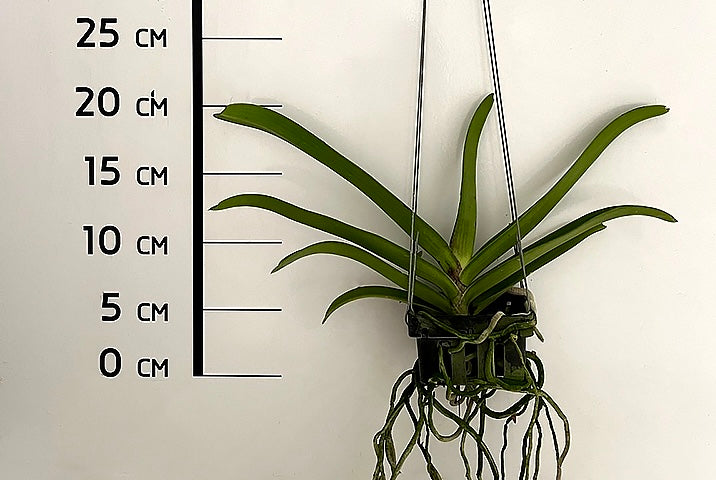
Vandachostylis Colmarie grows monopodially, with sturdy, leathery leaves arranged in an upright fan. The plant forms thick aerial roots and is often grown in an open basket, hanging basket, or other very airy growing medium. Compared to much larger Vanda hybrids, its growth typically remains more compact, though the plant still requires sufficient light, air, and space around its roots.
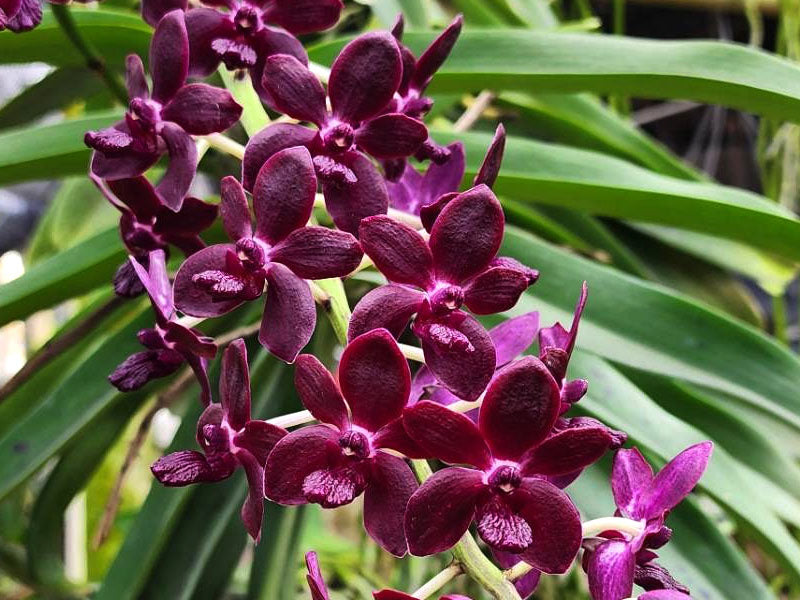
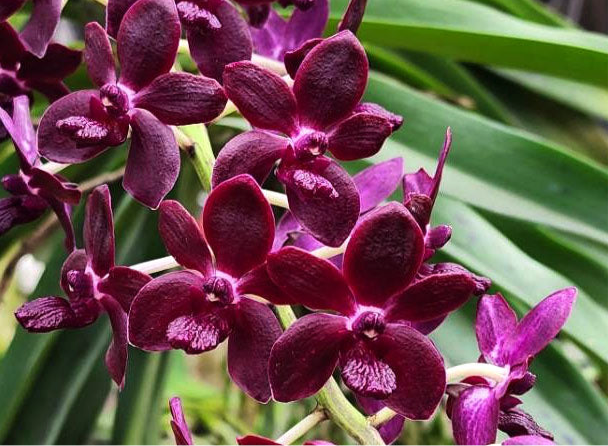
The flowers appear in compact to densely filled clusters. The color is usually dark purple, reddish-purple, burgundy, or nearly blackish-purple, depending on the clone, lighting conditions, and stage of flowering. Some plants are described as nearly black chestnut brown, especially when the flowers have just opened or under certain lighting conditions. With proper care, the flowers can remain beautiful for several weeks.
Many plants also have a sweet fragrance, especially during warm, sunny times of the day. It is precisely this combination of dark flowers, compact flower clusters, and fragrance that makes Vandachostylis Colmarie a favorite among collectors seeking a striking, yet not extremely large, Vanda-like orchid.
Care
Light
Place Vandachostylis Colmarie in a very bright spot with plenty of indirect light. Morning sun or late afternoon sun is usually well tolerated, but intense midday sun through a window can cause leaf damage. If there is too little light, the plant will often continue to grow, but flowering usually fails to occur.
Indoors, a very bright window, sunroom, or greenhouse is most suitable. This hybrid can also grow well under grow lights, as long as the plant receives sufficient air circulation and drying time around the roots.
Temperature
This hybrid grows best in warm to moderate conditions. A daytime temperature of about 22 to 28°C is ideal, with a slight drop at night to about 17 to 20°C. Short-term deviations are usually not a problem, as long as the plant is not left cold and wet for extended periods.
Like many Vanda relatives, the plant can tolerate higher temperatures when humidity, watering, air circulation, and shade are properly adjusted. Heat without sufficient moisture and air circulation causes stress to the leaves and roots more quickly.
Substrate and Cultivation Method
Vandachostylis Colmarie requires plenty of air around its roots. An open basket with coarse bark, a hanging basket without compacted growing medium, or bare-root cultivation works well for this growth form. When grown in a pot, the growing medium must remain very coarse and airy so that the roots can dry out quickly after watering.
For indoor cultivation, an open basket is often more practical than fully bare-root cultivation, as the roots dry out slightly more slowly this way. Bare-root cultivation can work well, but requires more regular misting or soaking.
Humidity
A humidity level of about 60 to 75% is ideal, especially in warm and bright conditions. Good air circulation is important, as stagnant, moist air can cause mold problems. In a dry living room, the plant may need extra care, especially when the roots are kept without growing medium.
At low humidity, the roots dry out more quickly and growth may slow down. A bright, warm room with regular watering and sufficient air circulation usually yields better results than a dark, damp spot.
Watering
When watering, allow the roots to get completely wet and then dry out thoroughly. When grown bare-root or in an open basket, watering may be needed more frequently than for a plant in coarse growing medium. During hot periods, regular misting or soaking may be necessary, while during cooler periods, watering is done less often.
Preferably use demineralized water or clean rainwater at room temperature. Healthy roots turn green when wet and become silvery as they dry out. This makes it easy to tell when this plant needs watering again.
Fertilization
During the active growth period, apply a light dose of orchid fertilizer regularly. A low concentration—for example, a quarter to half the recommended dose—is usually safer than occasional heavy fertilization. Rinse the roots thoroughly with clean water from time to time to limit the buildup of fertilizer salts.
When the plant is actively producing new root tips, it can absorb nutrients more effectively. During darker or cooler periods, you may reduce the amount of fertilizer.
Flowering
Vandachostylis Colmarie can bloom profusely with compact clusters of dark, often fragrant flowers when growth is vigorous and light is sufficient. Under good conditions, flowering can occur more than once a year, but this depends heavily on light, temperature, root health, and the plant’s vigor.
After flowering, the plant continues to grow from the top and may later form new flower stalks from the leaf axils. Do not cut back old flower stalks until they have clearly finished blooming and have dried out.
Care Level
Vandachostylis Colmarie is moderately to somewhat challenging to care for. The plant isn’t extremely difficult, but it does require more attention than a standard Phalaenopsis. Light, airy roots and regular watering are especially important. If you keep it in a spot that’s too dark, too wet, or too cold, you’ll usually see little growth and no blooms.
The plant is more forgiving than some large Vandas, but it remains an orchid for enthusiasts who actively monitor the roots and growth. A fixed watering schedule works less well than checking how quickly the roots dry out.
Who is this plant suitable for?
Vandachostylis Colmarie is suitable for enthusiasts looking for a compact, dark-flowering Vanda-like orchid with fragrance and collector’s appeal. The plant is a good fit for people with a bright windowsill, sunroom, plant room, warm greenhouse, or experience with orchids in baskets.
For someone looking for a low-maintenance orchid that can be placed in a dark living room, this hybrid is less suitable. For collectors who already have experience with Vandas, Rhynchostylis, or other epiphytic orchids, Vandachostylis Colmarie is actually an attractive choice: striking, profusely flowering, fragrant, and usually easier to care for than many larger Vanda hybrids.
Experience growing at home or in a greenhouse
In practice, Vandachostylis Colmarie is particularly easy to care for when the plant is allowed to dry out visibly between waterings. The roots give clear signals: silvery when dry, green when wet, and actively growing when the root tips are fresh green. This makes it easy to manage its care, especially when grown outdoors.
In a warm greenhouse or plant room, the plant generally grows more easily than in a dry living room. It can still grow well indoors, but a very bright spot and regular watering are important. An open basket lined with coarse material is often a good compromise between airy Vanda cultivation and practical maintenance.
Additional care tip
With Vandachostylis Colmarie, pay particular attention to the combination of light, root health, and drying time. Plenty of light stimulates flowering, but only if the roots remain healthy and are watered regularly. If the leaves become limp or wrinkled, this may indicate insufficient water uptake due to dry or damaged roots. If the roots turn brown and soft, the plant is likely staying wet for too long without enough air.