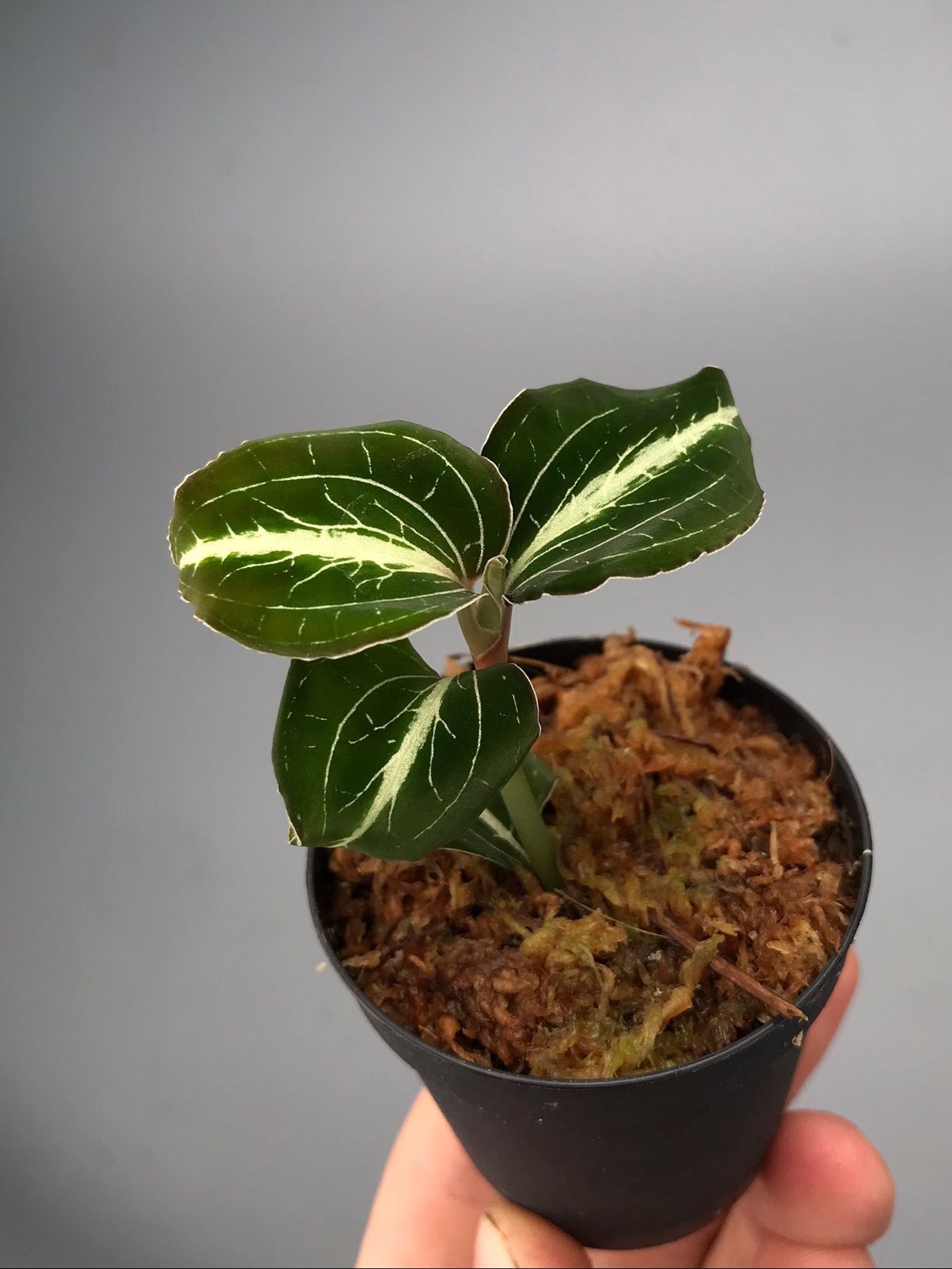
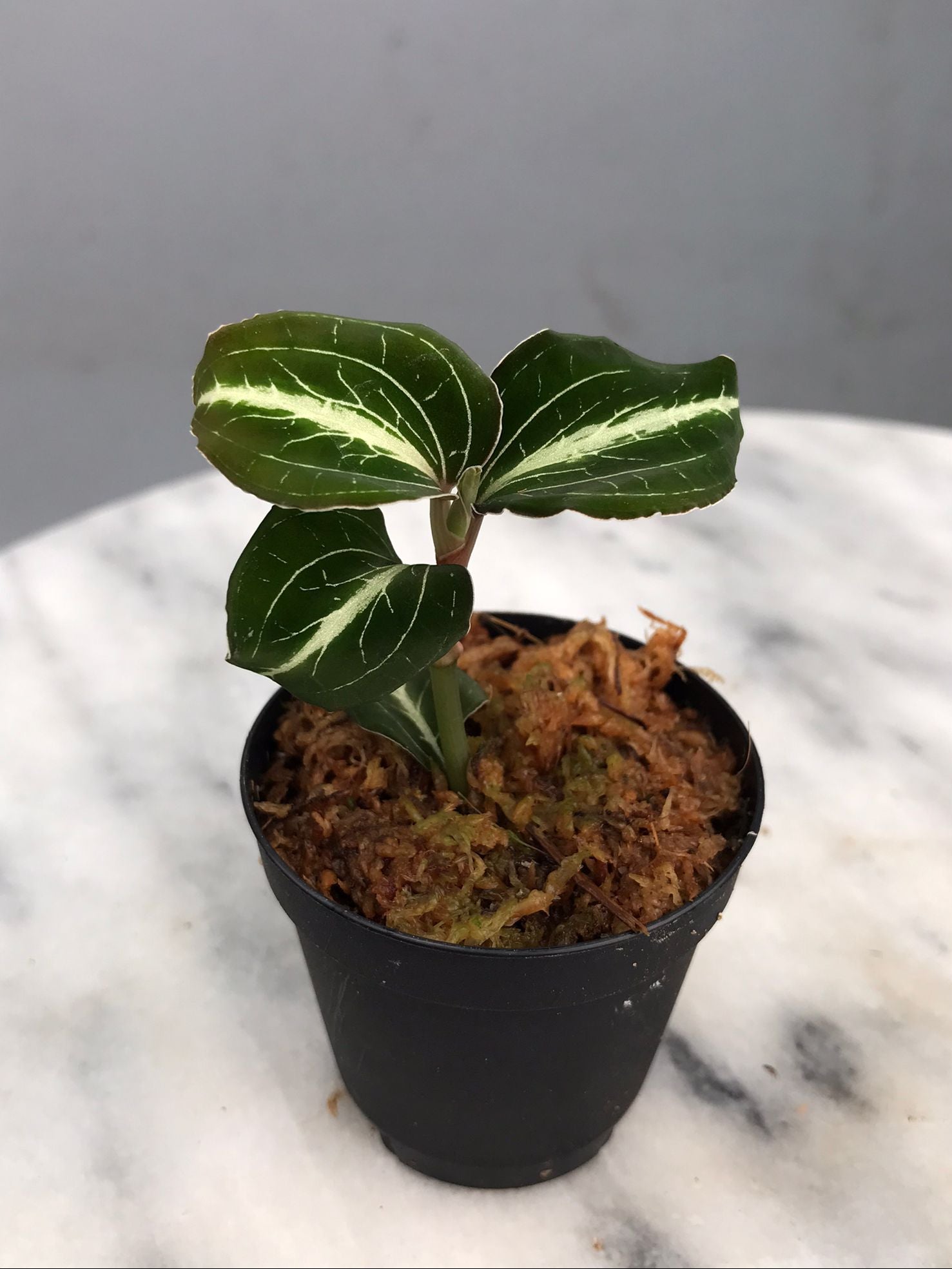
Anoectochilus leyli is a classic "jewel orchid": a low, terrestrial orchid in which the leaves are more important than the blooms. The leaves are dark, matte to slightly velvety, with a fine network of lighter veins that stand out clearly when light falls on them. In a display case, terrarium or sheltered corner of the greenhouse, those leaves are at their best.
Origin
Anoectochilus species come from moist, shady forests in Southeast Asia. They grow there on the forest floor among moss, leaf remnants and roots of larger plants. A. leyli fits that picture well: low-growing, creeping over or just below the litter layer, in filtered light and a consistently moist environment.
Characteristics
The plant forms a low rosette with medium-sized, oval to slightly heart-shaped leaves that lie densely over the substrate. The leaf color is dark green to brownish, with a clearly visible vein pattern across it in a lighter, sometimes metallic-looking hue. That contrast between leaf color and veins gives the plant its ornamental value. From the rosette, leyli makes short stems with which it slowly creeps onward; thus, over time, a compact carpet is formed. In season, the plant can form a thin flowering stem with small, light-colored flowers. These are botanically interesting, but visually clearly secondary to the foliage.
Care
Light
Anoectochilus leyli prefers light but sheltered, with plenty of indirect light and no bright sun. A spot slightly away from a window, or in a light terrarium, usually works well. Direct midday sun quickly causes leaf damage and discoloration.
Temperature
A constant, moderately warm environment is ideal: roughly between 18 and 26 °C. Avoid drafts and abrupt temperature fluctuations. Below about 16 °C, growth declines noticeably and sensitivity increases.
Substrate
Use an airy, moisture-retaining mixture that does not clog up. For example, fine bark with some peat moss or some sphagnum. The substrate may be slightly spongy to the touch, but should allow sufficient oxygen to reach the roots. A relatively shallow pot or container is often more practical than a deep one.
Humidity
Anoectochilus does well with high humidity, preferably 70-90%, with light ventilation (fresh air supply). An enclosed or semi-enclosed terrarium, showcase or greenhouse is therefore often the most stable solution. In an ordinary living room, humidity is usually too low for long-lasting beautiful leaves.
Nutrition
Please feed sparingly and regularly. In the growing period, once every 3-4 weeks a highly diluted orchid or houseplant fertilizer is sufficient. More is rarely needed and may be more likely to cause root or leaf damage.
Watering
Preferably use demineralized water or rainwater. Keep the substrate moist but not wet: slightly moist to the touch, with no water left at the bottom. In a terrarium, that usually means small, regular waterings. Preferably just don't let the top layer dry out completely.
Flowering
Flowering is subtle and usually appears when the plant is stable and well established. Thin stems lift small, neutrally colored flowers above the foliage. However, the plant is kept primarily for its leaves; therefore, healthy, even leaf growth is the best indication that conditions are right.