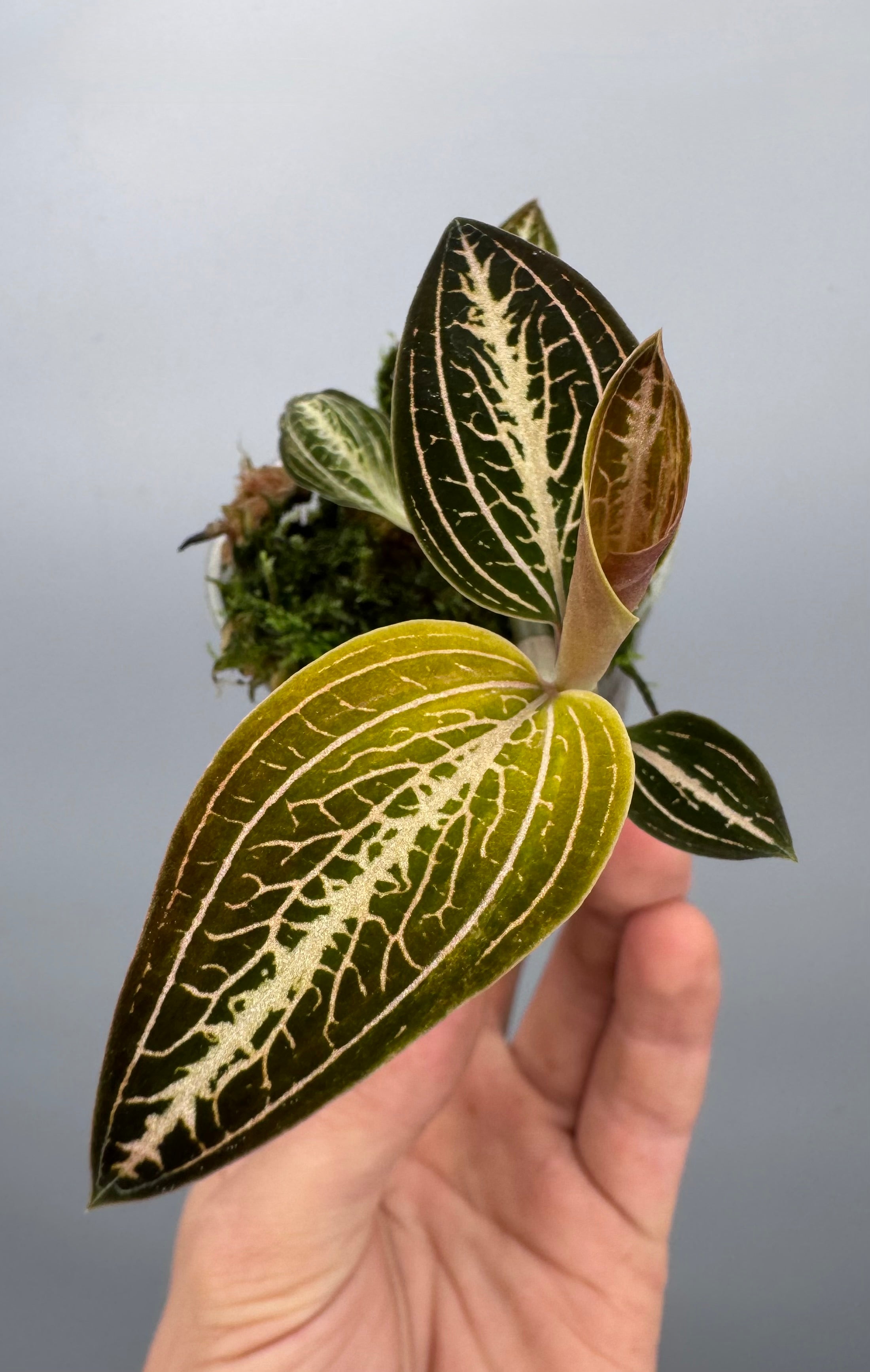
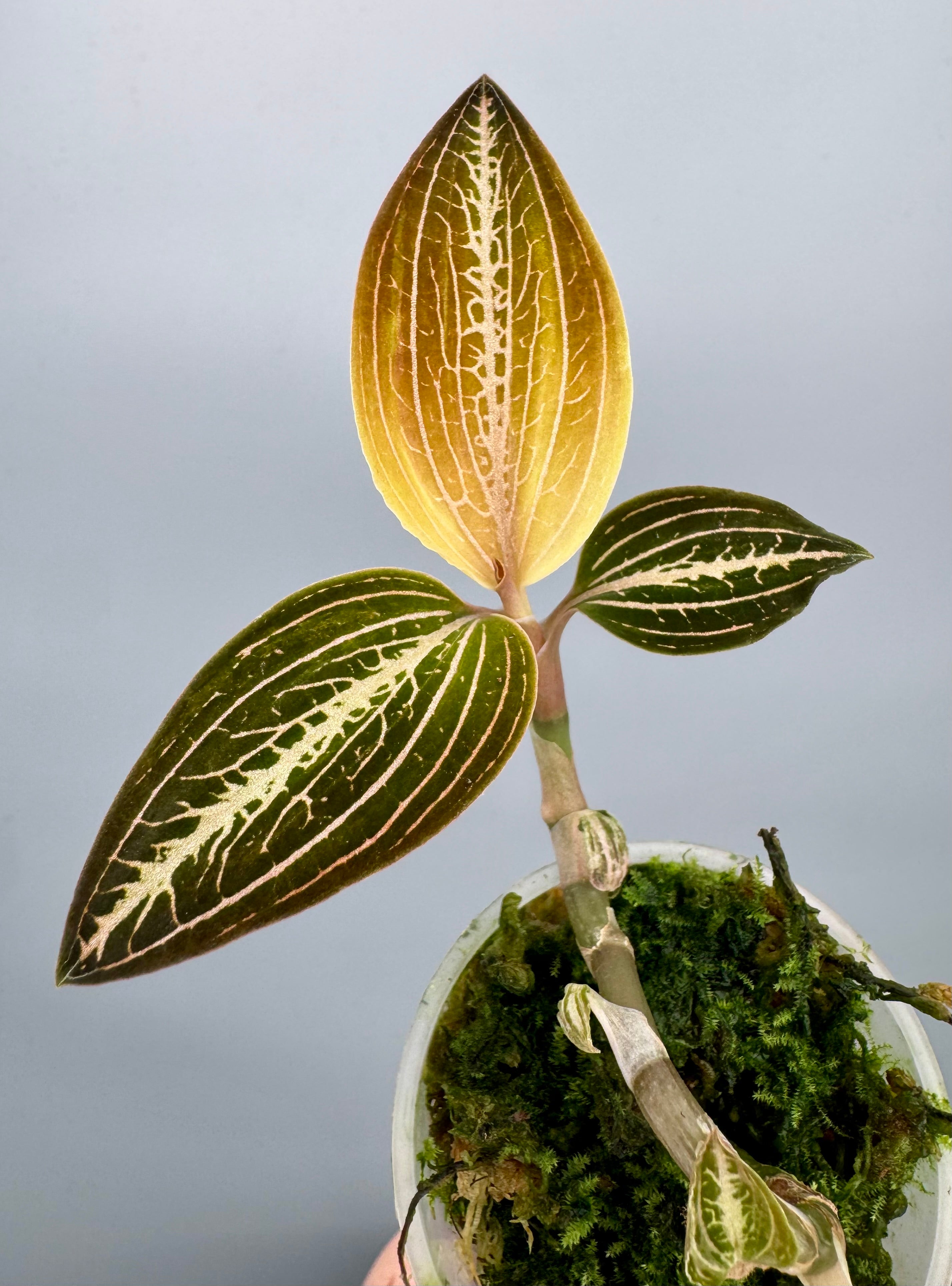
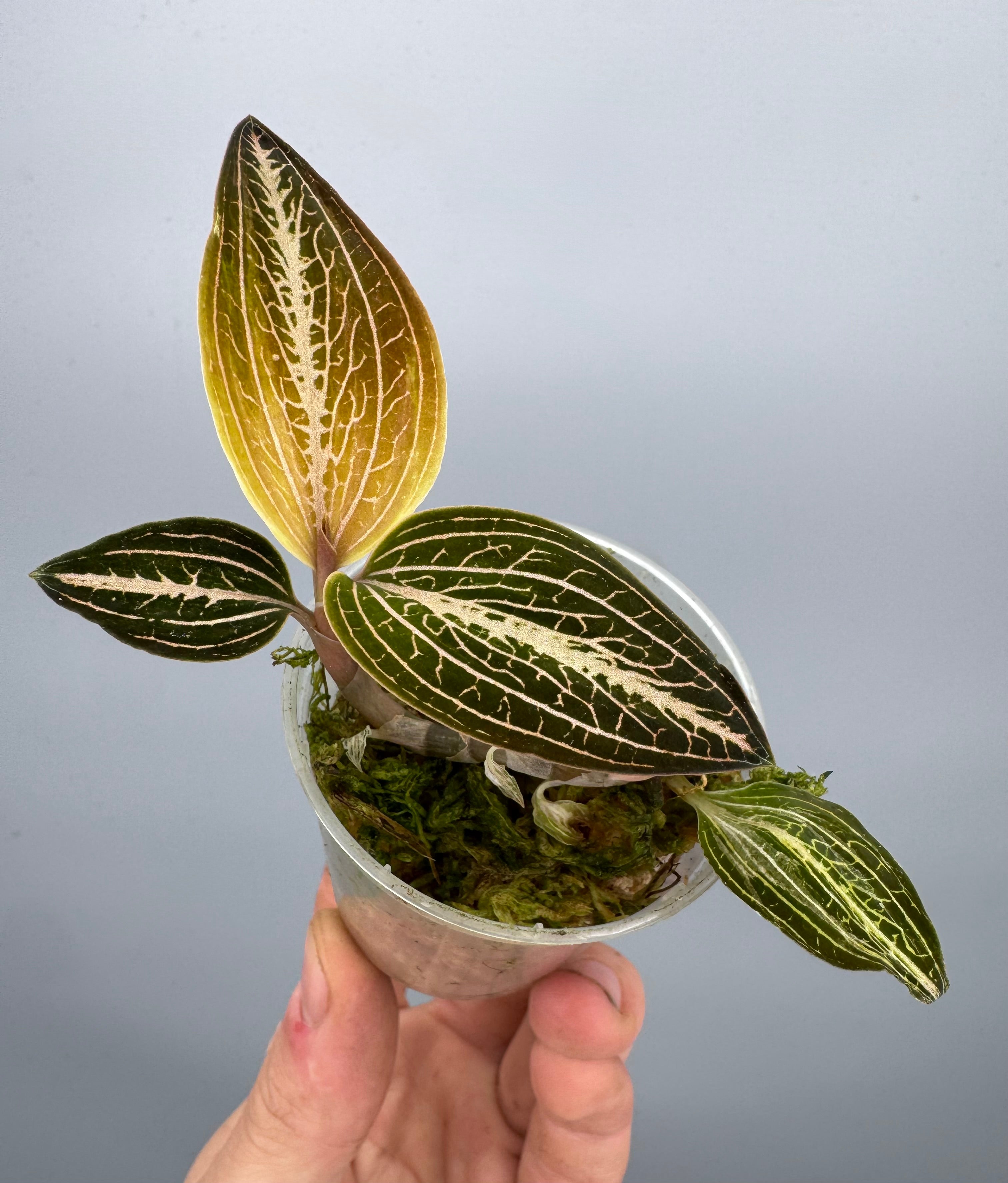
Some orchids don’t need to bloom to reveal something new every day. With this hybrid, the leaves change as soon as the light hits them from a different angle. The delicate veins then glow copper, gold, or soft pink against the dark, velvety foliage. The effect is reminiscent of a network of thin metal wire woven into the leaf.
This jewel orchid combines the distinctive leaf pattern of Anoectochilus reinwardtii with the sturdier, creeping growth habit of Ludisia discolor. The result is a compact foliage plant that can be kept both in a terrarium and in a sheltered spot indoors.
Origin
Anoectochilus reinwardtii is native to an area stretching from Thailand to Malaysia and Indonesia. Ludisia discolor has a broader range extending from southern China and Southeast Asia to Sumatra and the Philippines. Both species grow as terrestrial orchids in humid tropical forests, where they creep along the forest floor among leaf litter and organic matter.
Anoectochilus reinwardtii × Ludisia discolor is not a naturally occurring species, but a hybrid between two different orchid genera. For this combination, the genus name Ludochilus is used. The parent combination was officially registered under the name Ludochilus Luna.
Characteristics
The most distinctive feature is the leaf. The leaves are dark green, bronze-green to reddish-brown and have a soft, velvety appearance. A fine pattern of contrasting veins runs across the leaf. Depending on the plant, the age of the leaves, and the light conditions, these veins may appear copper-colored, golden, pink, or silvery.
The plant grows from fleshy, creeping stems. Where a stem touches the substrate, new roots and shoots can form. Over time, this causes the plant to become fuller, forming a low clump of variegated leaves.
The influence of Ludisia discolor generally makes its growth somewhat sturdier and more tolerant than that of many pure Anoectochilus species. Nevertheless, this remains a jewel orchid that appreciates stable humidity and careful watering.
The flowers appear on an upright flower stalk above the leaves. The individual flowers are small and predominantly white to cream-colored. They form a subtle contrast with the dark foliage, but in this hybrid, the glossy foliage remains the most important ornamental feature.
Care
Light
Place this jewel orchid in a spot with low to moderate, filtered light. A north-facing window or a sheltered spot near an east-facing window is suitable. The plant also grows well under artificial light or in a lit terrarium.
Direct sunlight can quickly damage the thin, dark leaves. Too much light will cause the leaves to lighten and may result in dry or faded spots. In very low light, growth may slow, and the markings may sometimes become less pronounced.
Temperature
A consistent temperature of approximately 18 to 26 °C suits this hybrid well. Avoid prolonged periods at temperatures below 15 °C, and do not place the plant in a cold draft.
The plant tolerates heat as long as humidity remains sufficient and the air is not completely stagnant. Large temperature fluctuations can lead to stunted growth or the loss of young leaves.
Substrate
Use an airy, fine, and moisture-retaining growing medium. A mixture of fine bark, coconut fiber, a small amount of humus-rich material, and fine sphagnum moss is suitable. The growing medium must be able to retain moisture without becoming compacted or waterlogged.
Because the roots are relatively fine and grow close to the surface, a shallow pot is often more suitable than a tall one. A slightly wider pot gives the creeping stems room to form new roots and shoots.
Humidity
A humidity level of approximately 60 to 80 percent supports steady, even growth. A terrarium or plant cabinet provides good conditions for this, but the plant can also be kept outside a terrarium as long as the humidity remains stable.
When humidity is high, always ensure there is a gentle air current. Damp, stagnant air can cause spots and mold to form on the velvety leaves. Daily misting is not necessary and makes the leaves unnecessarily wet.
Watering
Keep the substrate evenly slightly moist. Allow the top layer to dry out a bit before watering again, but do not let the fine roots dry out completely for long periods.
Preferably use demineralized water at room temperature. Water along the edge of the pot and avoid letting water sit on the leaves or around the growing tips for extended periods. A permanently saturated growing medium can cause stem and root rot.
Fertilization
During active growth, apply a weak dose of orchid fertilizer once every three to four waterings. The fine roots are sensitive to high concentrations of nutrient salts.
Rinse the growing medium regularly with demineralized water. When growth slows down in winter, the amount of fertilizer can also be reduced.
Flowering
The flower spike develops from a mature shoot and bears several small, pale flowers. The blooms are delicate but less striking than the foliage.
After flowering, the empty flower stalk can be removed close to the base. The creeping stem then continues to grow and can develop new shoots from the nodes.
Tips
After receiving the plant, allow it a few days to acclimate to its new location. Do not water immediately; first check the moisture level deeper in the substrate.
A transparent terrarium or one that’s open at the front really highlights the metallic leaf veins. Just make sure there’s some ventilation and that the leaves aren’t constantly touching wet glass.
If a stem becomes longer and sparser, gently lay it on the substrate. The nodes can form new roots there. This keeps the plant compact and allows it to gradually grow into a fuller clump.
Short product description
Anoectochilus reinwardtii × Ludisia discolor is a compact jewel orchid with dark, velvety leaves and a delicate network of copper-colored, golden, or pink veins. Officially registered as Ludochilus Luna, this hybrid combines spectacular leaf markings with sturdy, creeping growth. Suitable for a warm terrarium, plant cabinet, or sheltered spot indoors.