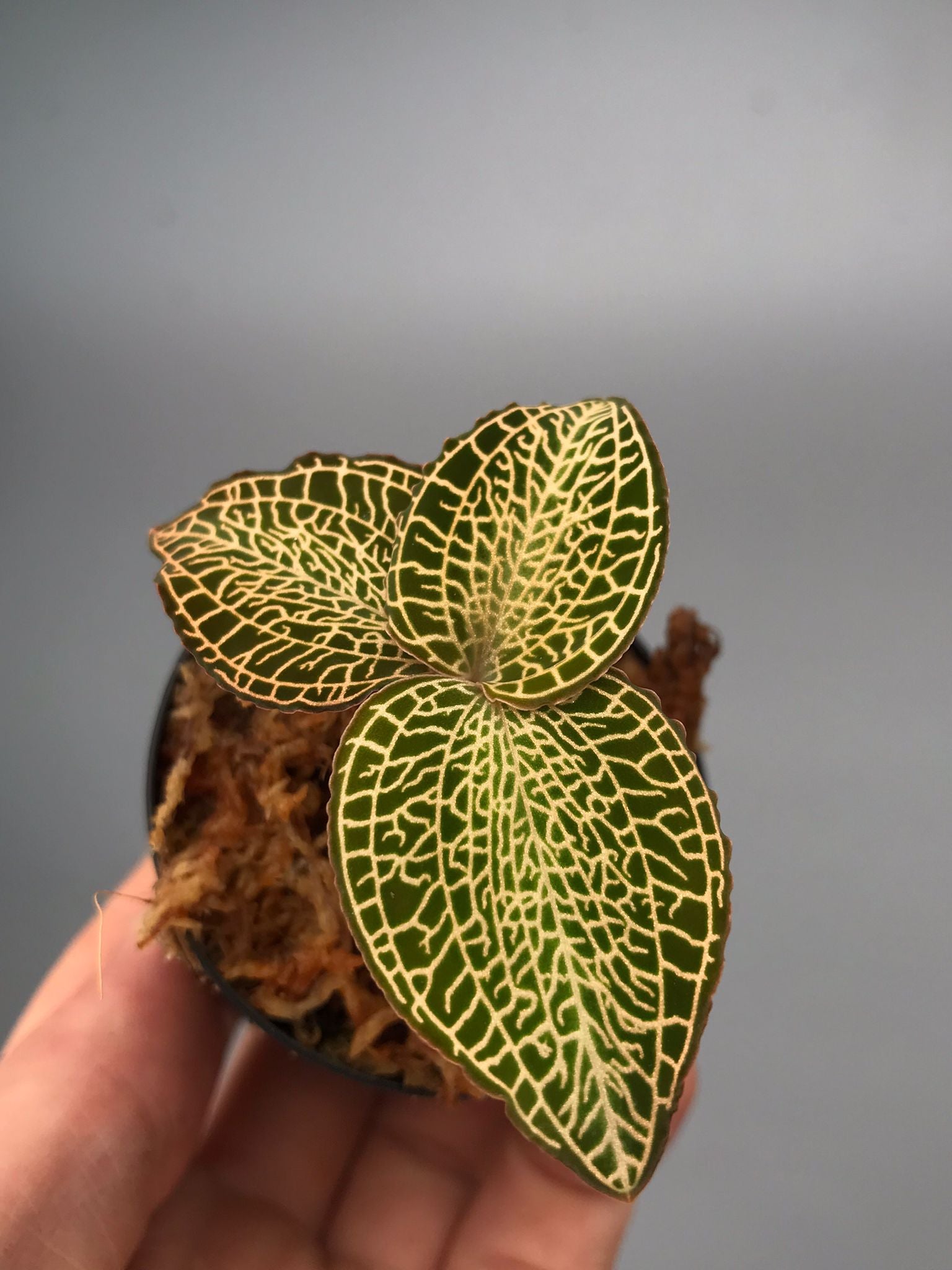
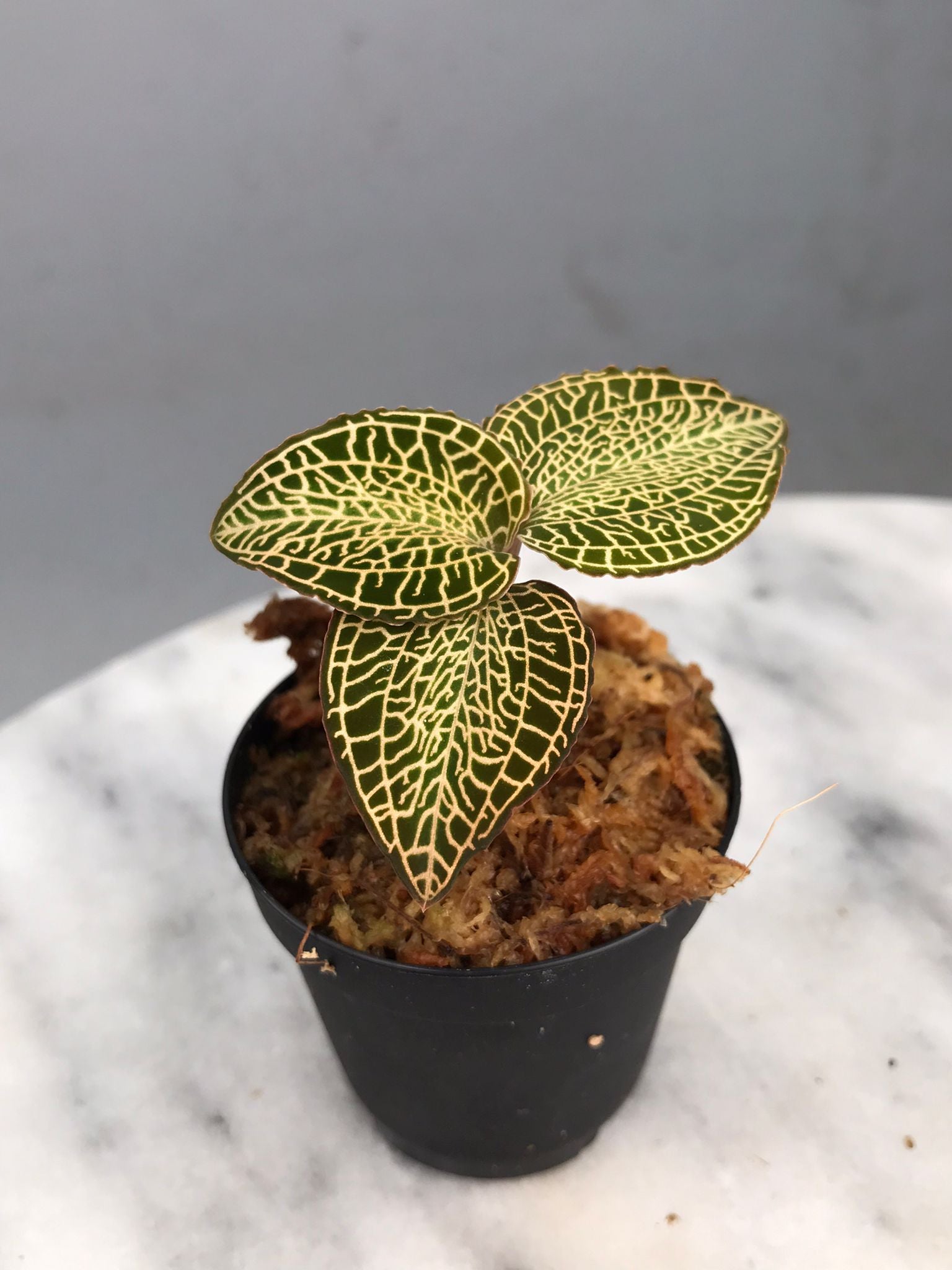
Anoectochilus roxburghii ‘Red Dragon’ is a compact jewel orchid that is primarily collected for its distinctive leaves. A dense network of golden-yellow to copper-colored veins runs across the velvety, green to bronze-green leaves. When light falls at an angle, these lines take on the characteristic metallic sheen that gives jewel orchids their name.
‘Red Dragon’ is not a red-leaved plant. The red to copper-colored hues are most visible around the petiole, along the leaf margin, on the underside, and sometimes in young leaves. The exact leaf color may vary depending on the plant, light level, and growth stage.
Origin
Anoectochilus roxburghii is a botanical orchid native to a wide range extending from the Himalayas and Nepal through Bangladesh and southern China to parts of Indochina. The species grows terrestrially on sheltered, moist forest floors with a loose layer of humus and organic matter.
‘Red Dragon’ is a form of this species selected in cultivation. The cultivar name refers to the warmer tones in the leaves and veins, but the plant retains the natural, delicately patterned appearance of Anoectochilus roxburghii.
Characteristics
The plant forms compact rosettes on a slowly creeping, fleshy stem. New roots and growth points can develop at the nodes of this stem. As a result, a well-established plant can form multiple rosettes over time and spread across the substrate as a small cluster.
The leaves are relatively thin and sensitive to drying out, direct sunlight, and prolonged contact with water. Their color ranges from a fresh dark green to bronze-green. Overlying this is a dense, almost mosaic-like network of golden-yellow, cream-colored, or light copper-colored veins.
Jewelry orchids do not naturally develop a large or coarse root system. A healthy plant therefore does not need to have roots filling the entire pot.
Care
Anoectochilus roxburghii ‘Red Dragon’ thrives in stable conditions: soft light, an airy but evenly moist growing medium, high humidity, and gentle air movement. Large fluctuations between wet and dry conditions are more harmful than slightly lower humidity.
Light
Provide this jewel orchid with low to moderate, indirect light. A spot near a north- or east-facing window is usually suitable, as is a terrarium or plant cabinet with controlled LED lighting.
Direct sunlight can quickly fade or scorch the thin leaves. Too much light often lightens the leaf color and can diminish the warm bronze and copper hues. Conversely, prolonged exposure to insufficient light causes the stems to grow longer and the plant to spread out more.
A location with bright, filtered light generally provides the best combination of compact growth and high-contrast veining.
Temperature
A temperature between approximately 18 and 25 °C is ideal. It’s okay for the temperature to drop a few degrees at night, but preferably keep the plant above 16 °C.
Avoid cold drafts, sudden temperature changes, and prolonged heat above 28 °C. At higher temperatures, increased humidity and ventilation are needed to prevent drying out, mold, and stunted growth.
Substrate and Cultivation Method
Use a fine, airy growing medium that can retain moisture without becoming compacted. A mixture of finely chopped sphagnum moss, fine orchid bark, perlite, and a small amount of coconut fiber or airy humus is suitable.
The creeping stem may rest on the growing medium so that new growth points can root at the nodes. Do not plant the stem too deeply; a constantly wet base can easily rot.
A wide, shallow pot is better suited to this plant’s shallow growth habit than a deep pot. Always ensure proper drainage and avoid using heavy, compacted potting soil.
Humidity
A humidity level of approximately 60 to 80% is ideal. In a terrarium or plant cabinet, this level may be temporarily higher, provided there is sufficient air circulation and the leaves do not remain constantly wet.
A closed terrarium without ventilation can become too humid. Condensation on the glass is not harmful in itself, but a constantly wet plant base, stagnant air, and water on the leaves increase the risk of mold and rot.
The plant can be kept in a normal living room as long as the air isn’t extremely dry and the growing medium is carefully kept moist. However, a ventilated plant cabinet or a partially open terrarium makes it easier to maintain stable conditions.
Watering
Keep the substrate evenly slightly moist, but never soggy. Allow the top layer to dry out slightly before watering again. The entire pot should not become bone dry, as the thin leaves and delicate roots react quickly to this.
Preferably use rainwater, reverse-osmosis water, or other soft water at room temperature. Water directly onto the substrate and try to prevent water from pooling between the leaves or around the soft base of the stem for extended periods.
A transparent pot can help you monitor the moisture level of the substrate and the development of new roots. Don’t water automatically according to a fixed weekly schedule; instead, observe how quickly the substrate dries out under the current conditions.
Fertilizer
During active growth, apply a highly diluted orchid fertilizer about once every three to four weeks. A quarter of the normal concentration is usually sufficient.
The fine roots are sensitive to accumulated fertilizer salts. Therefore, rinse the potting mix regularly with clean, soft water. In low light, during slower winter growth, or with a newly imported plant, fertilization can be temporarily reduced further.
Flowering
Anoectochilus roxburghii ‘Red Dragon’ is primarily grown for its foliage. A mature rosette may produce an upright flower stalk bearing small white to cream-white flowers. These flowers have a more delicately structured, sometimes slightly fringed lip.
The blooms are subtle and less striking than the foliage. For a small, newly rooted, or recovering plant, the flower stalk can be cut off to direct the plant’s energy toward new roots and side shoots. For a well-established specimen, the flower stalk can be left in place.
After flowering, an older rosette may grow more slowly. This does not automatically mean the plant is dying: new growth points can emerge from the creeping stem.
Care Level
Moderate to advanced.
In a well-ventilated terrarium or a stable plant cabinet, this Anoectochilus is fairly manageable. The main challenge lies in watering: the substrate must not be allowed to dry out completely, but the soft stem and delicate roots also cannot tolerate prolonged wetness.
Newly imported plants often still have a limited root system. This is not uncommon for jewel orchids. Stability, warmth, and a consistently moist yet airy substrate are more important during the first few months than additional fertilization.
Who is this plant suitable for?
Anoectochilus roxburghii ‘Red Dragon’ is suitable for enthusiasts of jewel orchids, miniature plants, and decorative foliage. Thanks to its compact size, the plant fits well in a terrarium, plant cabinet, glass display case, or small specialized orchid collection.
The plant is less suitable for someone who allows houseplants to dry out completely between waterings. A permanently sealed, waterlogged terrarium is also not a good environment. This species is best suited for a collector who enjoys monitoring small changes in foliage, substrate, and growth points.
Experience growing at home, in a terrarium, or in a greenhouse
In a terrarium, the velvety leaves really stand out, and it’s easier to maintain stable humidity. Be sure to provide ventilation and don’t let the substrate turn into permanently wet soil.
A plant cabinet offers more control over lighting and air circulation. Do not place the plant directly under a strong light or fan; instead, choose a sheltered spot with soft light.
The plant can be placed on a windowsill as long as it is out of direct sunlight and away from a heater. Check more frequently for drying out here, as a small 5.5 cm pot can lose moisture relatively quickly.
In a warm greenhouse, the plant should be placed low and in the shade. Protect it from strong sunlight and from water left on the leaves for extended periods after irrigation.
Extra care tip
Pay special attention to the base of the stem. A sturdy stem with new, light-colored root tips indicates healthy establishment. A dark, glassy, or softening stem base, on the other hand, is a warning sign of too much moisture and too little air.
Do not push a loose, creeping stem deep into the substrate. Gently place it on the surface so that it can form new roots on its own at the nodes.
Short product description
Anoectochilus roxburghii ‘Red Dragon’ is a compact jewel orchid with velvety green to bronze-green leaves and a dense network of golden-yellow to copper-colored veins. A unique foliage plant for a well-ventilated terrarium, plant cabinet, or sheltered spot in the home.